
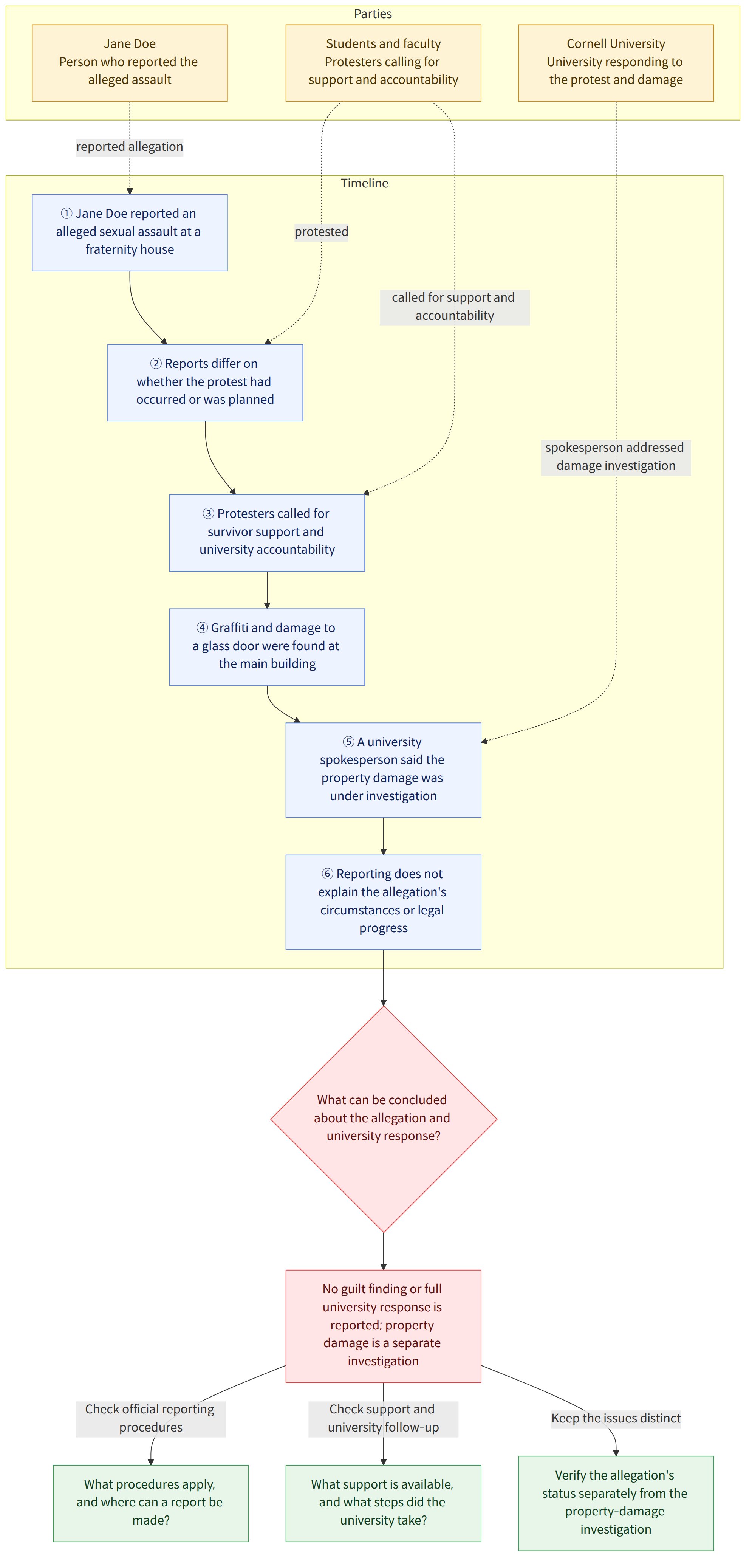
Students and faculty at Cornell University in Ithaca, New York, protested the university’s response to an alleged sexual assault at a fraternity house (a residence for members of a student social organization). Protesters wore purple ribbons and held signs bearing messages such as “Support survivors and expel rapists.” Meanwhile, the university’s main building was defaced with graffiti overnight, and a glass door was damaged.
Background and context
The woman who reported the alleged sexual assault is identified in court documents as “Jane Doe.” However, the reporting provided does not explain the specific circumstances of the allegation or how far any investigation or legal proceedings have progressed. The allegation therefore cannot be presented as an established crime or a finding of guilt.
Speakers at the protest questioned how the university should support survivors and respond to reports of sexual violence. Student Athena Holler said survivors face silence and procedures without receiving adequate support. Julia Chang, a professor of Hispanic studies, said, “Rape should not be inevitable.”
Speakers at the protest criticized the fraternity, the university’s board of trustees, and President Michael Kotlikoff. Their criticism went beyond calls to establish the facts of the allegation and highlighted a debate over what support and procedures the university should provide after a report is made. The information provided, however, does not describe the university’s specific response or any measures changed after the protest.
What this news means
The case bears on the debate over support for people who report sexual assault and survivors, as well as the university’s responsibility for its response. Since protesters called for more support and changes to the way reports of sexual assault are handled, the university’s explanation and any subsequent steps could become central to the debate. The damage to the building, meanwhile, should be treated as a separate matter from the protesters’ demands. In the reporting provided, a university spokesperson said that damaging property was not a way to address students’ frustration and strong emotions, and that the university was investigating the damage.
For example, in a similar situation, a student going through a reporting process may need to check not only the university’s official procedures but also what support is available and where to request it. The information provided does not say what support was available in this case or what support was provided to the person who reported the alleged assault.
Relevant legal framework and support information
An in-house legal guide explains relevant issues under South Korea’s Criminal Act (형법) and Act on Special Cases Concerning the Punishment, etc. of Sexual Crimes (성폭력처벌법). These laws do not govern the allegation made at Cornell University in the United States, and the information provided cannot be used to explain U.S. legal procedures. The guide should be treated only as a source of general principles that may be relevant when considering similar situations in South Korea.
According to the guide, in cases of indecent assault, the force involved does not necessarily have to be strong enough to make it difficult for the victim to resist; whether physical force was used against the victim’s will, among other issues, may be relevant. Whether conduct constitutes an indecent act is assessed by considering the victim’s wishes, the relationship between the parties, the circumstances of the conduct, and the surrounding context. Conclusions may vary depending on the specific facts, and the laws in force at the time of the conduct must also be checked.
The legal explanations in this guide are not a basis for determining whether a crime was committed in the Cornell case. Because the jurisdiction and facts are different, the legal progress of the current allegation must be verified separately.
Differences in how reports described the events
One report said students and faculty had already held a protest in a large plaza, while another said student groups had planned a “Justice for Survivors” protest for late Monday afternoon. The information provided is insufficient to establish the timing difference between the events described in the reports or the precise relationship between the protest schedules.
Regarding the damage to the building, one report described graffiti and damage to the building, while another specifically mentioned a broken glass door and red-painted words on a wall. The second report also said a university spokesperson had stated that the damage was under investigation. There is no information that anyone responsible for the damage has been identified.
What is known and what remains unknown
What is known
- Cornell students and faculty protested the university’s response to an alleged sexual assault at a fraternity house.
- The woman who reported the alleged assault is identified in court documents as “Jane Doe.”
- Protesters wore purple ribbons or held signs with messages supporting survivors and calling for expulsion.
- Graffiti was sprayed on Cornell’s main building, and a glass door was damaged. A university spokesperson said the damage was under investigation.
What remains unknown
- What were the specific circumstances of the allegation, and how far have any investigation or legal proceedings progressed?
- How did the university support the person who reported the alleged assault and survivors, and what steps did it take after the protest?
- Has anyone responsible for the damage to the main building and the graffiti been identified?
What readers should check
- Check whether Cornell has released an official explanation of its reporting procedures and survivor support, or announced any changes since the protest.
- Look for any further updates from the university on the investigation into the damage, including whether it has identified those responsible.
- When considering similar legal issues in South Korea, check the specific facts of the case and the laws that applied at the time of the conduct.
References
- Guide to the Crimes of Rape and Indecent Acts under the Criminal Act
- Other coverage consulted: koreatimes.co.kr