Section 1 — A Dedicated Official's Costly Mistake
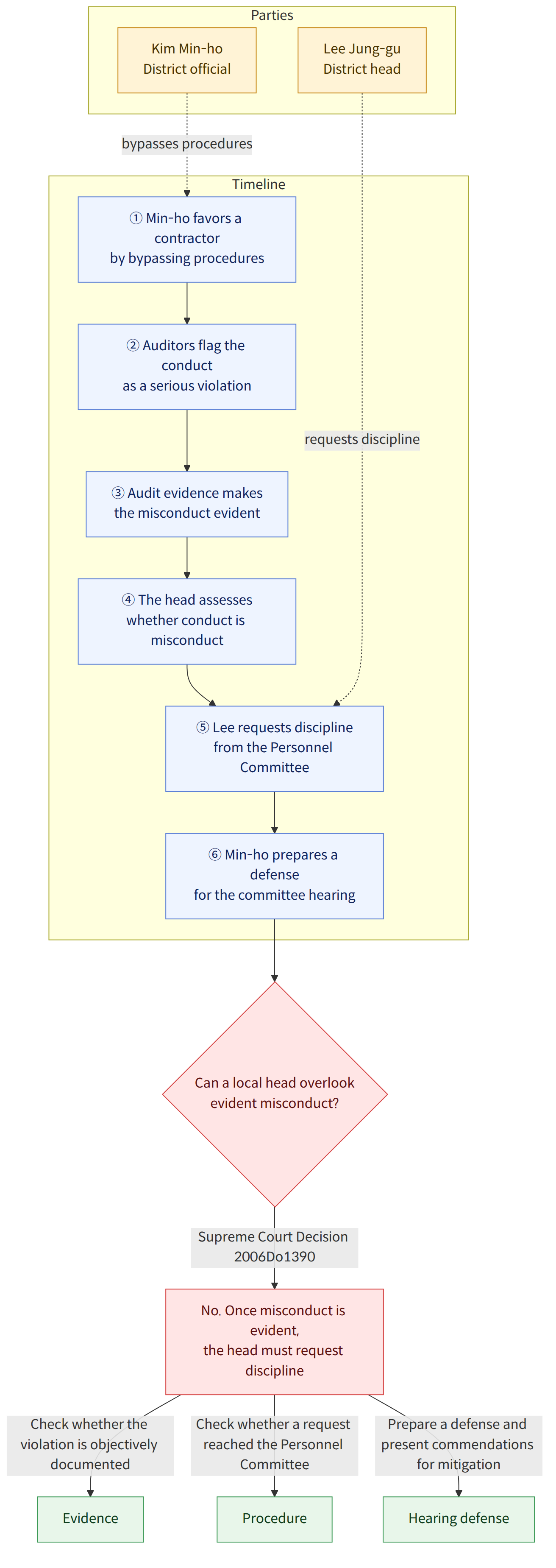
Kim Min-ho, a diligent official at a district office in Seoul, hasn't been able to sleep lately. Known for his tireless service to the community, Min-ho recently found himself in trouble. During a busy project, he bypassed official procedures to favor a specific contractor, a move he saw as 'getting things done' but which auditors flagged as a serious violation.
Min-ho shared a long-standing, trusting relationship with District Head Lee Jung-gu. He secretly hoped that Mayor Lee, recognizing his years of hard work, might quietly handle the matter internally or simply look the other way. His colleagues also whispered that since the Mayor is the ultimate boss, he surely has the power to decide whether to report the incident or not.
However, the reality of the law began to close in on Min-ho. Does a local government leader truly have the authority to ignore a subordinate's clear wrongdoing based on personal judgment or past merit?
Section 2 — The Legal Question
When it is clear and evident that a public servant’s actions constitute grounds for discipline under the Local Public Service Act, is the head of the local government legally obligated to request a disciplinary hearing? Or does the decision to initiate the process fall entirely within their personal discretion?
Section 3 — What Korean Law Says
The framework for maintaining discipline within the civil service is governed by the Local Public Service Act. This law ensures that the public interest is protected from arbitrary decisions by those in power.
Local Public Service Act, Article 69 (Grounds for Disciplinary Action)(1) If a public official falls under any of the following, a request for disciplinary resolution shall be made, and disciplinary action shall be taken according to the results of such resolution:1. Violation of this Act or orders pursuant to this Act.2. Breach of duties or negligence in performance.3. Acts that damage the dignity of a public official.
Under Korean law, the head of a local government holds two roles: the disciplinary authority and the appointing authority. Their power is categorized as follows:
- Discretion in Judgment: They have the initial right to assess whether an official's specific behavior actually falls under the legal definitions of misconduct.
- Mandatory Obligation to Request: Once it is determined that the misconduct is evident, they lose the choice and are legally bound to request action from the Personnel Committee.
Section 4 — How Korean Courts Approach This
Korean courts, including the Supreme Court, maintain a strict standard for public servant discipline. While they acknowledge that a leader needs some room to manage their organization, they have set a firm boundary to prevent favoritism or 'covering up' scandals.
In a landmark ruling (Supreme Court Decision 2006Do1390), the court stated that while the head of a local government has discretion in the assessment phase, they have no discretion in the execution phase when the violation is clear. Once the misconduct is objectively proven, the leader must refer the case to the Personnel Committee. Failing to do so could even expose the leader to charges of dereliction of duty.
Section 5 — Applying the Law to the Case
Let’s analyze Kim Min-ho’s situation. Min-ho’s act of favoring a specific contractor by skipping procedures is a clear violation of his duty and likely damages the dignity of his office.
Since the audit has already produced objective evidence of this violation, his misconduct is classified as 'evident.' In this scenario, Mayor Lee Jung-gu cannot choose to protect Min-ho based on their friendship or Min-ho's past performance. Legally, the Mayor's hands are tied; he is under a legal mandate to file a request with the Personnel Committee.
Min-ho's hope that the Mayor would 'grant him a pass' is legally unsustainable because the law prioritizes public integrity over administrative discretion in the face of clear wrongdoing.
Section 6 — Conclusion: What Happened, and What Should You Do?
As the law dictated, Mayor Lee proceeded to request disciplinary action against Kim Min-ho. While the Mayor expressed regret personally, he fulfilled his legal duty. Min-ho’s battle now shifts to the Personnel Committee, where he must argue that his actions were a result of negligence rather than malice and highlight his past commendations to seek a mitigated penalty.
If you find yourself in a similar situation in the Korean public sector, keep these tips in mind:
- Leniency is not a legal right: Do not assume your supervisor can simply 'bury' a case. Once a violation is documented, the procedural wheels must turn.
- Focus on the Personnel Committee: The focus should not be on stopping the request for discipline, but on preparing a robust defense for the hearing itself, including evidence of mitigating circumstances.
- Seek Legal Counsel Early: Determining whether an act is 'evidently' a disciplinary ground requires a high level of legal expertise. Engaging a lawyer during the initial audit stage can help you shape the narrative and protect your rights before the case reaches the committee.