
1. A Human Story
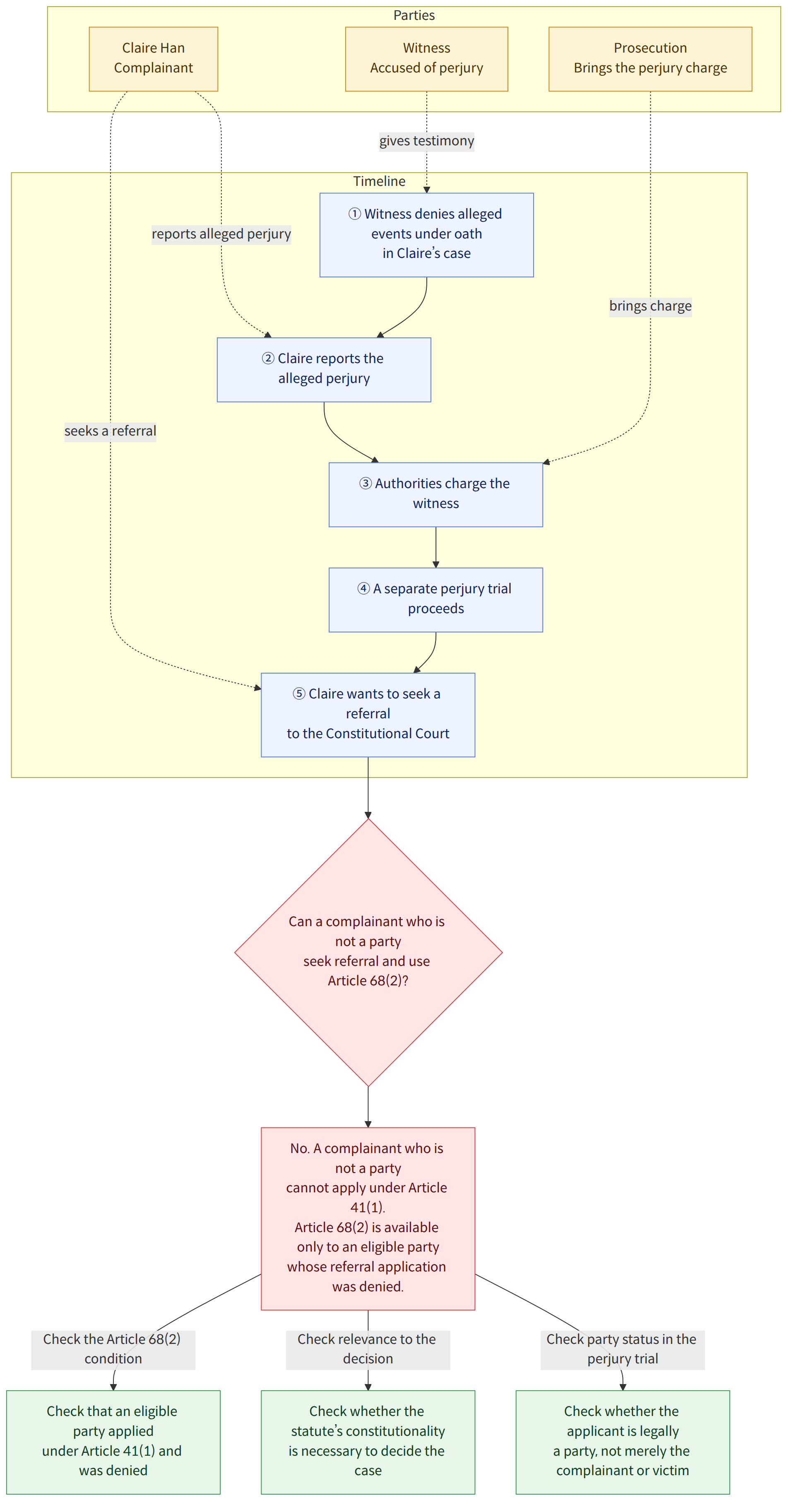
When Claire Han watched a witness deny under oath what Claire believed had happened, she felt the ground shift beneath her. The testimony had been given in Claire’s own case, and she believed it was a lie that had harmed her position. After the authorities charged the witness with perjury, Claire followed the new proceedings closely, hoping that the courtroom would finally address what she had experienced.
Then Claire wondered whether a statute governing the perjury trial violated her constitutional rights as a victim. She wanted to ask the court hearing the case to refer that law to the Constitutional Court. To Claire, the answer seemed obvious: she had reported the alleged crime and had been directly affected by the testimony. But the perjury case was not her case in the procedural sense that mattered.
2. The Legal Question
Can someone who reported alleged perjury, but is not a party to the resulting criminal trial, ask the trial court to refer a statute to the Constitutional Court—and, if the court refuses, file a constitutional complaint under Article 68(2) of the Constitutional Court Act?
3. What Korean Law Says
The Constitutional Court Act provides a route for a court to ask the Constitutional Court whether a statute is constitutional. But that route is available only in a case where the statute’s constitutionality is a necessary issue and the request comes from the court itself or a party to the case.
Article 41(1) of the Constitutional Court Act: If the constitutionality of a law is a prerequisite to deciding a case, the court handling that case may refer the question to the Constitutional Court, either on its own initiative or on an application by a party.
A related provision allows a party to seek constitutional review after the trial court rejects such an application.
Article 68(2) of the Constitutional Court Act: If an application for referral under Article 41(1) is denied, the party who made that application may bring a constitutional complaint before the Constitutional Court.
These provisions impose two separate limits:
- The applicant must be a party to the underlying case. In a criminal trial, the complainant is not automatically a party merely because they reported the alleged crime or were affected by it. The prosecution and the accused are the principal parties to the criminal proceeding.
- The constitutional question must matter to the decision. It is not enough to object to a law in general or to believe that the proceedings have treated someone unfairly. The constitutionality of the particular law must be relevant to resolving the case before the court.
The Constitution recognizes a crime victim’s right to make a statement during criminal proceedings, as provided by law. That right can be important, but it does not automatically turn a victim or complainant into a party entitled to exercise every procedural power available to the parties.
4. How Korean Courts Approach This
The Constitutional Court has treated the referral process as a procedure for participants who are legally parties to the case being heard. In criminal proceedings, a complainant’s role in setting the investigation in motion does not make that person a party to the prosecution of the accused.
The key principle: Being the person who reported an alleged crime—or having a strong personal interest in its outcome—is not the same as being a party to the criminal trial. The right to apply for referral depends on procedural status, not simply on how closely the complainant is connected to the events.
The Court has applied that distinction to a complainant seeking to challenge a law in another person’s criminal trial. It has also treated the Article 68(2) route as a follow-on remedy: it is for the party who made a valid Article 41(1) application and whose application was rejected. A person who was not eligible to make the initial application cannot gain access to that later route merely by asking the trial court to consider the issue.
5. Applying the Law to Claire’s Case
Claire’s position is understandable, but the legal analysis turns on the structure of the perjury case rather than on the seriousness of her grievance.
- The perjury prosecution is a separate case. The alleged false testimony arose in Claire’s earlier proceedings, but the later trial concerns whether the witness committed perjury. Claire’s role as the person who reported the conduct does not merge the two proceedings.
- Claire is not a party to the perjury trial. The defendant in that case is the person accused of perjury, and the prosecution brings the charge. Claire may have a personal interest and may have rights available to victims under applicable law, but those facts alone do not make her a party to the criminal case.
- She therefore cannot make an Article 41(1) application in that case. Even if Claire believes that a statute infringes her constitutional rights, the Act gives the application right to a party to the case. Her status as complainant does not satisfy that requirement.
- She cannot use Article 68(2) as a substitute. That provision allows a party whose Article 41(1) application has been rejected to bring a constitutional complaint. Since Claire was not entitled to make the application in the first place, she cannot create eligibility for the follow-on complaint simply by filing an application that the trial court has no procedural basis to accept.
- Her victim-related rights do not change the result. The right to make a statement or other rights granted to victims may allow participation in defined ways. They do not automatically confer the status of a party or the right to request constitutional referral.
6. Conclusion: What Happened, and What Should You Do?
The court would reject Claire’s request because she is a complainant, not a party to the perjury trial. And because she cannot make an Article 41(1) application as a non-party, she cannot pursue an Article 68(2) constitutional complaint based on the rejection of that request. That outcome does not mean her concerns are unimportant; it means Korean law reserves this particular procedural route for parties to the case.
If you are in a similar position:
- Confirm your procedural status first. Ask whether you are legally a party to the specific case in which you want to challenge a statute—not merely a complainant or an affected person.
- Check whether the challenged law is decisive to that case. A constitutional objection must concern a law whose validity matters to the court’s decision.
- Use the participation rights available to you and get case-specific advice. Ask the court or a qualified lawyer what victim statements or other procedures may be available; do not assume those rights include the power to seek constitutional referral.