
A major change to South Korea’s criminal justice system
South Korea began a sweeping overhaul of its criminal investigation system on October 2, when a revised Criminal Procedure Act (the law governing how police and prosecutors handle criminal cases) took effect. The change separates investigation from prosecution, ending a system that had combined the two functions for 78 years.
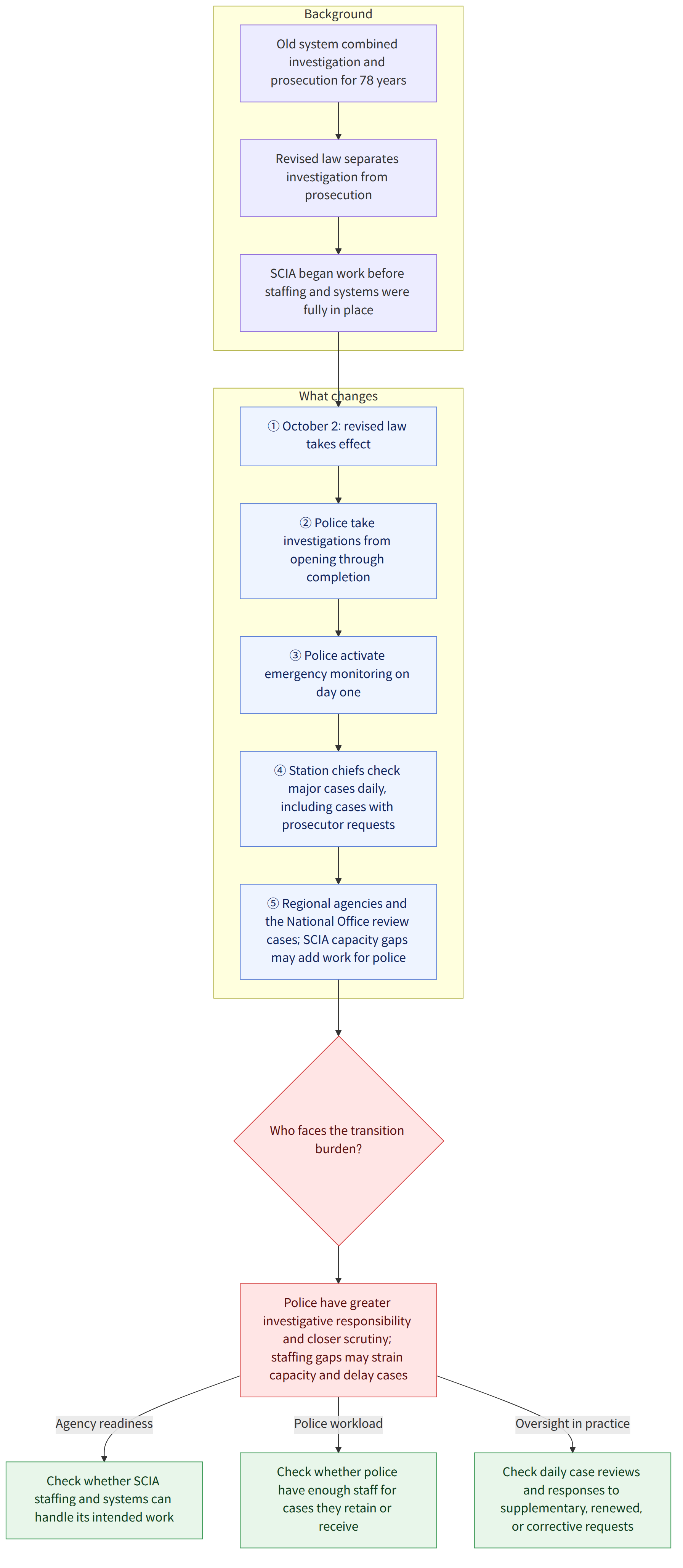
Police are now expected to take greater responsibility for the full investigative process: opening cases, gathering evidence, addressing requests for additional work, and deciding when an investigation is complete. At the same time, the new Serious Crimes Investigation Agency (SCIA) has begun operating before its staff and systems are fully in place, leaving police concerned that they may have to cover gaps during the transition.
The reform gives police a much larger role, but its first day has also brought immediate questions about staffing, oversight, and whether cases can be handled without delay.
Police move into emergency monitoring mode
Police activated an emergency response system on the law’s first day. Police station chiefs are required to check the progress of major investigations each day, along with cases involving prosecutors’ requests for supplementary investigation, renewed investigation, or corrective action. Regional police agencies and the National Office for Investigation will also review case handling and step in when they identify problems.
In practical terms, this means senior officers are expected to keep closer watch on important files rather than waiting for routine reporting cycles. A station chief might, for example, check whether investigators have followed up on a key piece of evidence or responded to a prosecutor’s request to clarify part of a case.
Regional police agencies also convened meetings of their investigation leaders. Seoul Police Commissioner Go Beom-seok described the launch as a historic moment and said the public had both high expectations and significant concerns. He said the police now carried a greater responsibility, requiring a particularly serious approach to the new system.
More investigative authority, but also more accountability
Under the previous arrangement, police and prosecutors shared investigative responsibilities in a system that gave prosecutors substantial influence over how cases progressed. The reform is intended to draw a clearer line between investigating suspected crimes and deciding whether to bring charges (formally accuse someone in court).
Police will now handle investigations more independently from beginning to end. Prosecutors can still ask police to conduct supplementary work, reopen an investigation, or correct an identified problem. These requests are a form of oversight: for instance, prosecutors may ask investigators to check a missing timeline detail or gather evidence that was not included in the original file.
For front-line officers, however, expanded authority does not necessarily feel like an unqualified benefit. A police investigator in the Seoul metropolitan area said officers knew their work would be watched closely, even though the practical changes had not yet become obvious on the first day. Another senior investigator said the increase in responsibility had not been something front-line police had sought, but that the burden had nevertheless grown.
Greater responsibility means that errors, delays, and uneven investigative quality may attract closer scrutiny. The challenge is to make the new authority workable while protecting the fairness of each case.
The new agency starts work before it is fully ready
The SCIA, which is intended to investigate serious crimes, began operating while still building its workforce and systems. Its early start has raised concern that the agency may not immediately be able to take on all the work expected of it. If capacity is limited, more cases could remain with or be transferred to the police for the time being.
Police investigators say their own staffing is already stretched, making it difficult to absorb a sudden rise in cases. One senior officer expressed concern that a lack of personnel or other operational limits at the new agency could lead to cases being passed to police. Officers, the investigator said, cannot simply refuse cases even when they do not have enough people to handle them.
A new agency typically needs more than a formal opening date to become fully operational. It must recruit and train staff, establish case-management procedures, build reliable information systems, and determine how it will coordinate with police and prosecutors. Until those arrangements work smoothly, the burden can fall unevenly on existing teams.
A large backlog could add to police caseloads
Police are expected to recruit 4,000 additional investigators this year and have created a dedicated support team to advise officers on interpreting the new rules. These steps are intended to reduce shortages and prevent confusion as investigators apply unfamiliar procedures in real cases.
But the scale of the potential workload remains a major concern. As of August, prosecutors had around 160,000 unresolved cases. A substantial share could eventually be transferred to police, while investigators will also have to handle cases returned for supplementary work or further review.
Police caseloads were already rising before the new system took effect. The average number of cases received by each police investigator increased from 110.4 in 2023 to 133.8 last year. That figure does not by itself show how much time or complexity each case requires, but it illustrates the direction of the pressure: officers were already receiving more cases per person even before a large transfer of work was possible.
- Potential incoming work: A large portion of the prosecutors’ unresolved cases may move to police.
- Additional investigative steps: Prosecutors can request supplementary or renewed investigations.
- Existing workload pressures: The average number of cases per investigator has risen in recent years.
- Staffing measures: Police plan to recruit 4,000 investigators and provide guidance on the new rules.
The transition will depend on coordination and capacity
The first day of the reform marks a structural change, but it does not establish how smoothly the new system will function in the months ahead. The outcome will depend partly on whether the SCIA can build enough capacity to take on its responsibilities, whether police can fill vacancies, and whether the agencies can transfer files and information without avoidable delays.
Clear procedures will also matter. When a prosecutor asks for additional investigation, officers need to know what work is required and how quickly it must be completed. When a case moves from one agency to another, records and evidence must follow it accurately so that victims, suspects, and witnesses are not left waiting because of administrative confusion.
For the public, the central test is not simply which agency holds formal authority. It is whether investigations remain timely, thorough, and fair. A person reporting a crime needs a clear path to an answer; a person under investigation needs decisions based on evidence and lawful procedures; and victims need to know that cases are not being delayed by institutional handoffs.
What to watch next
- Whether the SCIA completes its staffing and operational systems quickly enough to take on serious-crime investigations.
- How many of the roughly 160,000 unresolved prosecution cases are ultimately transferred to police.
- Whether recruitment and support measures reduce pressure on front-line investigators.
- How police and prosecutors resolve disagreements over additional investigative work.
The reform is designed to redraw the boundary between investigation and prosecution. Its success will depend on whether the new division of responsibilities is matched by adequate staffing, reliable oversight, and effective cooperation—without allowing the transition itself to become another source of delay.