
South Korea's Employment Landscape: A Tale of Two Realities
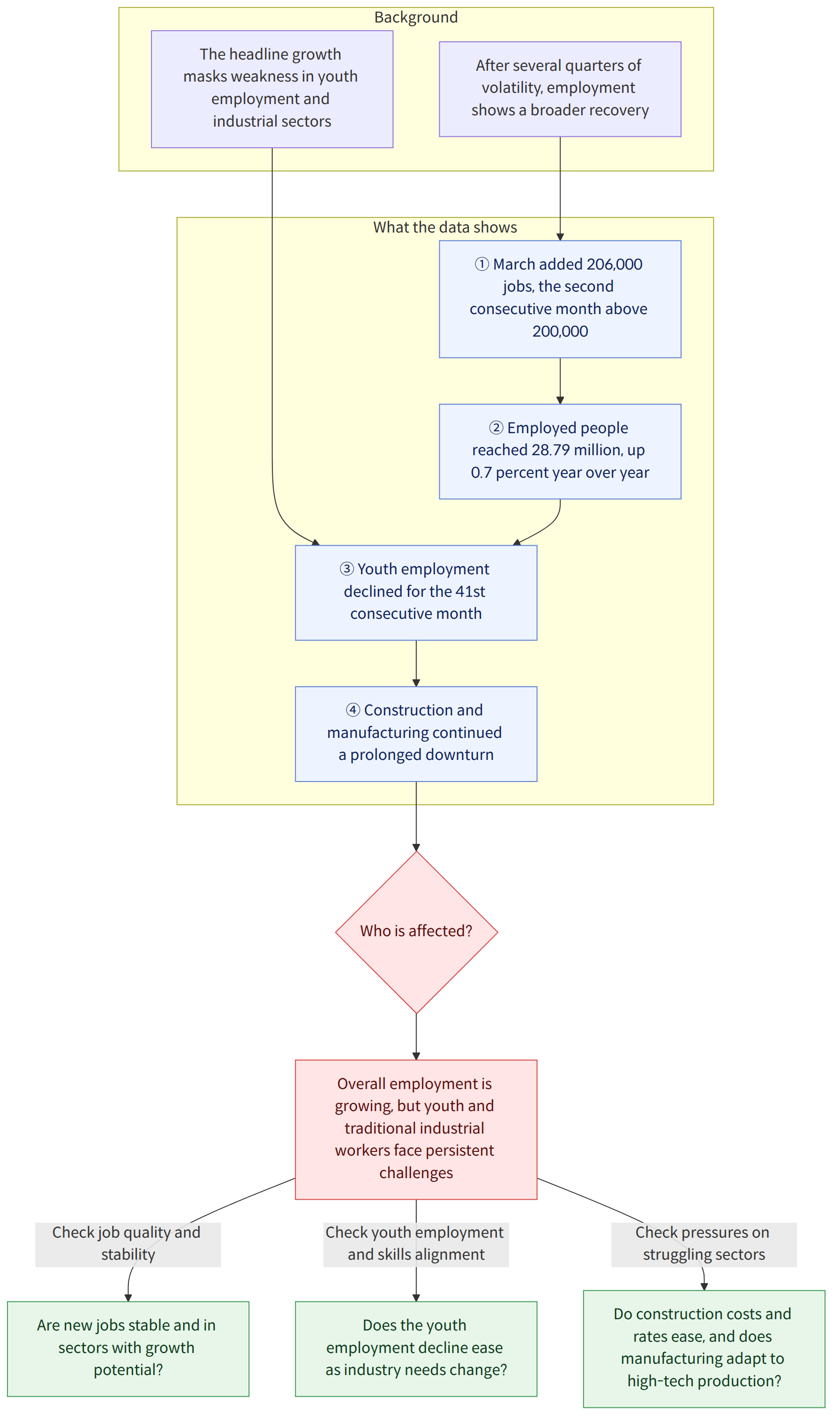
South Korea's labor market is currently experiencing a paradoxical trend. On the surface, the numbers suggest a robust recovery, but a deeper dive into the data reveals significant structural vulnerabilities. In March, the nation added 206,000 jobs, marking the second consecutive month where job growth exceeded the 200,000 threshold.
According to the latest data from the Ministry of Data and Statistics, the total number of employed individuals rose to 28.79 million, representing a 0.7 percent increase compared to the same period last year. This rebound follows a period of stagnation, suggesting that the broader economy is attempting to regain its footing after several quarters of volatility.
The Bright Side: Quantitative Growth and Recovery
The return to the 200,000-job growth range is seen as a positive signal for the overall economy. This growth indicates that certain service sectors and emerging industries are expanding their workforce to meet new demands.
For example, the rise in employment often correlates with an increase in aggregate demand (the total demand for goods and services within an economy), which encourages businesses to hire more staff to maintain operations. This quantitative surge provides a necessary cushion against the broader economic headwinds facing the Asia-Pacific region.
Key Statistic: The employment figure of 28.79 million indicates that a vast majority of the working-age population is engaged in economic activity, though the quality and stability of these jobs remain a subject of debate.
The Crisis in Youth Employment: A 41-Month Decline
While the headline numbers are encouraging, the situation for young job seekers is dire. Youth employment has declined for the 41st consecutive month, a streak that points to a systemic failure in matching education with industry needs.
This phenomenon is often linked to a skills mismatch (a situation where the skills possessed by job seekers do not align with the requirements of available jobs). For instance, while universities produce thousands of graduates in humanities or social sciences, the market may be demanding specialized skills in AI, semiconductor engineering, or green energy.
Why the Youth Job Market is Stalling:
- High Entry Barriers: Large corporations are increasingly favoring experienced hires over entry-level recruits to reduce training costs.
- Preference for Stability: Many young people are opting for long-term exam preparation for civil service roles rather than entering the private sector.
- Economic Uncertainty: Startups and SMEs (Small and Medium Enterprises), which typically hire the most youth, are struggling with high interest rates and funding shortages.
Structural Weakness in Manufacturing and Construction
The data also underscores a prolonged downturn in the manufacturing and construction sectors, which have traditionally been the backbone of South Korea's industrial strength.
In the construction sector, high raw material costs and increased interest rates have led to a decrease in new projects. This creates a ripple effect: when a large building project is canceled, not only are the laborers affected, but the suppliers of cement, steel, and interior materials also see a drop in demand.
Similarly, the manufacturing sector is facing a transition period. As the world moves toward digital transformation (the process of using digital technologies to change a business model), traditional factories that fail to automate or pivot to high-tech production are shedding workers.
Future Outlook and Economic Implications
Looking forward, the South Korean government faces the challenge of transforming quantitative growth into qualitative stability. Simply adding jobs is not enough if those jobs are temporary, low-paying, or concentrated in sectors with low growth potential.
Potential Strategic Shifts:
- Vocational Retraining: Implementing large-scale programs to retrain workers from declining sectors (like traditional construction) into growing ones (like smart-city infrastructure).
- Incentivizing Youth Hiring: Providing tax breaks or subsidies to companies that create permanent, high-quality positions for new graduates.
- Diversifying Industry: Reducing reliance on a few massive conglomerates (Chaebols) to foster a more diverse ecosystem of innovative startups.
Expert Perspective: The persistence of the youth employment slump suggests that the issue is no longer a temporary cyclical downturn but a structural shift that requires fundamental policy changes.
Ultimately, while the March data provides a glimmer of hope, the long-term health of the South Korean economy will depend on whether it can bridge the gap between its aging industrial base and the aspirations of its youngest generation.