
A Bolt from the Blue: The Busan Transfer
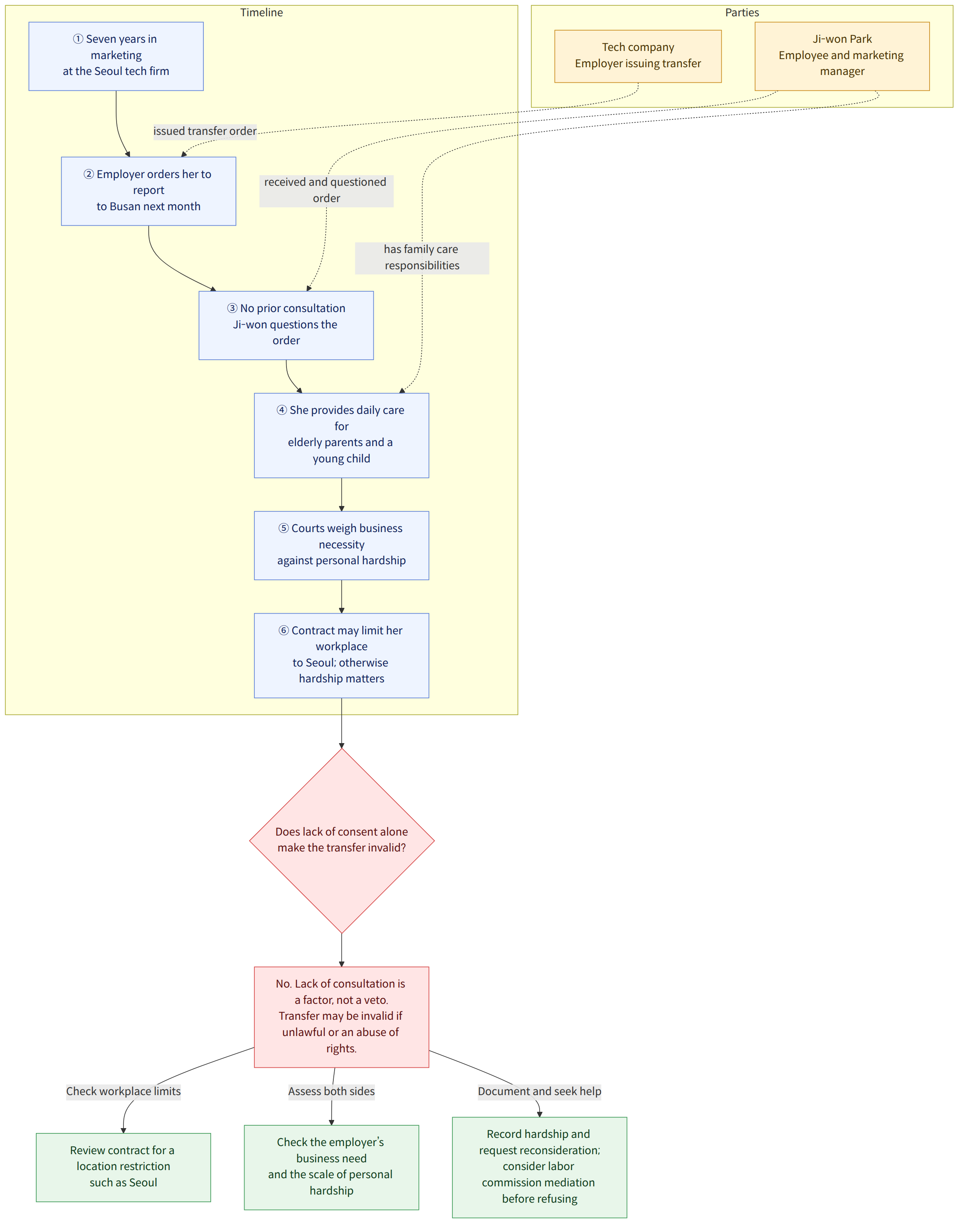
Ji-won Park, a marketing manager with seven years of tenure at a tech firm in Seoul, arrived at work on Monday only to be handed a life-altering notice. Starting next month, she was to report to the company's regional office in Busan—over 300 kilometers away. For Ji-won, this wasn't just a change of scenery; she provides daily care for her elderly parents and manages the demanding schedule of her preschool-aged child in Seoul.
What stung more than the distance was the process. The company hadn't asked for her opinion or even hinted at the possibility before the final order was issued. When she questioned her manager, the response was blunt: "Personnel decisions are the exclusive right of management. Employees are expected to follow orders, not debate them." Is Ji-won truly powerless against such a unilateral decision?
The Legal Question: Is Consent Mandatory?
The central issue in Ji-won's story is whether a transfer order issued without prior consultation or the employee's consent is legally valid under the Korean Labor Standards Act. While many employees believe they have a veto right over where they work, the legal reality in South Korea is nuanced.
What Korean Law Says About Management Rights
The framework for these disputes begins with the Labor Standards Act, which protects employees from arbitrary punishment.
Labor Standards Act, Article 23, Paragraph 1"An employer shall not, without just cause, dismiss, lay off, suspend, transfer, reduce wages, or take other punitive measures against an employee."
However, the Supreme Court of Korea has long established that personnel transfers (known as jeonbo) are a core component of management rights. The legal principles are as follows:
- Broad Discretion: Employers have significant leeway to move staff to optimize operations, improve efficiency, or resolve workplace conflicts.
- Consultation is Not a Veto: While failing to consult with an employee is considered a factor in determining the fairness of a transfer, it does not, by itself, make the transfer void.
- The Limit of Rights: A transfer is valid unless it violates the law or constitutes an "abuse of rights."
How Korean Courts Approach the "Abuse of Rights"
To determine if an employer has crossed the line into an abuse of rights, Korean courts apply a balancing test. They weigh two competing interests:
- Business Necessity: Is there a legitimate operational reason for the transfer? This includes reorganizing departments, addressing a shortage of skilled labor at a specific site, or even breaking up interpersonal friction that hinders productivity.
- Personal/Life Disadvantage: Does the transfer cause the employee economic, physical, or domestic hardship that significantly exceeds what a typical employee should reasonably endure?
If the business need is flimsy but the hardship to the employee is extreme (e.g., separating a nursing mother from her child or causing a massive financial loss without compensation), the court may rule the transfer invalid.
Applying the Law to Ji-won's Case
In Ji-won's situation, the court would look at whether the company has a compelling reason to send her to Busan specifically. If the company is simply trying to pressure her to resign or if the Busan office has no actual need for a marketing manager of her caliber, the order might be seen as an abuse of rights.
Furthermore, Ji-won should check her employment contract. If the contract explicitly limits her place of work to "Seoul," the company cannot move her without her express consent. Without such a clause, however, she must prove that the hardship of caring for her parents and child is so severe that the company's refusal to accommodate her constitutes a violation of the principle of good faith.
Conclusion: What Happened, and What Should You Do?
For Ji-won, the path forward involves documenting her family situation and formally requesting a reconsideration based on her hardships. While the lack of consultation doesn't automatically win her case, it shows a lack of effort by the company to minimize her disadvantage, which can be a persuasive argument in a labor tribunal.
If you find yourself in a similar situation, keep these three tips in mind:
- Review Your Contract Immediately: See if your workplace or job description is legally restricted to a specific location.
- Document the Impact: Gather evidence of the hardships the move would cause, such as medical records of family members you care for or documentation of increased financial burdens.
- Seek Mediation Before Defiance: Simply refusing to report to the new location can be grounds for dismissal. It is often better to file a "Request for Remedy for Unfair Transfer" with the Labor Relations Commission while seeking legal advice.
Management has the right to move the pieces on the board, but they cannot do so in a way that ignores the human cost of the move.