
A Sudden Memo, A Life Upended: Mirae Kim's Story
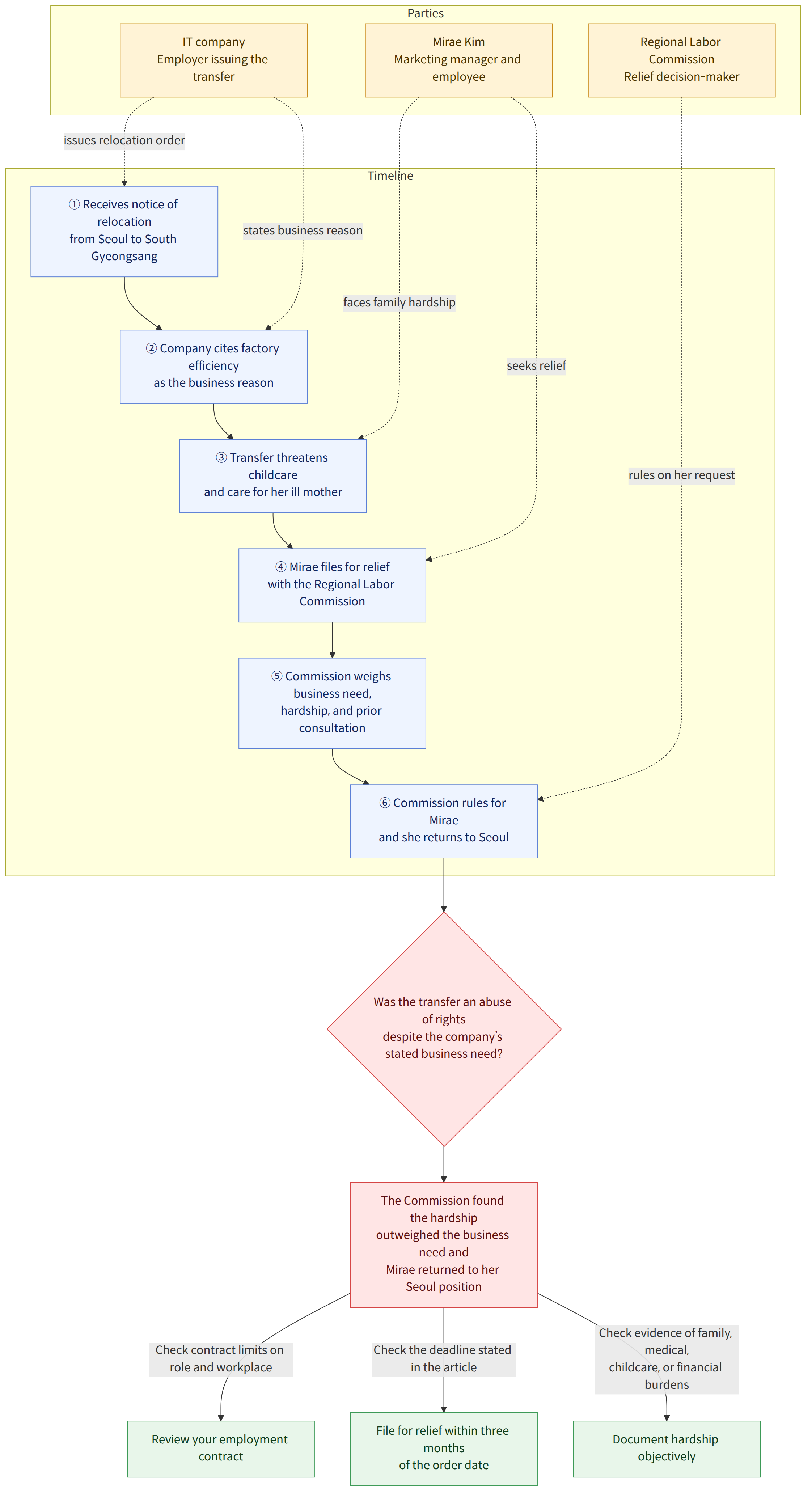
Mirae Kim, a marketing manager at a mid-sized IT firm in Seoul, arrived at work on a Monday morning to find a life-altering notification. Starting the following week, she was ordered to relocate to a remote support office at a factory in South Gyeongsang Province, hundreds of miles away. Mirae, who had worked at the Seoul headquarters for eight years, is a working mother caring for her preschool-aged daughter and an elderly mother who requires regular hospital visits.
Management cited "strategic realignment for factory efficiency," but Mirae felt blindsided. She suspected the move might be retaliation for a dissenting opinion she had voiced during a recent meeting. With her daughter’s childcare and her mother’s medical needs at stake, the relocation wasn't just a change of scenery—it was a threat to her entire support system.
Is a Personnel Transfer an Absolute Right?
The core legal question raised here is: "Is a company’s unilateral decision to transfer an employee a legitimate exercise of managerial authority, or is it an 'abuse of rights' that can be legally overturned?"
What Korean Law Says About Transfers
Article 23, Paragraph 1 of the Labor Standards Act (LSA) of Korea states:
"An employer shall not, without justifiable cause, dismiss, lay off, suspend, transfer, reduce wages, or take other punitive measures against a worker."
If a transfer is deemed unjustifiable, the employee can file a request for relief with the Regional Labor Commission within three months of the order date.
There are several legal boundaries an employer must respect:
- Contractual Limitations: If the employment contract specifically limits the workplace to "Seoul Headquarters" or the role to "Marketing," the employer generally needs the employee's consent to change them.
- Statutory Prohibitions: Transfers cannot be discriminatory or used as retaliation for reporting labor violations.
- The Principle of Good Faith: The company must weigh the business necessity against the employee’s personal disadvantage.
How Korean Courts Approach Personnel Orders
In Korea, courts generally recognize that employers have broad discretion in personnel matters to ensure efficient business operations. However, this discretion is not unlimited. Judges typically use a "balancing test":
- Business Necessity: Is there a genuine managerial need for the transfer? Was the selection of the employee based on reasonable criteria?
- Personal Disadvantage: How severe is the economic, mental, or familial hardship the employee will suffer? If the disadvantage significantly outweighs the business need, the transfer may be ruled invalid.
While courts look at whether the company sincerely consulted with the employee, the lack of consultation alone usually does not make the transfer void, though it is a factor in determining the order's legitimacy.
Applying the Law to Mirae’s Case
In Mirae’s situation, if her contract contained a general clause saying "the workplace may change according to company needs," the company has more leeway. However, her specific family situation—caring for a young child and a sick parent—represents a substantial "personal disadvantage."
Furthermore, moving a marketing expert to a factory support role with no clear connection to her expertise suggests that the "business necessity" might be a pretext for retaliation. If the company made no effort to mitigate her hardship (such as providing housing or travel subsidies), a court or Labor Commission would likely view this as an abuse of rights.
Conclusion: Justice for Mirae and Advice for You
Mirae Kim filed for relief with the Regional Labor Commission. The commission ruled in her favor, stating that the company’s business need did not justify the extreme personal hardship Mirae would face, especially given the lack of meaningful prior consultation. Mirae was able to return to her position in Seoul.
If you find yourself in a similar situation, consider these two practical tips:
- Review Your Employment Contract Immediately: Check if your job description or work location is narrowly defined. This is your strongest shield.
- Document Your Hardship Objectively: Don't just argue that you don't want to go. Collect evidence of specific burdens, such as medical records of dependents, childcare enrollment, or financial loss, to prove that the disadvantage is "beyond the normal acceptable level."
Managerial rights are a tool for growth, not a weapon for intimidation. Knowing your rights is the first step in protecting your life and career.
--- This column is provided for informational purposes only and does not constitute legal advice. Legal outcomes may vary based on specific circumstances.