
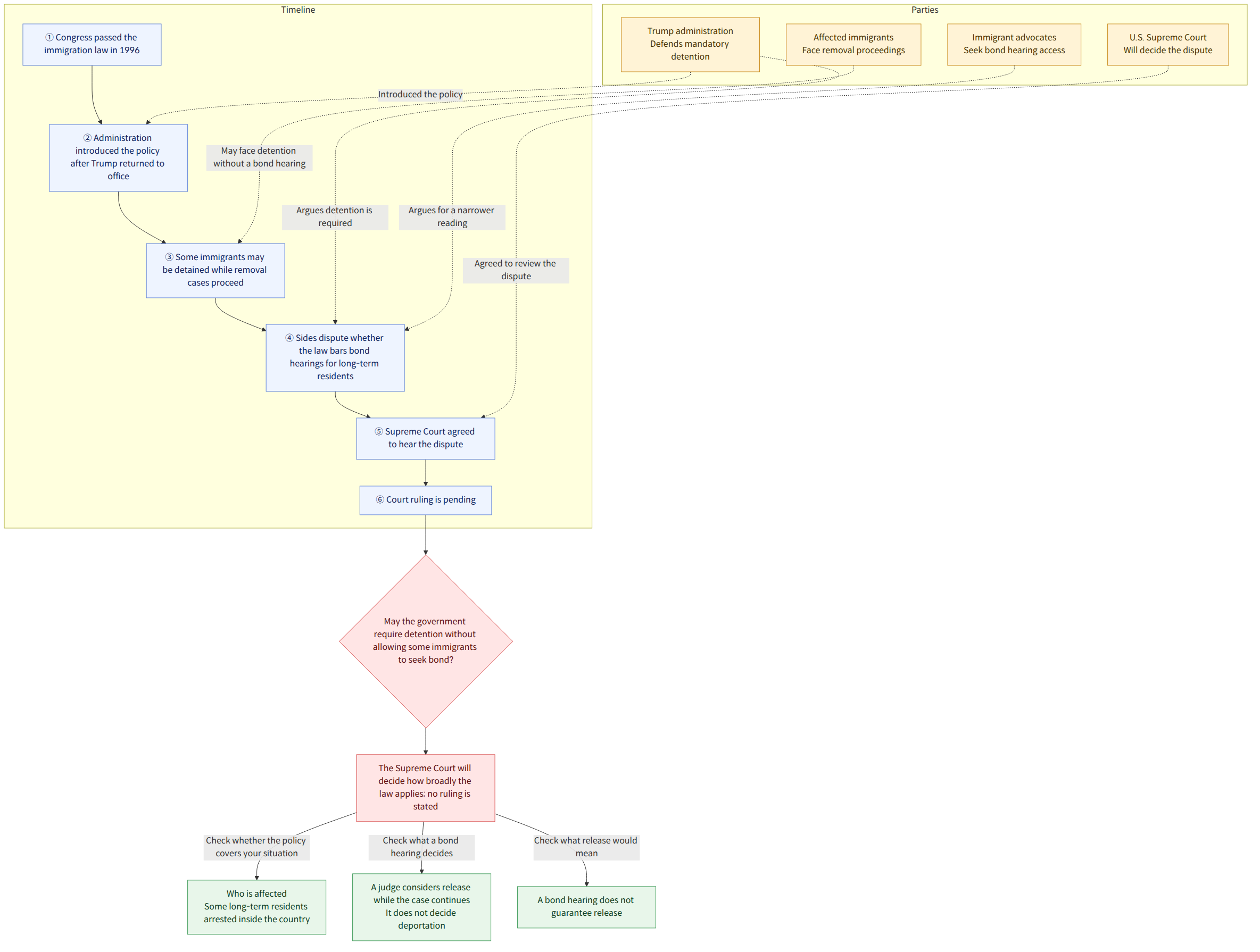
A major test of the administration’s detention policy
The U.S. Supreme Court will decide whether President Donald Trump’s administration may prevent some immigrants facing deportation from asking an immigration judge to release them on bond. The policy, introduced after Trump returned to office, allows authorities to keep certain people in detention while their removal cases proceed. In some cases, that process could take years.
The dispute concerns more than whether a person may eventually be deported. It also asks whether someone can remain in custody for a long period without an individual hearing where a judge considers whether detention is necessary.
The central question: Can the government require detention throughout a deportation case without giving some immigrants an opportunity to seek release on bond?
What a bond hearing means
A bond hearing is a court proceeding where an immigration judge considers whether a detained person may be released while their case continues. If release is allowed, the person may have to pay money as a guarantee that they will attend future hearings. A bond hearing does not decide whether the person has the right to remain in the United States.
In earlier administrations, including Trump’s first, many people in this situation could ask a judge for bond. Judges generally considered whether a person posed a danger to others or was likely to miss court. The new policy, as described in the case, removes that opportunity for some immigrants by treating detention as mandatory.
That distinction can have immediate consequences. Someone who is released may be able to return to family, keep a job, and work with a lawyer while their case is pending; someone who remains detained may have to do all of that from custody or may struggle to take part in their case.
Detention can extend beyond a short wait
Immigration proceedings do not always end quickly. Cases can involve multiple hearings, requests for more time, appeals, or questions about a person’s eligibility to stay. When a case lasts months or years, detention may become a lengthy part of a person’s life rather than a brief pause before a decision.
The people affected may include long-term residents who were arrested inside the country, not only people who have just arrived at the border. Some may have lived in the United States for decades before their cases began. The length of their residence does not, by itself, determine the outcome of a deportation case, but it is part of the broader context behind the debate over detention.
Two competing readings of immigration law
The administration argues that a federal immigration law passed in 1996 requires detention for people who entered the country unlawfully. Under its interpretation, that requirement can apply regardless of how long ago the person arrived. The government’s position treats the law as a basis for holding certain immigrants while their removal proceedings are underway.
Immigrant advocates offer a narrower reading. They say the detention provision was intended mainly for people stopped at or near the border, rather than long-term residents arrested inside the country. In their view, those residents should still be able to ask an immigration judge for bond.
- The administration’s view: The law requires detention for the covered group, even if an individual has been in the country for many years.
- The advocates’ view: The law was chiefly aimed at people encountered near the border and should not automatically bar bond hearings for long-term residents arrested inside the country.
- The legal issue: How broadly the 1996 law applies, and whether it permits an individual judge to consider release in these cases.
Why the wording of the law matters
A dispute over a law’s scope can determine how government rules apply to thousands of individual cases. If the Supreme Court adopts the administration’s interpretation, the policy could continue to block bond hearings for the group covered by that reading. If the justices reject it, people affected by the policy could regain the ability to ask a judge to consider release, though that would not guarantee that they would be released.
What the Supreme Court will—and will not—decide
The justices agreed to take up the legal dispute, but that does not mean they have endorsed either side’s position. Their eventual ruling will address the meaning and application of immigration law, not simply whether detention is difficult for the people experiencing it. The Court’s decision could clarify which categories of immigrants may be held without access to a bond hearing while their cases remain open.
A ruling on bond eligibility would also be different from a decision on the underlying deportation cases. A person granted a bond hearing could still lose their immigration case and face removal. Conversely, a person who is denied bond could still continue to challenge deportation through the legal process.
A bond hearing is not a decision to stay in the country. It is a chance to ask a judge whether release is appropriate while the case is pending.
The case is therefore about both legal authority and the practical limits of detention. It may help define how the government balances its power to enforce immigration law with the ability of detained people to seek individualized review.
Why the case matters beyond the courtroom
The ruling could affect how immigration authorities handle people who have established lives in the United States but are placed in deportation proceedings. It may also influence how much discretion immigration judges have to assess individual circumstances, such as a person’s ties to the community, history of attending court, or potential risk to public safety.
The practical difference can be substantial. For example, two people facing similar immigration proceedings could experience very different outcomes if one is allowed to request bond and the other is automatically detained under the policy. A judge’s review does not guarantee release, but it provides a formal way to assess whether custody is necessary in that particular case.
The issue also sits within a wider debate over immigration enforcement. Governments have authority to detain people in certain circumstances, while courts are often asked to determine the boundaries of that authority. In this case, the Supreme Court’s interpretation of a law enacted in 1996 could shape how that balance works under the current administration.
What comes next
The Supreme Court will hear the legal arguments and issue a decision at a later date. Until then, the justices’ agreement to review the case leaves the central question unresolved. The eventual ruling may set a nationwide standard for whether the immigrants covered by the policy can ask for bond hearings.
The outcome will not settle every dispute over immigration detention. It will, however, clarify whether the government can keep certain people in custody throughout removal proceedings without allowing an immigration judge to consider release. For detained immigrants and their families, that difference could determine whether they wait for a case outcome in custody or have a chance to return to their communities while the legal process continues.