1. A Human Story
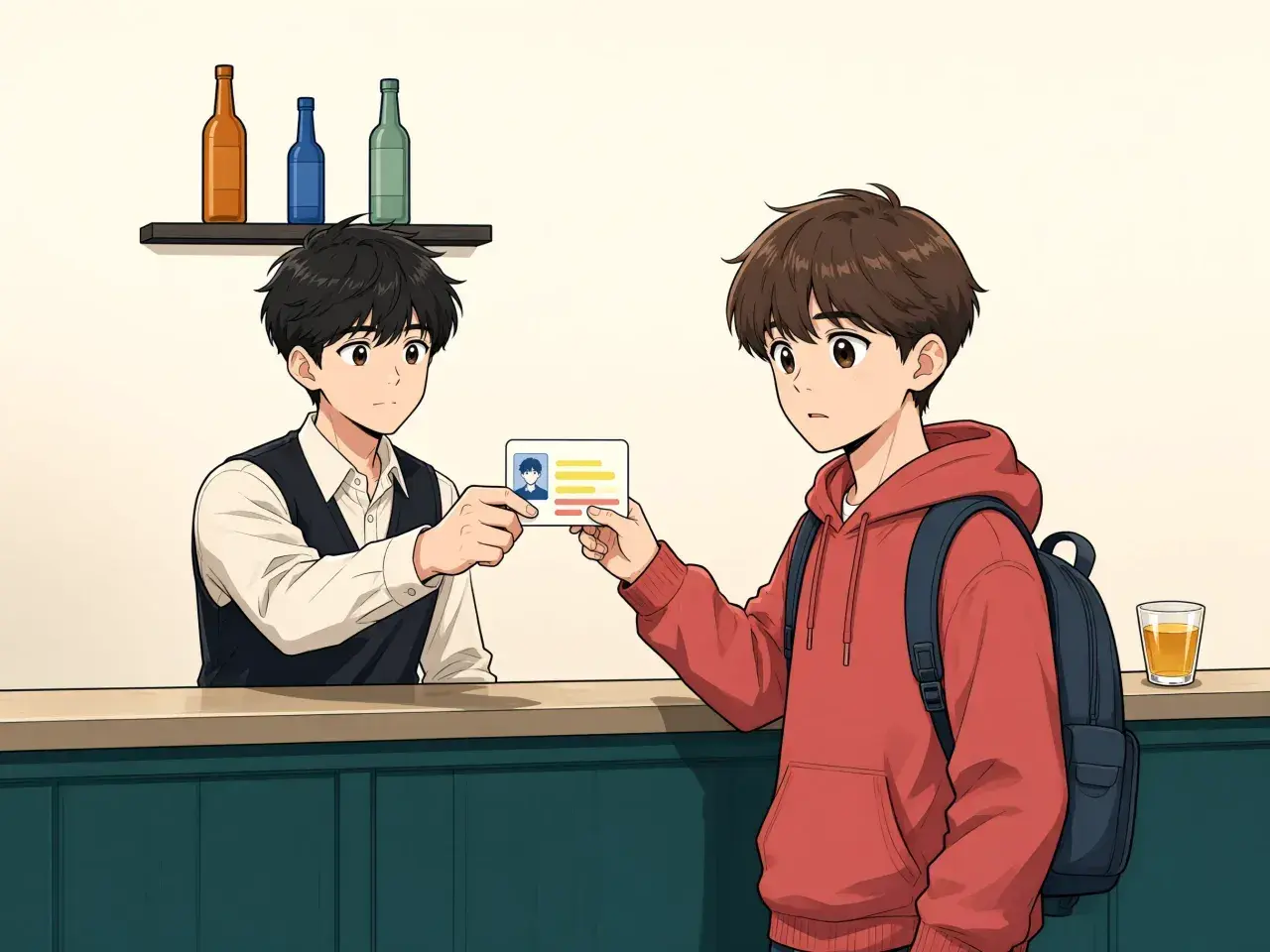
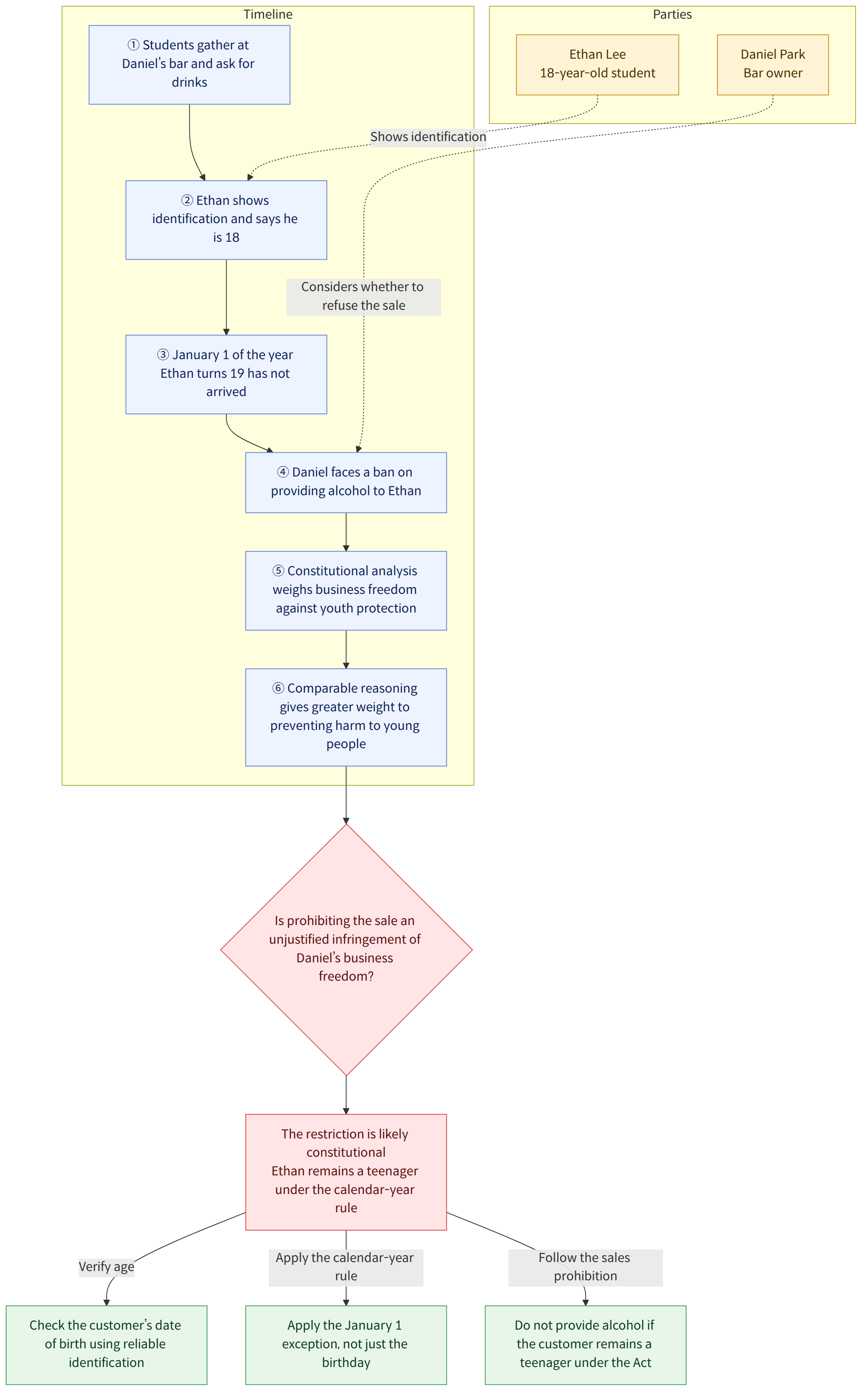
On a Friday evening near a university campus, Daniel Park watched a group of students squeeze into his small bar. They ordered food and asked for drinks. One student, Ethan Lee, showed Daniel his identification: Ethan had already turned 18, was enrolled at university, and supported himself with a part-time job. But he had not yet reached January 1 of the calendar year in which he would turn 19.
Daniel knew the law could treat Ethan as a teenager despite his adult responsibilities. Selling him alcohol could expose the bar to serious consequences. Refusing the order, however, felt difficult to explain to a student who was legally an adult for many ordinary purposes. Daniel wondered whether the restriction unfairly interfered with his right to run his business.
2. The Legal Question
May Korea constitutionally prohibit a bar owner from selling alcohol to someone who is already 18 but has not yet reached the statutory threshold for no longer being a teenager? In particular, does that prohibition unjustifiably infringe the owner’s freedom to conduct a business?
3. What Korean Law Says
Korean law classifies alcohol as a substance harmful to teenagers. The Youth Protection Act prohibits providing such substances to people who fall within its definition of a teenager. The prohibition covers sales and also applies when alcohol is provided without payment or through vending, remote, or other distribution methods.
The Act defines a teenager as a person under 19, but makes an important exception: a person is not treated as a teenager once January 1 of the year in which that person turns 19 has arrived. In practical terms, this is a calendar-year rule, not simply a test of whether someone has already had their 19th birthday.
The age rule: A person under 19 is generally a teenager, except that someone who has reached January 1 of the year in which they turn 19 is excluded from that definition.
The sales rule: Alcohol is a youth-harmful substance, and it may not be sold, distributed, or otherwise provided to a person who is legally classified as a teenager.
A violation can have significant consequences. The statutory provisions described here allow an administrative surcharge of up to 10 million won and criminal punishment of up to two years’ imprisonment or a fine of up to 20 million won. The precise consequences in an individual case depend on the applicable law and the facts.
For a bar owner, the practical checks are therefore:
- Confirm the customer’s date of birth using reliable identification.
- Apply the statutory January 1 exception, rather than relying only on whether the customer has celebrated a particular birthday.
- Do not sell or provide alcohol if the customer remains a teenager under the Act.
4. How Korean Courts Approach This
Korean constitutional analysis recognizes that a rule restricting alcohol sales can limit a bar owner’s freedom to conduct an occupation. But recognizing a limit does not automatically make it unconstitutional. Courts assess whether the restriction serves a legitimate public purpose, whether it is reasonably connected to that purpose, and whether the burden imposed on the business is excessive when weighed against the public benefit.
In considering a comparable age-based restriction, the Constitutional Court emphasized that young people may still be in school or at an early stage of work or military service. It reasoned that excessive drinking could harm their health, development, education, and ability to adjust to adult responsibilities. The Court considered those risks—and the public interest in helping young people grow into healthy adults—more significant than the limited loss suffered by a food-and-drink business that cannot serve customers below the legal threshold.
The central balance: A business owner’s freedom matters, but Korean constitutional reasoning gives strong weight to preventing alcohol-related harm to young people. A restriction is not excessive merely because it prevents a business from serving some otherwise capable customers.
The current definition is, moreover, less restrictive than a rule that treated every person under 19 as a teenager throughout the year. By excluding people who have reached January 1 of the year they turn 19, the statute permits some customers to buy alcohol before their 19th birthday. That feature makes a constitutional challenge to the current rule harder, not easier.
5. Applying the Law to the Case
Daniel’s concern is understandable, but the legal analysis points in a clear direction.
- Ethan falls within the protected age group. Although he is 18, he has not yet reached January 1 of the calendar year in which he will turn 19. On these facts, he remains a teenager under the Act.
- Alcohol is covered by the prohibition. The law expressly treats alcohol as a youth-harmful substance. Daniel cannot avoid the restriction because Ethan is a university student, has a job, or appears mature and independent. The statutory category turns on the age rule, not a customer’s educational, employment, or personal circumstances.
- The rule does restrict Daniel’s business activity. He cannot serve a customer who might otherwise be a paying adult patron. That is a real limit on the way he conducts his business, rather than a purely theoretical one.
- The public-interest justification is substantial. The government’s aim is to reduce young people’s exposure to alcohol-related harm during a stage of life that courts have treated as particularly important for health and development. A clear age line also gives businesses an administrable standard that does not require staff to assess each customer’s maturity.
- The present rule is unlikely to be found disproportionate. Korean constitutional reasoning has upheld a comparable prohibition, weighing the business owner’s limited commercial disadvantage against the broader public interest in protecting young people. The current calendar-year exception further narrows the restriction. On these facts, Daniel would have a weak basis for arguing that the rule unconstitutionally deprives him of occupational freedom.
6. Conclusion: What Happened, and What Should You Do?
Daniel declined Ethan’s order for alcohol and explained that the law uses a specific calendar-year threshold, not university enrollment or apparent adulthood. That decision was legally prudent. Under the facts given, Ethan remained a teenager under the Youth Protection Act, and selling him alcohol could expose Daniel to both administrative and criminal penalties. A constitutional challenge based on the effect on Daniel’s business would be unlikely to succeed under the principles Korean courts have applied.
For readers running bars, restaurants, or other businesses that serve alcohol:
- Check identification carefully and calculate eligibility using the statutory January 1 exception, not assumptions about age or student status.
- Train staff to apply one consistent rule and keep clear procedures for refusing service when a customer’s eligibility cannot be verified.
- If a violation is alleged, get prompt legal advice before responding to an investigation or administrative notice, because the consequences can be substantial.