
1. A Human Story
Daniel Reed filed a constitutional complaint after a government decision disrupted an important part of his life. He hired a lawyer because Korean law generally requires a person bringing a constitutional complaint to be represented by counsel. The case took time, and the legal bills arrived even as Daniel waited for the court to consider his claim.
Before the Constitutional Court issued a decision on the underlying issue, circumstances changed. The measure Daniel had challenged no longer affected him, and the court dismissed his complaint because he no longer had a practical interest in obtaining constitutional relief. Daniel understood why the case could not continue. But he was left with a pressing question: if the Constitution required him to hire a lawyer, should the state reimburse that expense when the case ended?
2. The Legal Question
When a constitutional complaint is dismissed because the claimant’s interest in obtaining relief has disappeared, must the state repay the claimant’s lawyer’s fees, given that legal representation is generally mandatory in Constitutional Court proceedings?
3. What Korean Law Says
Korean constitutional adjudication serves a public purpose. It can protect constitutional rights, keep public power within constitutional limits, and safeguard the constitutional order. For that reason, the state bears certain costs of running the Constitutional Court’s proceedings.
But proceeding costs are not the same as every expense a party chooses or is required to incur in pursuing a case. The distinction is between the court’s own expenses and a claimant’s personal expenses.
Costs borne by the state include court fees and expenses incurred by the Constitutional Court in conducting the proceeding. They do not include a party’s own costs, such as fees paid to a lawyer for representation.
In practice, the distinction is as follows:
- Court-related costs: Court fees and expenses the Constitutional Court incurs to hear and decide a matter are borne by the state.
- Party-related costs: A claimant’s own legal fees and other expenses of presenting the case are not part of those state-paid costs.
- Required legal representation: The fact that a lawyer is generally required does not, by itself, convert the claimant’s lawyer’s fee into an expense of the court.
- Appointed counsel: Korean law also provides for a court-appointed counsel system in qualifying circumstances. That is a separate way eligible applicants may receive legal assistance; it does not mean that the state must reimburse every claimant who hires a private lawyer.
4. How Korean Courts Approach This
The Constitutional Court treats the state’s responsibility for proceeding costs as a way to support the court’s public constitutional function—not as a general promise to repay each person for the cost of bringing a claim.
The Court has reasoned that making the state responsible for parties’ private expenses, including lawyer’s fees, could encourage excessive or abusive filings. That could increase the burden on the Court and, in turn, make it harder for other people to obtain access to constitutional review. The existence of a system for appointed counsel also matters: if private legal fees were automatically reimbursed, there would be less reason to provide that targeted form of assistance.
The general judicial approach is to distinguish expenses incurred by the Court from expenses incurred by the parties. Mandatory representation does not erase that distinction.
This applies even when a complaint is dismissed because the claimant’s interest in relief has disappeared. The reason for dismissal may explain why the proceeding ended, but it does not transform a private legal bill into a court expense.
5. Applying the Law to the Case
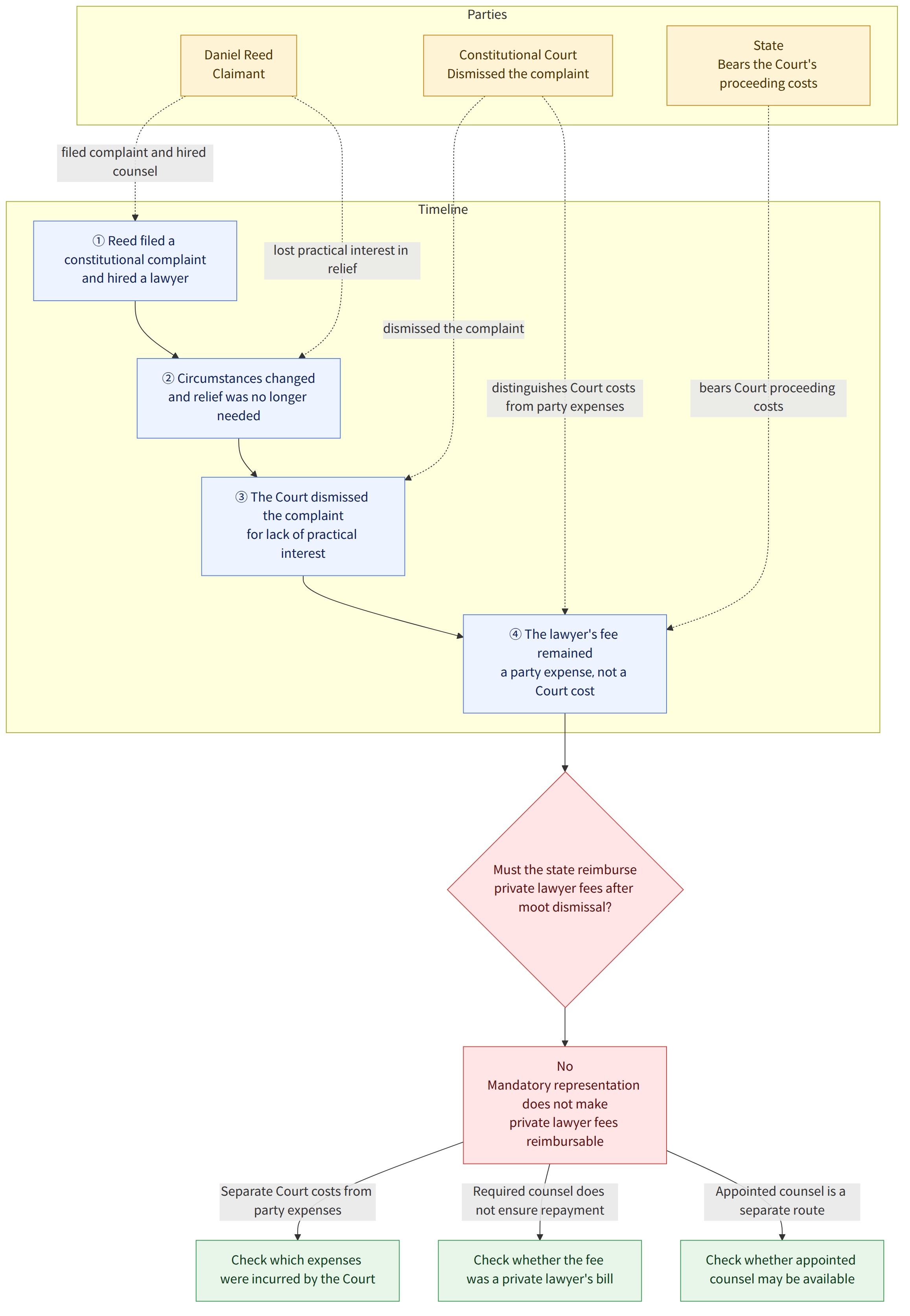
Daniel’s situation can be assessed in four steps.
- The complaint ended because the need for relief had disappeared. The Constitutional Court dismissed Daniel’s complaint after the circumstances changed, leaving no continuing practical interest for the Court to resolve. That dismissal did not itself determine who had to pay his lawyer.
- The state remains responsible for the Court’s own proceeding costs. Court fees and expenses incurred by the Constitutional Court in handling the matter fall within the costs borne by the state.
- Daniel’s lawyer’s bill was his party-related expense. He paid counsel to prepare and present his complaint. Although he generally needed a lawyer to bring the case, the fee remained an expense he incurred as a party—not an expense incurred by the Court.
- The requirement to have counsel does not create a right to reimbursement. Daniel could not require the state to repay his private lawyer’s fees merely because representation was mandatory. If he had qualified for appointed counsel, that might have offered assistance through a different route, but it would not turn his private fee into a recoverable court cost after the fact.
The outcome is therefore not a judgment that Daniel’s complaint was improper or that hiring counsel was unnecessary. It is a narrower rule about how Korean constitutional proceedings divide costs.
6. Conclusion: What Happened, and What Should You Do?
Daniel was not reimbursed for the legal fees he had paid. The state covered the costs of the Constitutional Court’s own proceeding, but not his lawyer’s bill—even though he had needed counsel to bring the complaint. The fact that the case ended after his interest in relief disappeared did not change that division.
If you are considering a constitutional complaint, keep these practical points in mind:
- Budget for private legal fees: Do not assume the state will repay your lawyer’s fees, even if your complaint is dismissed or representation is required.
- Ask about appointed counsel early: If you may qualify, check the applicable eligibility requirements and how to apply before retaining private counsel.
- Monitor whether your claim remains live: If circumstances change, promptly discuss with your lawyer whether you still have a practical interest in the relief sought and what that may mean for the proceeding.