1. A Human Story
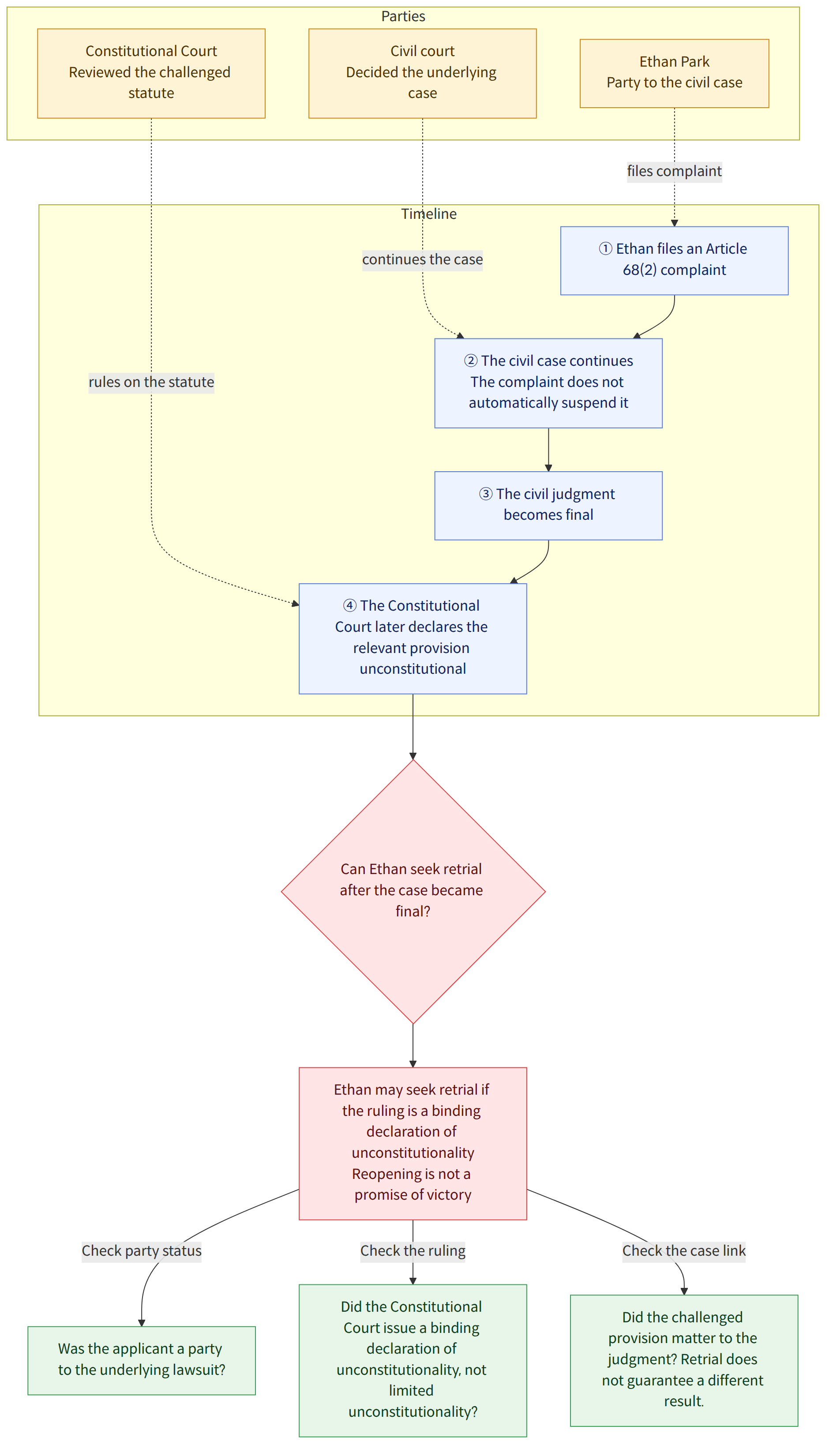
When Ethan Park lost a civil lawsuit, the judgment seemed to settle a dispute that had consumed months of his life. The court had relied on a statutory provision Ethan believed violated the Constitution. He had already challenged that provision through a constitutional complaint, but the case in court kept moving while the Constitutional Court considered his challenge.
The civil judgment became final before the Constitutional Court ruled. Ethan had no immediate way to stop that outcome. Then, later, the Constitutional Court declared the provision unconstitutional. Ethan wondered whether the ruling came too late to matter—or whether Korean law gave him a route back into court.
2. The Legal Question
If a lawsuit becomes final before the Constitutional Court decides a constitutional complaint under Article 68(2), can the party later ask for a retrial after the Court rules that the statute applied in the case is unconstitutional? And who is entitled to make that request?
3. What Korean Law Says
An Article 68(2) constitutional complaint challenges the constitutionality of a statute relevant to a court case, generally after the ordinary court has declined a request to refer the issue to the Constitutional Court. Filing the complaint does not automatically suspend the underlying lawsuit. The trial or appeal may therefore reach a final judgment before constitutional review is complete.
The Constitutional Court Act provides a possible remedy for that timing problem:
Article 75(7) allows a party to seek a retrial of an underlying case that has already become final when the constitutional complaint is upheld.
The remedy is limited in important ways:
- The applicant must have been a party to the underlying lawsuit. The Constitutional Court has confined the right to seek retrial to parties in that case. A person does not gain that right merely because the person filed, supported, or was affected by the constitutional complaint.
- The constitutional ruling must meet the legal standard for an “upheld” complaint. The Supreme Court has interpreted this to mean a decision declaring the statute unconstitutional that has binding force on the courts.
- A limited-unconstitutionality ruling is not enough under that interpretation. A decision that identifies an unconstitutional meaning or application while leaving the statute in place does not, for this retrial provision, qualify as the required binding unconstitutionality decision.
- Retrial is a way to reopen the case, not a promise of victory. The court handling the retrial must still decide the dispute under the applicable law and facts.
4. How Korean Courts Approach This
Korean courts treat retrial as an exceptional procedure, not as an automatic consequence of a later constitutional ruling. The ordinary judgment does not simply disappear when the Constitutional Court rules. Instead, Article 75(7) supplies a specific route for a qualifying party to ask that the already-final case be reconsidered.
The courts also draw a firm line around who may use that route. The right belongs to a party to the underlying case, rather than to every person with an interest in the constitutional issue. This connects the remedy to the judgment the applicant wants reopened.
The nature of the Constitutional Court’s decision matters just as much. The Supreme Court has read “the constitutional complaint is upheld” to require a binding declaration of unconstitutionality. A limited-unconstitutionality decision does not satisfy that requirement. The distinction can determine whether a retrial application is available at all.
A later constitutional ruling does not, by itself, undo a final judgment. The party must qualify for retrial, and the ruling must be the kind that Article 75(7) recognizes.
5. Applying the Law to the Case
Ethan’s situation can be assessed in several steps.
- His case became final while constitutional review was pending. That timing does not bar relief. Article 68(2) proceedings do not automatically stay the underlying lawsuit, and Article 75(7) exists for cases that have already become final by the time the constitutional ruling arrives.
- Ethan was a party to the underlying civil case. He therefore meets the standing requirement described by the Constitutional Court. If someone who was not a party to that lawsuit tried to reopen it, filing the constitutional complaint alone would not give that person the same right.
- The challenged provision mattered to the judgment. In this fictional case, the civil court relied on the provision Ethan challenged. That connection makes the later constitutional ruling relevant to the case he seeks to reopen; a ruling about an unrelated statute would not provide the same basis.
- The form of the Constitutional Court’s ruling is decisive. Here, the Court issued a binding decision declaring the provision unconstitutional. That satisfies the standard the Supreme Court has applied to Article 75(7). Had the Court instead issued only a limited-unconstitutionality decision, Ethan would not have the retrial ground described here.
- Ethan must still pursue the retrial procedure. The favorable constitutional ruling does not automatically revise the civil judgment. Ethan must apply for a retrial, and the court must consider the reopened dispute. The constitutional decision gives him a procedural opportunity, not an assured result on the underlying claim.
6. Conclusion: What Happened, and What Should You Do?
Ethan had a route to seek relief even though his lawsuit became final before the Constitutional Court ruled. Because he was a party to the original case and the Court later issued a binding decision declaring the relevant statute unconstitutional, he could apply for a retrial under Article 75(7). The judgment would not be erased automatically, and Ethan would still need to pursue the retrial and establish his case again under the applicable rules.
If you face a similar situation:
- Keep track of both proceedings. A constitutional complaint does not automatically pause the underlying lawsuit, so do not assume the court case will wait for the Constitutional Court.
- Check your status and the exact ruling. Confirm that you were a party to the underlying case and determine whether the constitutional decision is a binding declaration of unconstitutionality rather than a limited-unconstitutionality decision.
- Get prompt legal advice about retrial. Preserve the final judgment and the Constitutional Court’s decision, and ask a Korean lawyer to assess the filing requirements and timing that apply to your case.