
A Human Story
Sarah Jenkins had been a dedicated senior analyst at a leading logistics firm in Seoul for ten years. She had built a life of stability, but a sudden family crisis changed everything. Her parents back home faced a mounting medical emergency, and Sarah found herself in desperate need of a significant amount of cash that her monthly salary simply couldn't cover.
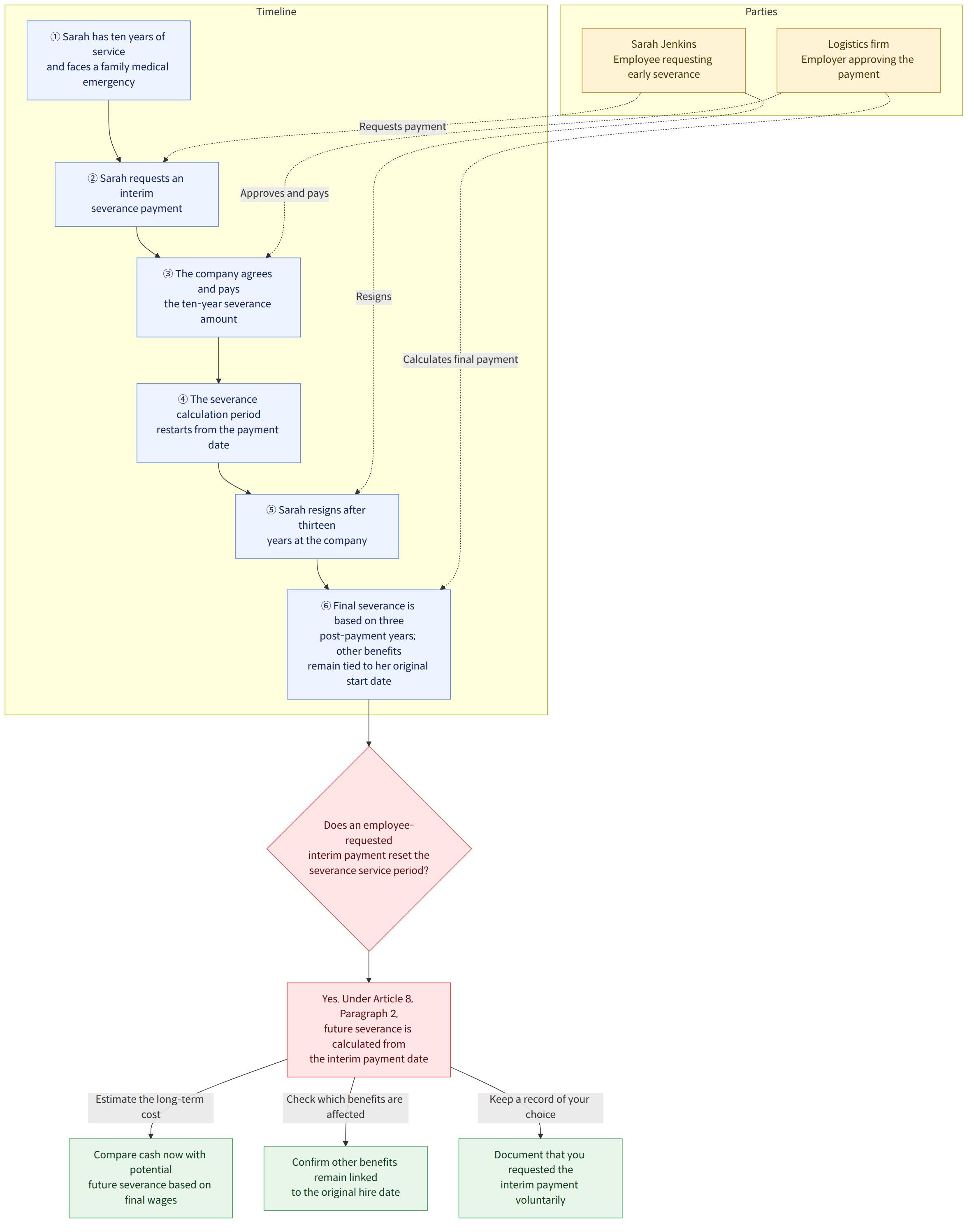
Remembering that she had accumulated a decade's worth of severance pay, Sarah approached her HR manager. She requested an "interim payment" of her severance pay—essentially asking the company to pay out the money she would normally receive only upon leaving the company. The company agreed, and Sarah received a much-needed windfall that saved her parents' health.
Fast forward three years. Sarah decided to change careers. As she prepared her resignation, she assumed her final severance check would be calculated based on her full thirteen years of service, minus the amount she had already received. However, when the HR department presented her final statement, the number was shockingly lower than she expected. Sarah was devastated: had she accidentally erased three years of her hard-earned seniority?
The Legal Question
The core issue here is whether a worker who receives an interim severance payment can still claim a "continuous service period" starting from their original hire date when they eventually retire, or if the payment acts as a legal "reset button" for the calculation of future severance.
What Korean Law Says
In Korea, the Employee Retirement Benefit Security Act governs how workers are compensated upon departure. Under normal circumstances, severance is paid based on the total years of continuous service multiplied by the average wage of the final three months.
Regarding interim payments, the law is clear:
According to Article 8, Paragraph 2 of the Act, an employer may settle and pay severance pay in advance if the employee requests it. In such cases, the period of continuous service for the purpose of calculating future severance pay shall be recalculated from the date of the interim payment.
Key requirements for this process include:
- Employee Initiative: The request must come from the worker. An employer cannot force an interim settlement to clear their liabilities.
- New Calculation Point: The "clock" for severance purposes restarts from the day the payment was made.
How Korean Courts Approach This
Korean courts maintain a strict stance on the "disruption of the employment relationship" regarding severance pay. The judiciary generally rules that when a worker voluntarily requests a settlement of their severance pay, it constitutes a valid legal break in the tenure used for financial calculation.
Even if the employee continues to work at the same company without a gap in their daily attendance, the courts view the interim payment as a settlement of the past. Therefore, the seniority used for the financial payout is reset, regardless of whether the employee's professional status or rank remained intact.
Applying the Law to the Case
Applying these principles to Sarah's situation, we can break down the result step-by-step:
- The Request: Sarah initiated the request due to family hardship. This makes the interim payment legally valid under the Act.
- The Reset: The moment Sarah received her ten-year payout, her "severance clock" reset to zero.
- The Final Calculation: When Sarah retired after thirteen years, the company did not calculate her pay based on 13 years. Instead, they calculated it based only on the 3 years of service that occurred after the interim payment.
- Other Benefits: Crucially, this reset only applied to her severance pay. Her annual leave, seniority-based bonuses, and her rank as a senior analyst were still based on her original ten-year start date.
Conclusion: What Happened, and What Should You Do?
In the end, Sarah had to accept the lower final payment. While she received the money she needed three years prior, the trade-off was the loss of the "compounding" effect of her long-term seniority on her final payout.
If you are considering an interim severance payment in Korea, keep these three tips in mind:
- Evaluate the Long-Term Cost: Remember that severance is usually calculated based on your final salary. If you expect your salary to be much higher in the future, taking money now may cost you significantly more in the long run.
- Verify the Scope: Confirm with your HR department that while your severance clock resets, your other benefits (like vacation days and pay grades) will remain linked to your original hire date.
- Document the Request: Ensure the request for interim payment is documented as your choice to avoid any disputes regarding the legality of the payout later on.