
1. A Human Story
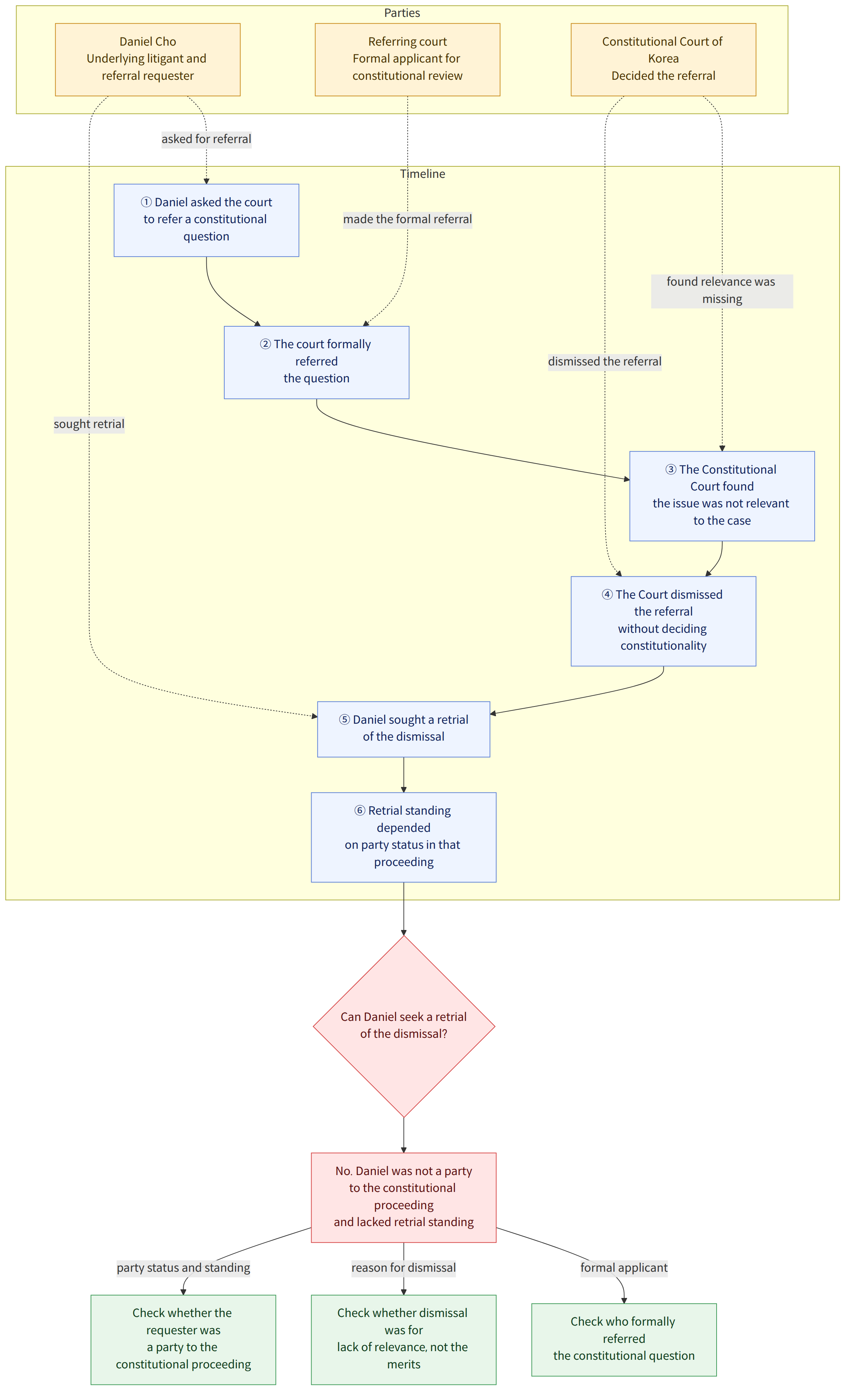
Daniel Cho had spent months contesting a decision that affected his small business. In the middle of the court proceedings, he came to believe that a statute the judge might apply was unconstitutional. Daniel asked the court handling his case to refer that question to the Constitutional Court of Korea.
The court agreed and formally referred the constitutional question. For Daniel, that felt like a turning point: the country’s highest constitutional tribunal would now consider whether the law could stand. But the Constitutional Court dismissed the referral, finding that the statute’s constitutionality was not a necessary premise for deciding Daniel’s case. Daniel wondered whether he could ask the Constitutional Court to reconsider through a retrial.
2. The Legal Question
Can a person who asked a court to refer a statute for constitutional review seek a retrial of the Constitutional Court’s decision dismissing that referral?
The key distinction is between requesting a referral and being a party to the constitutional review proceeding. Under Korean law, those are not the same thing.
3. What Korean Law Says
Korean courts can refer a question about a statute’s constitutionality to the Constitutional Court when the statute’s constitutionality matters to a case before them. The referral is formally made by the court, even if one of the parties asked the court to make it.
The constitutional question must be relevant to the case: the court must need to resolve the statute’s constitutionality in order to decide the underlying dispute.
That requirement is often described as relevance to the judgment or the prerequisite of relevance. If the Constitutional Court concludes that this condition is missing, it may dismiss the referral without deciding whether the statute is constitutional on its merits.
A retrial is an exceptional procedure for seeking a new decision in a case. It is not an appeal open to anyone who is dissatisfied with a ruling. In this context, the important points are:
- The referring court is the formal applicant. A litigant may ask the court to refer a question, but the court itself makes the referral to the Constitutional Court.
- The person who requested referral is not automatically a party to the constitutional proceeding. The request in the underlying lawsuit does not, by itself, make the requester a party to the separate constitutional review case.
- Retrial standing depends on party status. Because retrial is an extraordinary remedy for a party to the decision, someone who was not a party to the constitutional proceeding cannot seek a retrial of that decision in their own name.
4. How Korean Courts Approach This
The Constitutional Court draws a formal line between the underlying lawsuit and the constitutional review proceeding. Even when a litigant’s application prompts the referral, the referral is made by the court hearing the lawsuit. The litigant does not become a party to the constitutional proceeding simply because the constitutional question arose from their dispute.
A person who is not a party to the constitutional decision lacks the standing required to seek a retrial of that decision.
This approach reflects the limited role of retrial: it is a special form of relief for those who were parties to the proceeding in which the challenged decision was made. Dissatisfaction with the outcome, or a personal stake in the underlying dispute, does not alone create eligibility to use that procedure.
5. Applying the Law to the Case
Daniel’s situation turns on the sequence of events and the legal character of each step.
- Daniel asked for a referral in his own case. His request invited the court handling his dispute to raise the constitutional issue. It did not make him the formal applicant before the Constitutional Court.
- The court made the referral. Once the court referred the question, the constitutional review proceeding was formally between the referring court and the Constitutional Court—not a separate case brought by Daniel as a party.
- The Constitutional Court dismissed the referral for lack of relevance. That meant the Court concluded it did not need to decide the statute’s constitutionality to resolve Daniel’s underlying case. It was a procedural dismissal, not a ruling that the statute was constitutional.
- Daniel sought a retrial of that dismissal. But because he was not a party to the constitutional review proceeding, he did not have the standing required to ask for a retrial of its decision.
The fact that the constitutional question mattered greatly to Daniel’s business does not change who formally brought the constitutional case. His personal interest in the underlying lawsuit cannot replace the party status required for this particular remedy.
6. Conclusion: What Happened, and What Should You Do?
Daniel’s retrial request would be dismissed because he lacks standing to seek a retrial of the Constitutional Court’s decision on the referral. That result does not decide whether the statute he challenged is constitutional. It means only that he cannot use retrial as a party to a constitutional proceeding in which he was not a party.
For readers facing a similar situation:
- Keep the two proceedings distinct. Ask your lawyer what the Constitutional Court’s decision means for the underlying lawsuit, especially if the referral was dismissed for lack of relevance.
- Focus on the case still before the ordinary court. Discuss the arguments and procedural steps available in that case rather than assuming a retrial of the constitutional decision is open to you.
- Check standing before filing an extraordinary remedy. Confirm who was formally a party to the decision and whether you are eligible to seek the specific procedure you are considering.