1. A Human Story
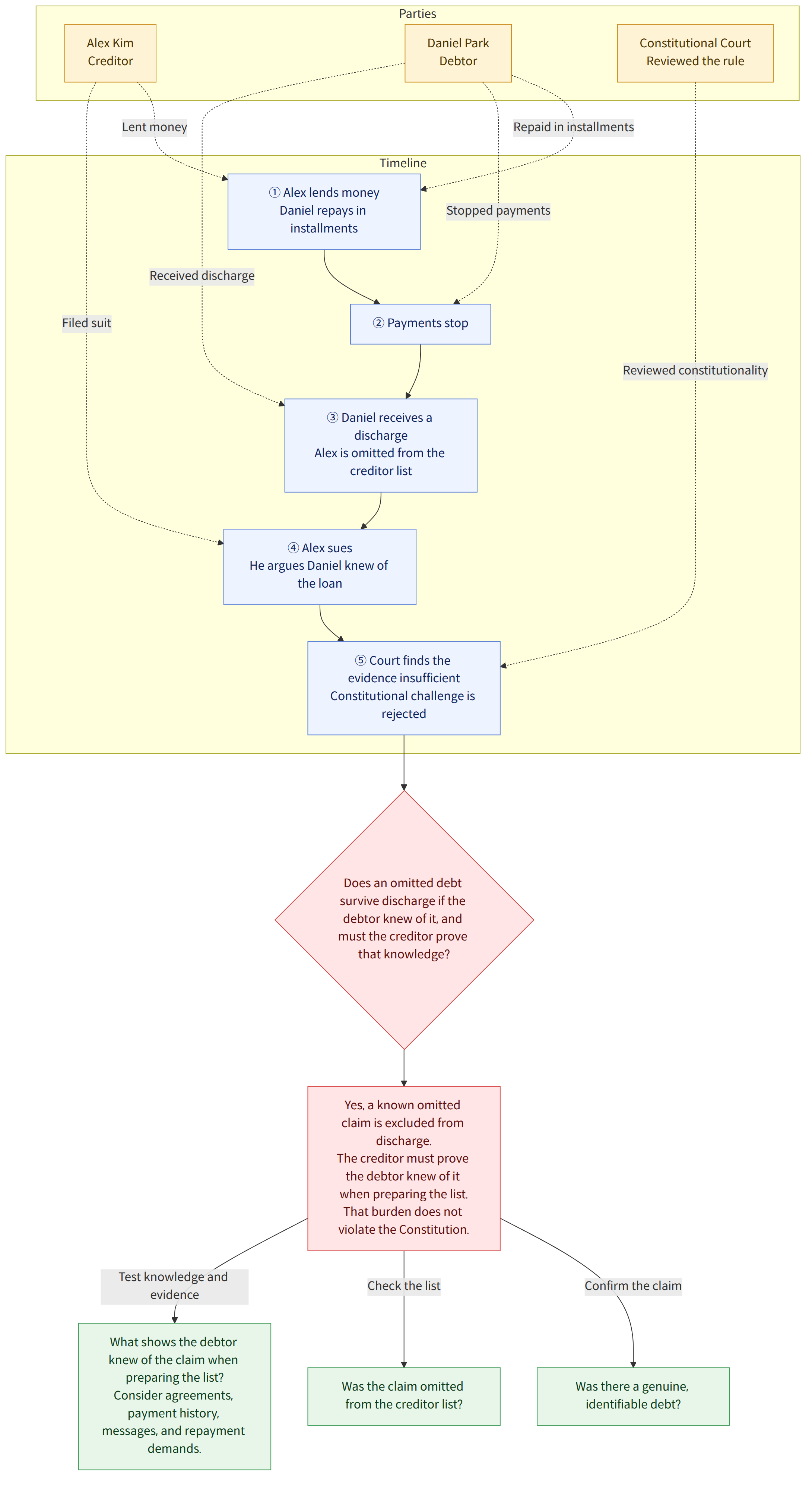
Alex Kim had lent Daniel Park money to help him keep a small restaurant open. Their agreement was simple: Daniel would repay the loan in installments as business improved. For a while, he did. Then the payments stopped, and Daniel’s calls became less frequent. Alex assumed the debt remained unresolved and that he could pursue it when Daniel’s circumstances improved.
Months later, Alex learned that Daniel had obtained a bankruptcy discharge. Alex’s name had not appeared on the creditor list, and he had not known about the bankruptcy proceedings in time to object. He sued, arguing that Daniel had known about the loan and should not be allowed to escape it. But the evidence did not persuade the court that Daniel knew of the debt when he prepared the list. Alex lost—and then asked whether the law itself was unfair because it required him, the creditor, to prove what Daniel knew.
2. The Legal Question
When a debtor receives a bankruptcy discharge, can a debt omitted from the creditor list remain payable because the debtor knew it existed? And is it unconstitutional to require the creditor—not the debtor—to prove that knowledge?
3. What Korean Law Says
Korea’s Debtor Rehabilitation and Bankruptcy Act generally allows an individual debtor who completes the bankruptcy process to obtain a discharge, giving the debtor a chance to rebuild financially. The discharge does not wipe out every kind of obligation. One statutory exception concerns a bankruptcy claim omitted from the creditor list when the debtor knew the claim existed.
Under Article 566(7), a claim omitted from the creditor list is excluded from the discharge if the debtor was aware of its existence.
In practical terms, a creditor relying on this exception must establish the facts that bring the claim within it. The key question is whether the debtor knew about the particular claim when the creditor list was prepared. In this context, “bad faith” is a legal way of describing that knowledge; it does not necessarily mean the debtor acted out of spite or with a broader dishonest motive.
The rule matters because a creditor whose claim is omitted may otherwise miss the opportunity to object during the bankruptcy process and could lose the right to collect. At the same time, bankruptcy proceedings are meant to reach a conclusion and give debtors a realistic opportunity to start again. The law therefore draws a line between a claim the debtor knew about but left off the list and one that was omitted without that knowledge.
When a creditor argues that an omitted debt survived the discharge, the practical questions are usually:
- Was there a genuine, identifiable claim against the debtor?
- Was the claim absent from the creditor list?
- Did the debtor know the claim existed when preparing that list?
- What evidence supports the creditor’s account of the parties’ dealings and the debtor’s knowledge?
The creditor’s task is not necessarily to prove a particular motive for concealment. It is to prove the debtor’s awareness of the claim. Evidence may include the agreement, payment history, messages acknowledging the debt, and records of demands for repayment.
4. How Korean Courts Approach This
The Constitutional Court considered whether assigning this burden to creditors violated their constitutional property rights. It upheld the provision. The Court recognized that an omitted creditor can suffer a serious loss without having had a fair chance to participate in the discharge process. Protecting that creditor is a legitimate purpose, and keeping a known but omitted claim outside the discharge is a suitable way to serve it.
The Court also concluded that the rule was not an excessive restriction on creditors. It applies to the relevant situation—an omitted claim that the debtor knew about—rather than preserving every debt that happens to be missing from the list. The Court further considered the public value of personal bankruptcy: an effective discharge system can help debtors recover economically and should not be undermined by unresolved claims whenever a list is incomplete.
The Court held that requiring the creditor to prove the debtor’s knowledge did not violate the Constitution. The need for a workable bankruptcy process and the debtor’s opportunity for economic rehabilitation carried substantial weight.
The Court also rejected an equality-based challenge arguing that personal bankruptcy creditors and personal rehabilitation creditors were treated differently. It did not find that difference sufficient to make the challenged rule unconstitutional.
In assessing knowledge, the relevant evidence is not confined to documents in the bankruptcy file. Courts may look closely at the relationship between the creditor and debtor, the nature of the claim, and the timing, method, and frequency of payment requests. A creditor’s difficulty accessing bankruptcy records, by itself, does not establish that collecting evidence about the parties’ own dealings is exceptionally difficult.
5. Applying the Law to the Case
Alex’s loan agreement and the payments Daniel made could help show that the debt was real. But proving that the loan existed is not the same as proving that Daniel knew it existed when he completed his creditor list. The legal exception turns on that additional point.
The next question is what happened before Daniel filed for bankruptcy. Did Alex send written demands? Did Daniel acknowledge the remaining balance in a text or email? Were there recent conversations about repayment? Did Daniel make a partial payment close to the time he prepared the list? Evidence of this kind could support an inference that Daniel knew the debt remained outstanding.
On the facts of the story, however, Alex could not establish that link. The payments had stopped, communication had dwindled, and the evidence did not convince the court that Daniel was aware of the outstanding claim at the relevant time. Alex’s understandable belief that Daniel still owed him money could not take the place of proof of Daniel’s knowledge.
That is why the burden allocation becomes decisive. If the creditor cannot prove the debtor knew of the omitted claim, the statutory exception does not apply. A final discharge can then prevent the creditor from collecting the debt through an ordinary lawsuit. The law does not presume that every omission was innocent—but neither does it presume that every omission was knowing.
6. Conclusion: What Happened, and What Should You Do?
Alex’s constitutional argument was unlikely to succeed. The Constitutional Court has upheld the rule placing the burden of proving the debtor’s knowledge on the creditor, finding that it reasonably balances creditor protection with the debtor’s chance to obtain a fresh financial start. In Alex’s case, because he could not prove Daniel knew about the loan when the creditor list was prepared, the debt remained covered by the discharge and his lawsuit failed.
For anyone in a similar position:
- Keep a paper trail: Save contracts, payment records, messages acknowledging the balance, and dated requests for repayment.
- Act quickly if bankruptcy is possible: Check whether proceedings have begun and seek advice about deadlines and opportunities to object or submit a claim.
- Focus on knowledge, not just nonpayment: To rely on the omitted-claim exception, gather evidence showing the debtor knew the specific debt remained outstanding when the creditor list was prepared.