
1. A Touch of Paris in Seoul, But No Korean Rights?
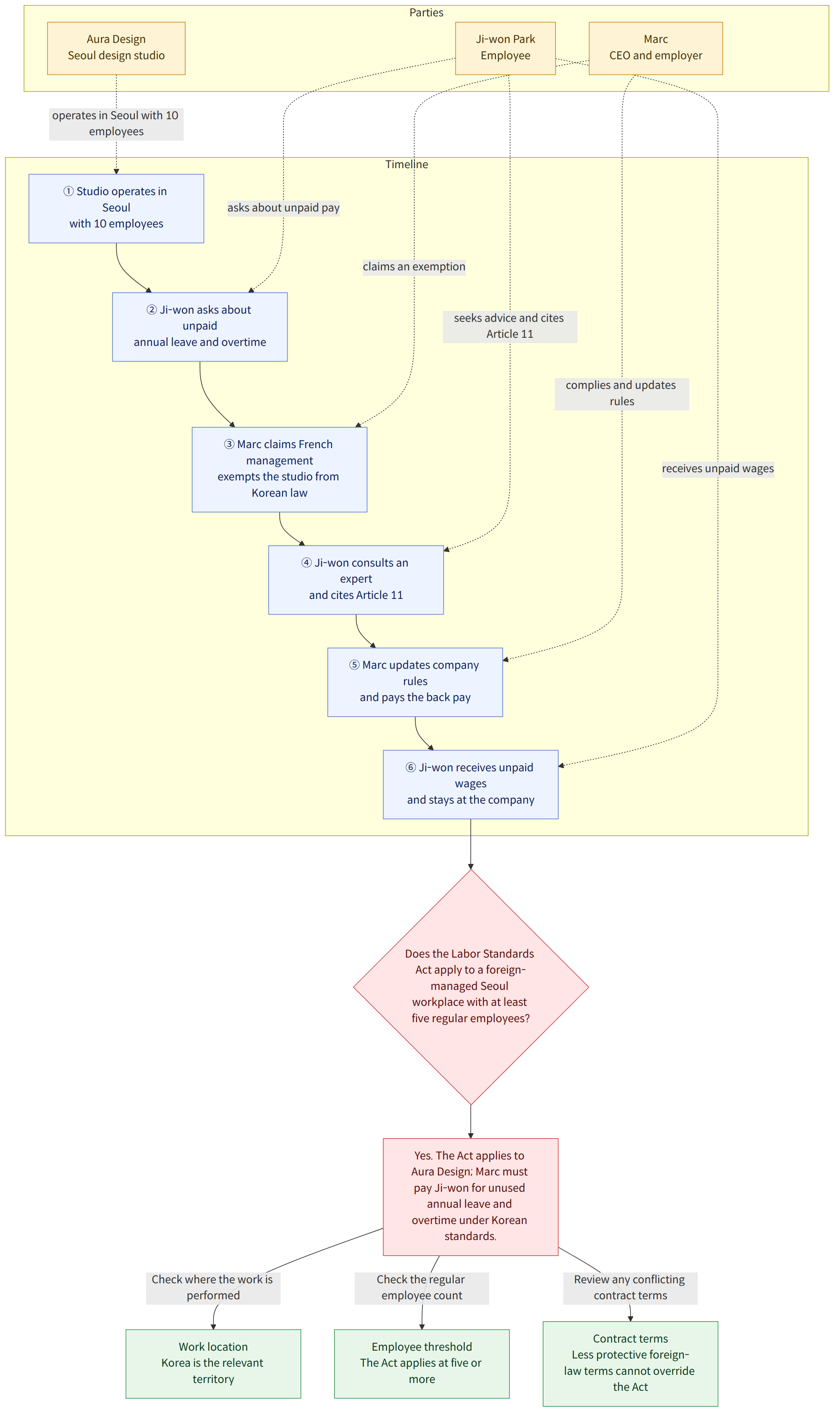
Ji-won Park had spent the last two years working at 'Aura Design,' a boutique French design studio located in the heart of Gangnam. Her CEO, Marc, was a charismatic Frenchman who prided himself on the creative and 'European' atmosphere of the office. With 10 employees, the company was small but highly successful.
However, the creative vibe soured when Ji-won asked about her unused annual leave allowance and overtime pay. Marc simply shrugged and said, "Ji-won, this is a French-run studio. My management style and our company policies are based on European standards. Since I am a foreign national, we don't need to follow those rigid Korean labor laws to the letter."
Ji-won was stunned. She was working in Seoul, paying taxes in Korea, and was hired locally. Could her boss's nationality really act as a shield against the legal protections she thought she had?
2. The Core Legal Question
The central issue raised by this case is: "Does the Korean Labor Standards Act (LSA) apply to a business operating within Korea if it is owned or managed by a foreign national and employs at least 5 regular workers?"
3. What Korean Law Says
The Korean Labor Standards Act is very clear about its scope of application.
Labor Standards Act, Article 11 (Scope of Application)(1) This Act shall apply to all businesses or workplaces in which five or more employees are ordinarily employed.
There is no exception mentioned for the nationality of the employer or the source of the company's capital. This is based on the legal principle of 'Territoriality' (lex loci solutionis). This principle dictates that laws apply to all persons and actions within a country's territory.
- Applicability: The LSA applies to government offices, public enterprises, religious organizations, and most importantly, foreign-managed companies operating in Korea.
- Threshold: As long as the business employs 5 or more regular workers, the core protections of the Act—such as severance pay, overtime limits, and dismissal restrictions—are mandatory.
4. How Korean Courts Approach This
Korean courts have long held that any business activity occurring on Korean soil is subject to the jurisdiction of Korean labor laws. The judiciary views the LSA as a 'mandatory provision' (public policy law) designed to protect the minimum living standards of workers.
Even if an employer and an employee sign a contract stating they will follow the laws of a foreign country, such an agreement is void if it provides less protection than the Korean LSA. The courts consistently rule that the nationality of the owner does not grant 'legal immunity' from local employment standards.
5. Applying the Law to Ji-won's Case
Applying these principles to Ji-won and Marc, the conclusion is straightforward:
First, 'Aura Design' employs 10 people, which puts it well above the 5-employee threshold required for the full application of the LSA.
Second, Marc's claim that his 'European management style' or his French nationality exempts him from Korean law is legally invalid. Because the business is operating in Seoul, it must adhere to the LSA regardless of the owner’s origin.
Therefore, Marc is legally obligated to pay Ji-won for her unused annual leave and overtime work according to Korean standards. Refusing to do so constitutes a violation of the law and can lead to penalties or a labor office investigation.
6. Conclusion: What Happened, and What Should You Do?
After consulting with a legal expert, Ji-won formally requested her back pay, citing Article 11 of the LSA. Marc, realizing that 'cultural differences' do not supersede the law, eventually complied and updated the company's rules to meet Korean standards. Ji-won received her unpaid wages and remained at the company under a much fairer environment.
If you are working for a foreign boss or a multinational startup in Korea, keep these tips in mind:
- Location is King: The law of the land where the work is performed (Korea) is what matters most, not the passport of the CEO.
- Count the Heads: Verify if your workplace has 5 or more regular employees, as this is the trigger for most legal protections.
- Contracts Can't Override Law: A contract that says "we don't follow Korean labor law" is generally unenforceable. Your rights are protected by the state, not just your employer's whim.
Your labor in Korea is protected by Korean law. Don't let a 'global' brand name trick you into waiving your local rights.
This column is for informational purposes only and does not constitute formal legal advice. For specific cases, always consult with a qualified legal professional.