
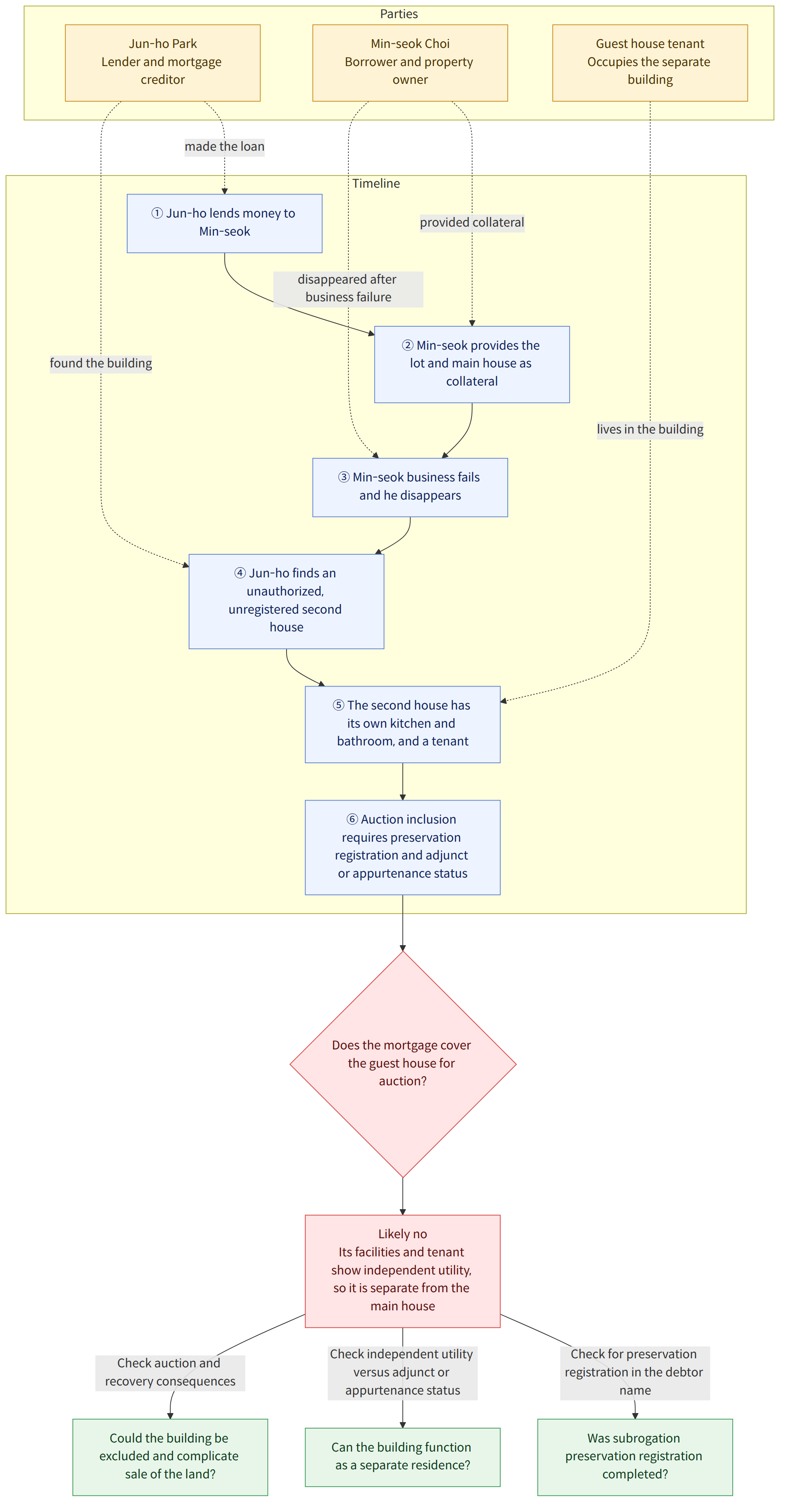
The Unexpected Headache: The Guest House at the Back
Jun-ho Park, who lent a significant portion of his retirement savings to an acquaintance, recently found himself in a legal quagmire. The borrower, Min-seok Choi, disappeared after his business failed. To recover his money, Jun-ho prepared to file for an auction of the suburban lot and the single-family home Min-seok had provided as collateral.
However, when Jun-ho visited the property, he was shocked to find a second, smaller brick house in the corner of the yard. This building was not on the real estate registry and was technically an unauthorized structure. To make matters worse, a tenant was living there. The building was nearly as large as the main house and fully equipped with its own kitchen and bathroom.
Jun-ho was furious. "To get my money back, I need to sell everything on this land. Since this 'ghost house' isn't even registered, can't I just include it in the auction? It’s on the land I have a mortgage on!"
The Legal Question: Including Unregistered Buildings in Auctions
The core of the issue is whether unregistered, unauthorized buildings (often called 'non-listed buildings' in legal terms) can be included in the foreclosure sale of the registered land and the main house. The answer depends on whether the law views this structure as an extension of the main building or as a completely separate piece of real estate.
What Korean Law Says: The Reach of a Mortgage
The Korean Civil Code defines the scope of a mortgage's effect. This is the starting point for Jun-ho's dilemma.
Civil Code Article 358 (Scope of Effect of Mortgage)The effect of a mortgage shall extend to all things attached (adjuncts) to and appurtenances of the mortgaged immovable property; provided, however, that this shall not apply where otherwise provided by law or agreed upon in the act of creation.
To understand this, we must distinguish between two types of additions:
- Adjuncts (Buhapmul): Items that are physically integrated into the main building and cannot be separated without significant damage or loss of value (e.g., a room added onto the side).
- Appurtenances (Jongmul): Independent items that serve the economic utility of the main property (e.g., a storage shed or an old outdoor toilet for the main house).
According to Supreme Court precedents, an unregistered building can only be included in an auction if:
- The creditor performs a subrogation preservation registration (registering it in the debtor's name on their behalf) to officially include it in the auction.
- The building is clearly an adjunct or an appurtenance of the mortgaged property.
How Korean Courts Approach This: The Independence Test
Courts do not decide based on the mere absence of a registration. Instead, they apply a strict 'independent utility' test. If a structure can function as a stand-alone building for economic purposes, it is treated as a separate property, not covered by the mortgage on the main house.
Past rulings have included items like coal sheds or shared toilets in auctions because they were deemed 'appurtenances' that exist only to serve the main house. Even small unregistered additions like a tiny kitchen or a small outhouse have been treated as 'adjuncts' that become part of the main mortgaged building.
However, in a case like Jun-ho's, where the unauthorized building has its own kitchen, bathroom, and a separate tenant, the court views it as an independent building. Because it is a separate entity from the main house, the mortgage on the main house does not automatically extend to it.
Applying the Law to Jun-ho’s Case
Let’s analyze Jun-ho's situation step-by-step:
- Structural Independence: Min-seok’s unauthorized building is fully equipped with facilities. It doesn't rely on the main house for basic living functions.
- Functional Independence: The fact that a tenant lives there independently proves that the building has its own economic value as a separate residence.
- Legal Conclusion: This structure is neither an adjunct nor an appurtenance. It is a separate building that happens to sit on the same land. Therefore, the mortgage Jun-ho holds on the main house does not cover this unauthorized guest house.
Consequently, if Jun-ho proceeds with the auction, the unauthorized building will likely be excluded from the sale. This could lead to a lower auction price because whoever buys the land will have to deal with an unauthorized building they don't own sitting on their new property.
Conclusion: What Happened, and What Should You Do?
For Jun-ho Park, the road to recovery will be bumpy. Since he cannot easily include the unauthorized building in the auction, he may face a lower recovery amount. Furthermore, the existence of a tenant in that building adds layers of complexity regarding eviction and potential legal disputes over the land use.
If you find yourself in a similar situation, keep these practical tips in mind:
- Always Conduct a Site Visit: Before lending money or setting a mortgage, physically inspect the property. If you see unregistered buildings, ensure they are either included in the mortgage agreement or require the debtor to register them.
- Verify Subrogation Possibilities: If an unregistered building exists, consult a legal expert to see if it meets the requirements for 'subrogation preservation registration.' This is the only way to legally bring a truly independent structure into the auction cycle.
- Anticipate Valuation Drops: Be aware that land with an 'excluded' building often sells for much less at auction due to the legal risks involved for the buyer (such as potential 'statutory surface rights' disputes).