20 Years of Service: Min-jun Kim’s Retirement Dilemma
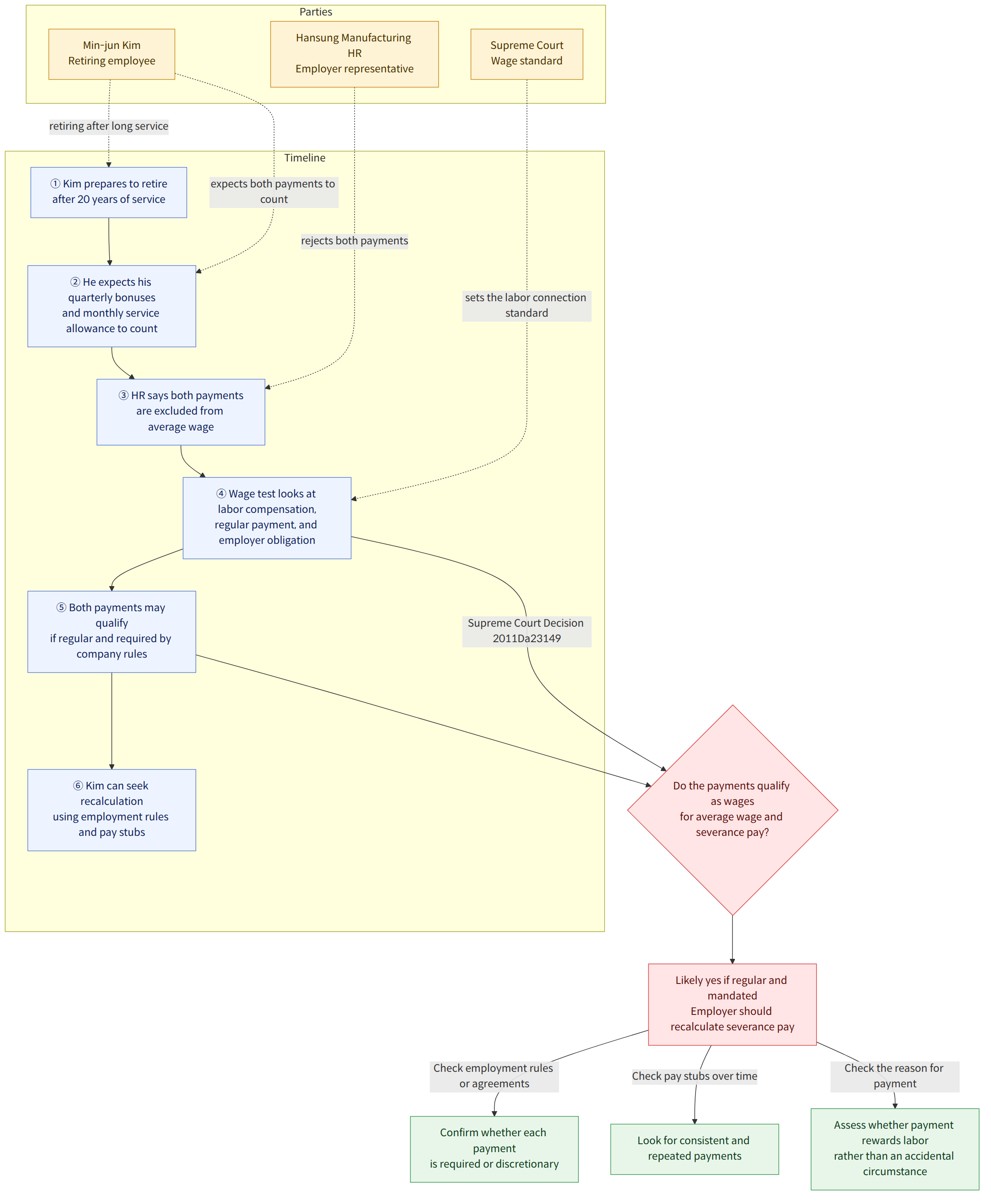
Min-jun Kim, a dedicated manager who spent 20 years at Hansung Manufacturing, was recently preparing for his retirement. Excited about a new chapter in his life, he began calculating his expected severance pay. He assumed that the 'Quarterly Performance Bonuses' he received diligently and the 'Long-term Service Allowance' paid monthly to senior employees would naturally be included in the calculation.
However, the HR department had a different take. "The performance bonus is variable based on business conditions, and the service allowance is a welfare benefit," they explained. "Neither counts toward the 'Average Wage' used for severance pay." Min-jun was stunned. Could the money he had relied on as part of his salary for years suddenly be disqualified when it mattered most?
What Determines the 'Average Wage'?
In this scenario, the core legal question is: "Does a specific payment made by an employer qualify as 'wages' that form the basis of the 'Average Wage' for severance pay?"
In South Korea, not every dollar deposited into your bank account by your employer is legally considered a 'wage.' Defining the scope of wages is critical, as it dictates the amount of not only severance pay but also suspension allowances and annual leave pay.
Criteria for Wages Under Korean Law
Korean labor law and Supreme Court precedents look past the label of a payment—whether it's called a 'bonus,' 'allowance,' or 'incentive'—and focus on its substance. For a payment to be part of the total wages used to calculate average wage, it must meet three criteria:
- Compensation for Labor: The payment must be given in exchange for the work provided.
- Continuity and Periodicity: It must be paid regularly and repeatedly over time.
- Employer Obligation: The employer must be legally obligated to pay it based on collective agreements, employment rules, or the employment contract.
"The total amount of wages, which is the basis for calculating average wages, includes all types of money and goods paid by an employer to a worker as compensation for labor, provided they are paid continuously and periodically and the employer is under an obligation to pay them regardless of their name."
The Court's View: Labor vs. Accidental Circumstances
A pivotal factor for Korean courts is the direct link between the labor and the payment. If the payment is triggered by the special or accidental circumstances of an individual worker—rather than the provision of labor itself—it is not considered a wage.
For example, a one-time celebratory gift for a personal milestone or a discretionary bonus paid only when profits exceed an unexpected threshold might not be considered 'wages,' even if mentioned in company policy. The Supreme Court (Decision 2011Da23149) emphasizes that for a payment to be a wage, its trigger must be closely or directly related to the provision of labor.
Applying the Law to Min-jun's Case
Let’s revisit Min-jun Kim’s situation.
Regarding the 'Quarterly Performance Bonus': If the employment rules specify the conditions and amounts for this bonus and it has been paid regularly every quarter, it becomes an 'obligation' of the employer rather than a discretionary gift. Thus, it likely qualifies as part of his average wage.
As for the 'Long-term Service Allowance': Since this is paid regularly to all employees who reach a certain tenure, it is viewed as compensation for the employee’s accumulated skill and continued service. Therefore, it should be included in the severance pay calculation, regardless of the company calling it a 'benefit.'
Conclusion: How to Protect Your Rights
Ultimately, the law is likely on Min-jun Kim's side. If the payments were regular and mandated by company policy, the employer must recalculate his severance pay to include them. Min-jun can now use his employment rules and past pay stubs to demand his rightful compensation.
For readers in similar situations, here are two practical tips:
- Secure Your Employment Rules: Always have a copy of your company’s employment rules (취업규칙) or collective bargaining agreements. These documents define whether a payment is an obligation or a discretion.
- Track Payment Patterns: Keep records of your pay stubs. Demonstrating that a specific bonus was paid consistently over several years is strong evidence that it is a 'periodic wage' rather than a 'one-time favor.'
This column is provided for informational purposes only and does not constitute legal advice. For specific cases, please consult with a legal professional.