
1. A Human Story
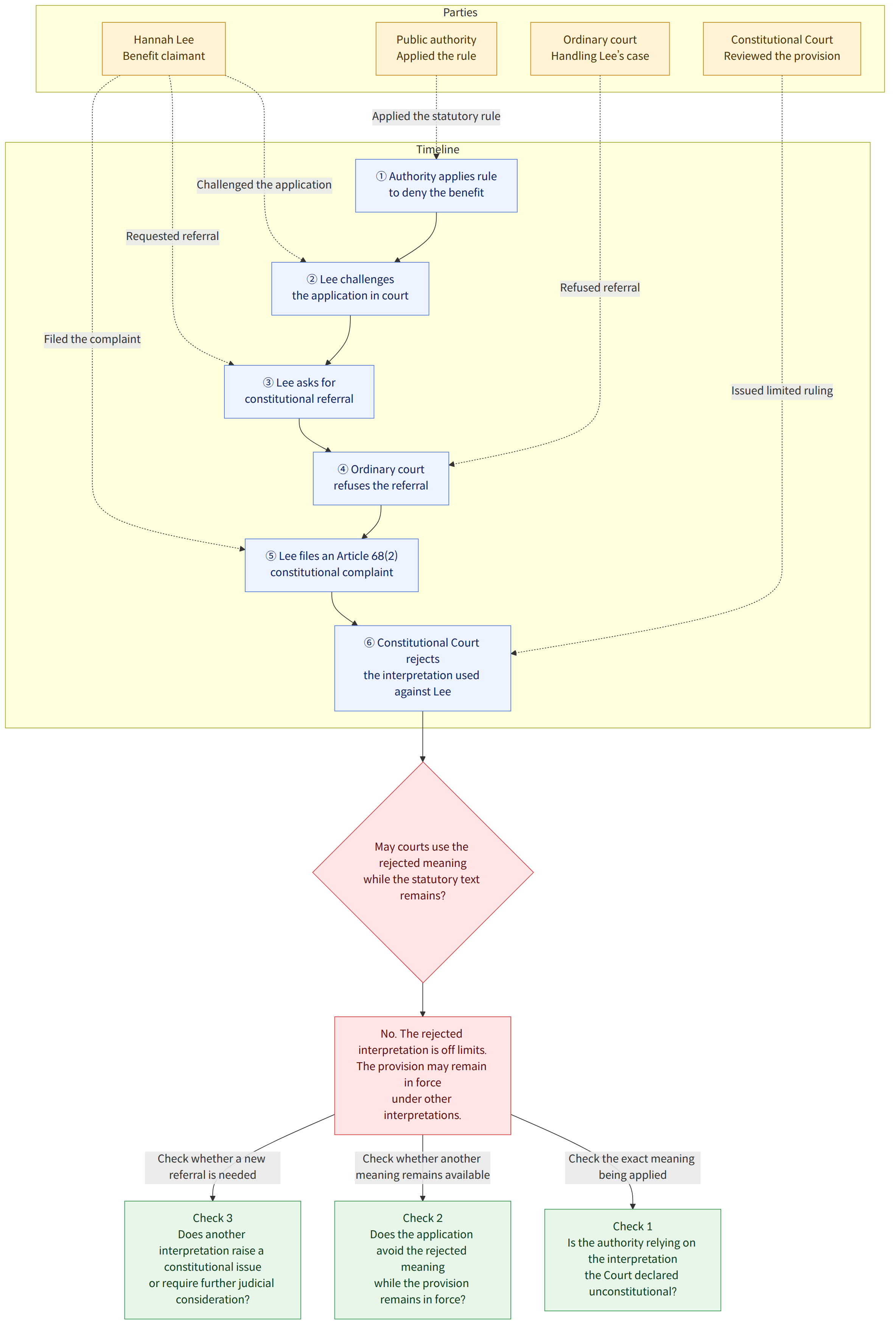
Hannah Lee had spent months trying to understand why a public authority had applied a statutory rule in a way that shut her out of a benefit. She believed the law did not require that result. In the case she brought before an ordinary court, she asked the judge to refer the relevant provision to Korea’s Constitutional Court for review. The judge refused.
That refusal did not end the matter. Under a procedure available when a court rejects a party’s request for a constitutional referral, Hannah filed a constitutional complaint under Article 68(2) of the Constitutional Court Act. The Constitutional Court then issued a limited-unconstitutionality decision: it did not strike the statutory provision from the statute book altogether, but held that the provision was unconstitutional when understood in the particular way that had been used against her. The practical question was now urgent: could the ordinary court still rely on that interpretation because the provision itself remained in force?
2. The Legal Question
When the Constitutional Court finds a statutory provision unconstitutional only under a specified interpretation, what part of its decision binds the courts and other authorities? In particular, must they stop applying the rejected interpretation even though the statutory text remains in place?
3. What Korean Law Says
A constitutional complaint under Article 68(2) gives a party a route to challenge a law’s constitutionality after the ordinary court handling the party’s case refuses to refer the constitutional question to the Constitutional Court. The complaint concerns the law, not simply whether the party will win the underlying case.
A limited-unconstitutionality decision draws a distinction between the wording of a provision and a particular meaning assigned to it. The provision may formally remain in force, while one interpretation of it is declared unconstitutional.
The key rule: The interpretation identified as unconstitutional loses legal effect. Courts and other bodies applying the law must not use that interpretation, and the decision has binding force as to that unconstitutional meaning.
This has two important consequences:
- The whole provision is not necessarily erased. The statute may continue to apply in other ways, provided those applications do not rely on the interpretation the Constitutional Court rejected.
- The constitutional meaning is not binding in the same way. A reading that was treated as constitutional is not, merely for that reason, binding on ordinary courts. A court may ask the Constitutional Court to review the issue again.
That distinction matters because a limited decision is not a general instruction to resolve every future dispute in one particular way. It removes the unconstitutional route; it does not necessarily settle all remaining questions about the law or the facts of a case.
4. How Korean Courts Approach This
Korean courts must respect the binding force of the Constitutional Court’s ruling within its proper scope. For a limited-unconstitutionality decision, that means identifying the meaning the Constitutional Court actually rejected and ensuring that the challenged rule is not applied on that basis. Keeping the statutory wording on the books does not permit a court or public authority to revive the forbidden interpretation through a different label.
At the same time, courts distinguish that binding prohibition from the Court’s treatment of other possible meanings. A limited ruling does not automatically make every interpretation left standing constitutionally settled for all time. If a court considers that another interpretation raises a constitutional problem, it may seek a new referral rather than treating the earlier decision as a final answer to every question.
The course of later review is not mechanically predetermined. In a later challenge involving a provision previously considered in a limited decision, the Constitutional Court may issue another limited decision or dismiss the complaint, depending on the issue before it. The earlier ruling therefore controls the interpretation it condemned, but it does not guarantee a particular result in every subsequent case.
A useful distinction: The rejected interpretation is off limits. Other interpretations and the ultimate outcome of the underlying dispute may still require judicial consideration.
5. Applying the Law to Hannah’s Case
Hannah’s position can be assessed in a series of steps.
- Identify the exact interpretation at issue. The important question is not simply whether the statutory provision remains in force. It is whether the authority or court is relying on the particular meaning the Constitutional Court declared unconstitutional.
- Apply the binding prohibition. If the ordinary court’s earlier approach depended on that meaning, the court cannot continue to use it after the limited-unconstitutionality decision. The fact that the statutory words have not been deleted does not change that result.
- Reconsider the case under the remaining law. The ordinary court must deal with Hannah’s dispute without relying on the forbidden interpretation. It may need to consider another permissible reading of the provision, other legal requirements, and the evidence in her case.
- Separate constitutional relief from winning the underlying case. The decision removes one unconstitutional basis for deciding against Hannah; it does not itself establish that she qualifies for the benefit or that every other issue must be resolved in her favor.
- Allow for further constitutional questions. If the court believes a different interpretation presents a constitutional issue, the earlier decision does not necessarily prevent it from seeking another review.
So Hannah has gained something concrete: the interpretation that blocked her claim cannot lawfully be used as the reason to reject it. But the court still has to decide whether she succeeds under the law as properly applied and on the facts of her case.
6. Conclusion: What Happened, and What Should You Do?
The ordinary court in Hannah’s case must reconsider the dispute without applying the interpretation the Constitutional Court found unconstitutional. The statutory provision may remain in force, but the particular meaning that made it unconstitutional has lost legal effect. Hannah has not automatically won her claim; she has secured a binding ruling that removes one legally impermissible basis for deciding it.
If you face a similar situation:
- Get the decision’s precise scope in writing. Identify the interpretation the Constitutional Court rejected, rather than relying on a general description of the ruling.
- Show how that interpretation affects your case. Point to the authority’s reasoning or the court’s decision and explain why it depends on the meaning that is now barred.
- Keep pursuing the underlying case. A constitutional ruling may remove a legal obstacle, but you may still need to prove the facts and satisfy other legal requirements.