
A Human Story: The Cost of Loyalty
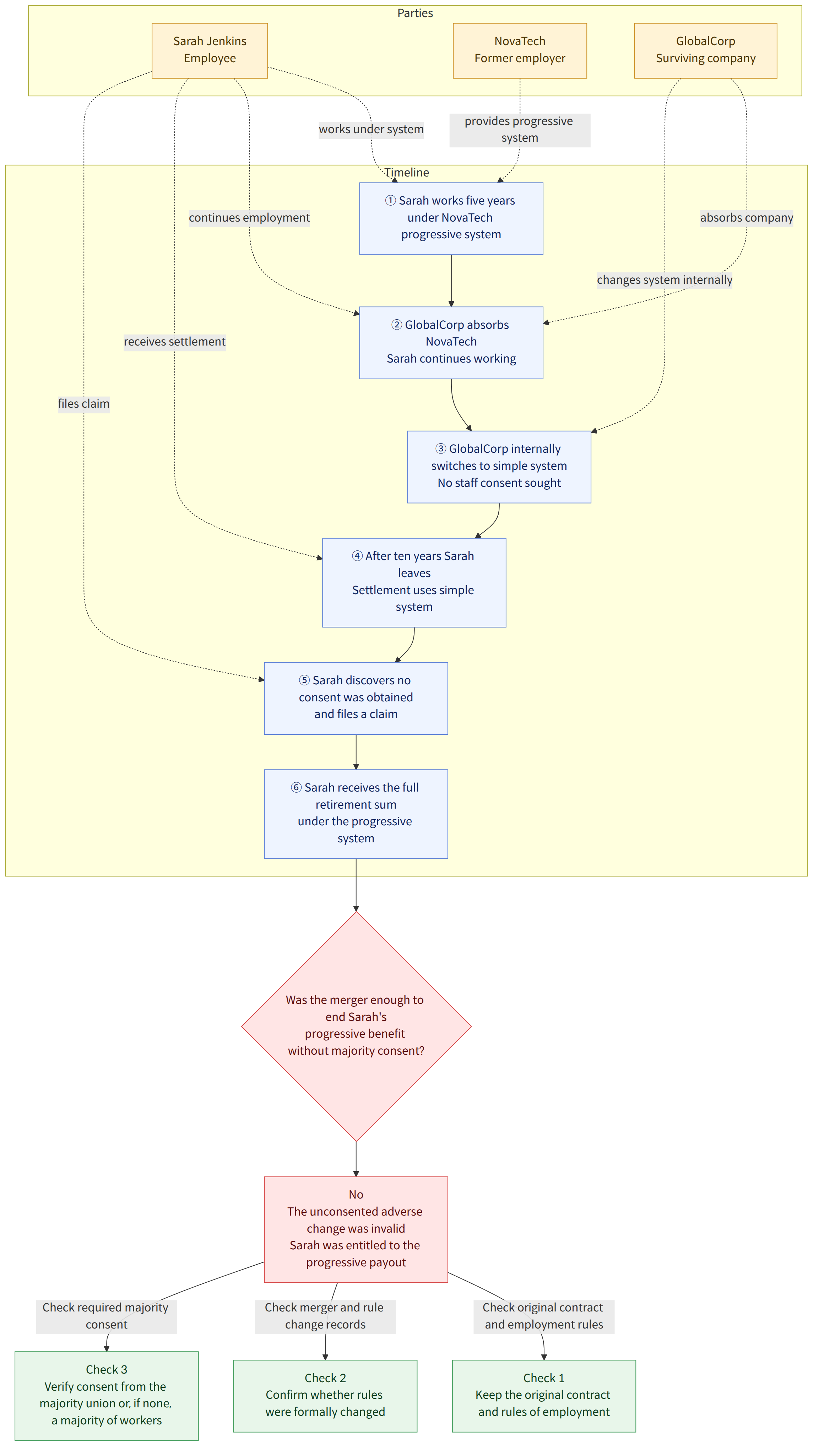
Sarah Jenkins had dedicated a decade of her life to NovaTech, a burgeoning electronics firm. For the first five years, she climbed the ladder, confident in the company's generous "Progressive Retirement System." Under this scheme, the longer an employee stayed, the higher the multiplier for their final payout—a reward for loyalty that Sarah counted on for her future retirement.
Five years ago, NovaTech was absorbed by a larger conglomerate, GlobalCorp. The merger was presented as a strategic move for growth, and Sarah remained in her role, continuing her work seamlessly. However, GlobalCorp operated on a "Simple Retirement System," where the payout is a flat rate of one month's average salary for every year of service, regardless of how long the tenure extends.
Recently, after ten total years of service, Sarah decided to move on to a new venture. When the HR department handed her the final settlement check, Sarah was shocked. The calculation was based on the Simple System. The generous progressive multipliers she had earned during her time at NovaTech had vanished, resulting in a significantly lower sum than she had anticipated. Sarah felt betrayed: had her years of loyalty been erased by a corporate merger?
The Legal Question
Does a company merger allow the surviving company to unilaterally change an employee's retirement benefit scheme from a progressive system (where payouts increase with tenure) to a simple system (a flat rate), and can the employee demand the original, more favorable terms?
What Korean Law Says
In Korea, the Employee Retirement Benefit Security Act establishes the baseline for retirement payments. While it sets a minimum standard, it allows companies to define the specifics in their own employment rules or collective agreements.
"The employer shall establish one or more retirement benefit systems... if the employer wishes to establish a retirement pay system, the employer shall establish a system that can pay the retiring employee retirement pay of 30 days or more of average wages for each year of continuous service."
There are two primary types of systems mentioned in this context:
- Simple System (단수제): A standard calculation where 1 year of service = 1 month of average salary.
- Progressive System (누진제): A more generous system where the multiplier increases as the years of service increase (e.g., 1.5x or 2x after a certain threshold).
How Korean Courts Approach This
Korean courts prioritize the principle of comprehensive succession. When a company is absorbed via merger, the surviving entity does not start a new relationship with the employees; rather, it inherits the existing employment contracts and their associated rights and obligations.
Generally, the courts rule that:
- If there is no new agreement or change in the rules of employment, the terms of the defunct company are automatically carried over.
- Any change to employment rules that is disadvantageous to the employee (an "adverse change") is invalid unless it follows strict legal procedures for consent.
Applying the Law to the Case
To determine if Sarah is entitled to the progressive payout, we must look at what happened during the merger of NovaTech and GlobalCorp:
Scenario A: No formal change in rules If GlobalCorp simply absorbed NovaTech and never formally changed the employment rules or signed a new collective agreement regarding retirement pay, the law is clear. The employment relationship was comprehensively succeeded. Sarah's right to the progressive system stayed with her. In this case, GlobalCorp is legally obligated to pay her based on NovaTech's progressive system.
Scenario B: The rules were changed, but without consent If GlobalCorp updated its "Rules of Employment" to switch everyone to the Simple System, we must check the Labor Standards Act. Specifically, for a change to be valid when it harms the employee:
- The company must obtain the consent of a labor union representing the majority of employees, or
- If no such union exists, the consent of a majority of the workers.
If GlobalCorp implemented the Simple System without this majority consent, the change is null and void. Sarah would still be entitled to the progressive payout.
Conclusion: What Happened, and What Should You Do?
In Sarah's case, after reviewing the merger documents, she discovered that GlobalCorp had switched the system internally without ever seeking a vote or consent from the absorbed NovaTech staff. Consequently, the change was legally invalid. Sarah successfully filed a claim for the difference in payment and received her full retirement sum based on the progressive system.
Practical Advice for Employees:
- Archive Your Documents: Always keep a copy of your original employment contract and the "Rules of Employment" (취업규칙) from your original company before a merger occurs.
- Verify Consent: If your benefits are reduced after a merger, ask HR for proof of the "majority consent」 process used to authorize the change. If no such proof exists, the change may be illegal.
- Seek Specialized Counsel: Retirement pay disputes involving mergers can be complex. If you suspect a loss of benefits, consult a labor attorney to file a "Confirmation of Invalidity of Employment Rules" and a claim for the unpaid balance.