
A Family Favor and a Fancy Title
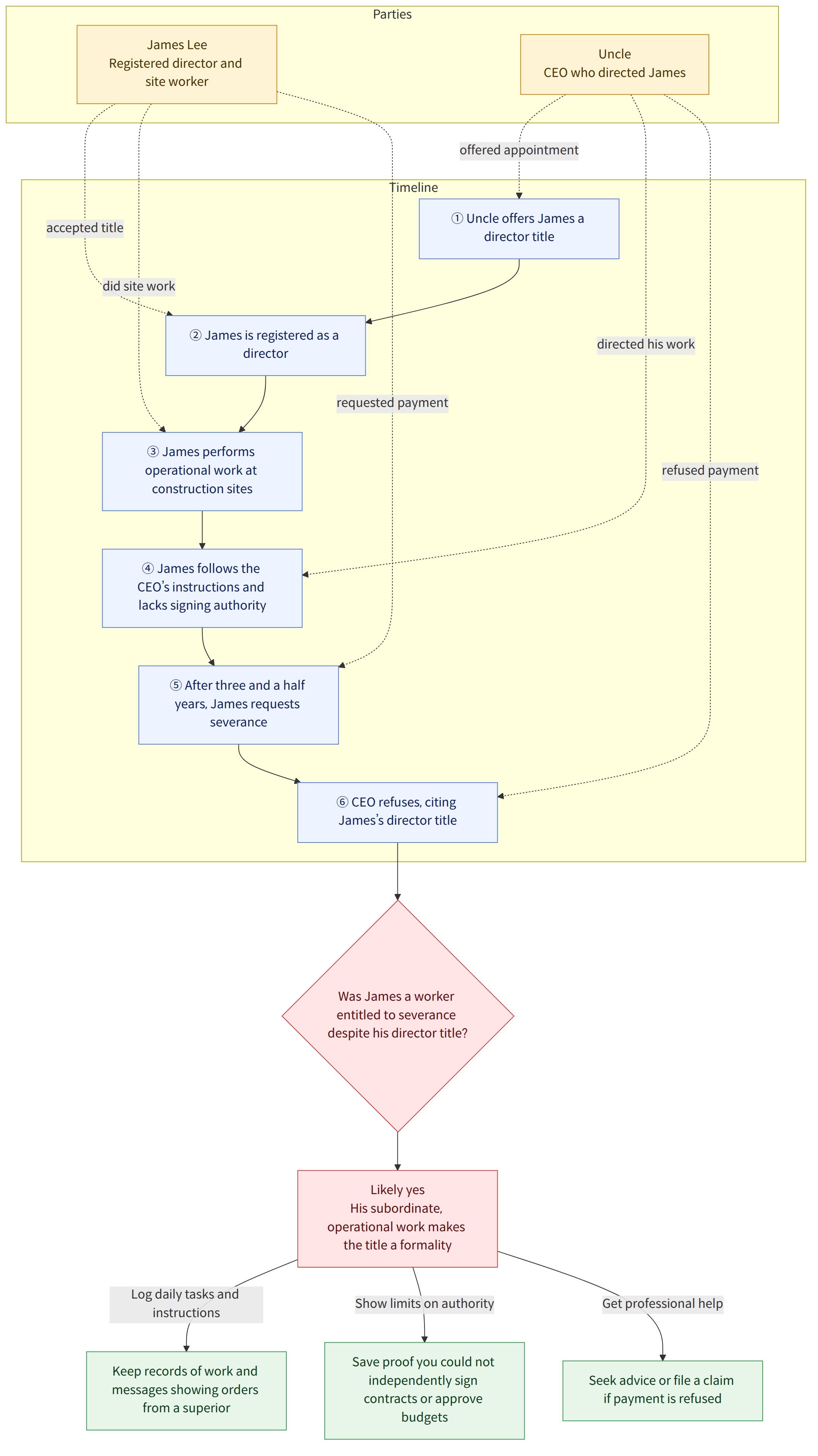
James Lee had always trusted his uncle, the CEO of a mid-sized construction firm. Four years ago, when the company was expanding, his uncle approached him with an offer: "James, I need someone I can trust in a leadership role. I'll appoint you as a Director of the company." Flattered and eager to help the family business, James accepted. He was officially registered as a director on the corporate registry, and his business card bore the prestigious title.
However, the reality of James's daily life was far from the boardroom. While his title suggested executive power, his boots were perpetually covered in mud. James spent his days at construction sites, supervising laborers, managing raw materials, and often picking up a shovel to work alongside the crew. He never attended board meetings, had no authority to sign off on company expenditures, and reported every single decision to his uncle.
After three and a half years of grueling work, James decided to move on. When he requested his severance pay, his uncle's response was cold and abrupt: "You were a Director, James. Directors are owners and managers, not employees. We don't pay severance to directors."
The Legal Question
Can an individual who is formally registered as a corporate director still be recognized as a "worker" under Korean law and claim statutory severance pay if they performed tasks under the direction and supervision of the employer?
What Korean Law Says
Under the Labor Standards Act and the Employee Retirement Benefit Security Act, severance pay is a fundamental right reserved for "workers."
Definition of a Worker: A person who provides labor to a business or workplace for the purpose of earning wages, regardless of the type of occupation.
Generally, a director of a joint-stock company is considered an agent of the corporation, entrusted with the management of the business. Because they are supposed to exercise their own judgment and authority, they are typically seen as employers (or representatives of the employer) rather than employees. Therefore, unless there is a specific internal company rule or a collective agreement granting them severance, they are not entitled to it by law.
How Korean Courts Approach This
Korean courts recognize that titles can be deceptive. The judiciary employs the principle of "Substance over Form." This means the court does not look at what is written on the business card or the corporate registry, but rather at the actual nature of the working relationship.
If a person is a director in name only—a "paper director"—the court examines several factors to determine if they were actually a worker:
- Whether they were subject to specific instructions and supervision.
- Whether they had actual authority to make management decisions or sign contracts.
- Whether their daily tasks were operational (labor) rather than managerial.
- Whether they were dependent on the employer for their livelihood (receiving a fixed wage).
Applying the Law to the Case
Let's analyze James Lee's situation through the lens of the law.
First, while James was registered as a Director, he lacked any actual executive authority. He never exercised decision-making power or signing authority, which are the hallmarks of a true corporate director.
Second, his actual duties were purely operational. Supervising laborers and working on-site are tasks typical of a site manager or a foreman—roles that are clearly within the realm of "providing labor."
Third, James operated under a strict hierarchy of subordination. He did not set his own goals or manage the company's direction; he followed the orders of the CEO (his uncle).
Because James functioned as a subordinate employee in every practical sense, the law views his "Director" title as a mere formality. His compensation was not a director's fee for management, but a wage for labor.
Conclusion: What Happened, and What Should You Do?
In the end, James Lee would likely succeed in his claim. Because his actual work relationship was one of subordination and labor, he is legally a "worker." The court would rule that the company must pay him severance for the three and a half years he served, regardless of his title on the registry.
If you find yourself in a similar situation—where your title is "Director" or "Executive" but you have no real power and are treated as an employee—keep these tips in mind:
- Document Your Daily Routine: Keep a log of your tasks, emails, and messages that show you were taking orders from a superior rather than giving them.
- Save Evidence of Lack of Authority: Collect proof that you were not allowed to sign contracts or approve budgets independently.
- Seek Professional Help: If the company refuses payment, you can file a claim with the local Ministry of Employment and Labor (labor inspector) or initiate a civil lawsuit for severance pay.