Min-jun Kim’s Quiet Winter Office
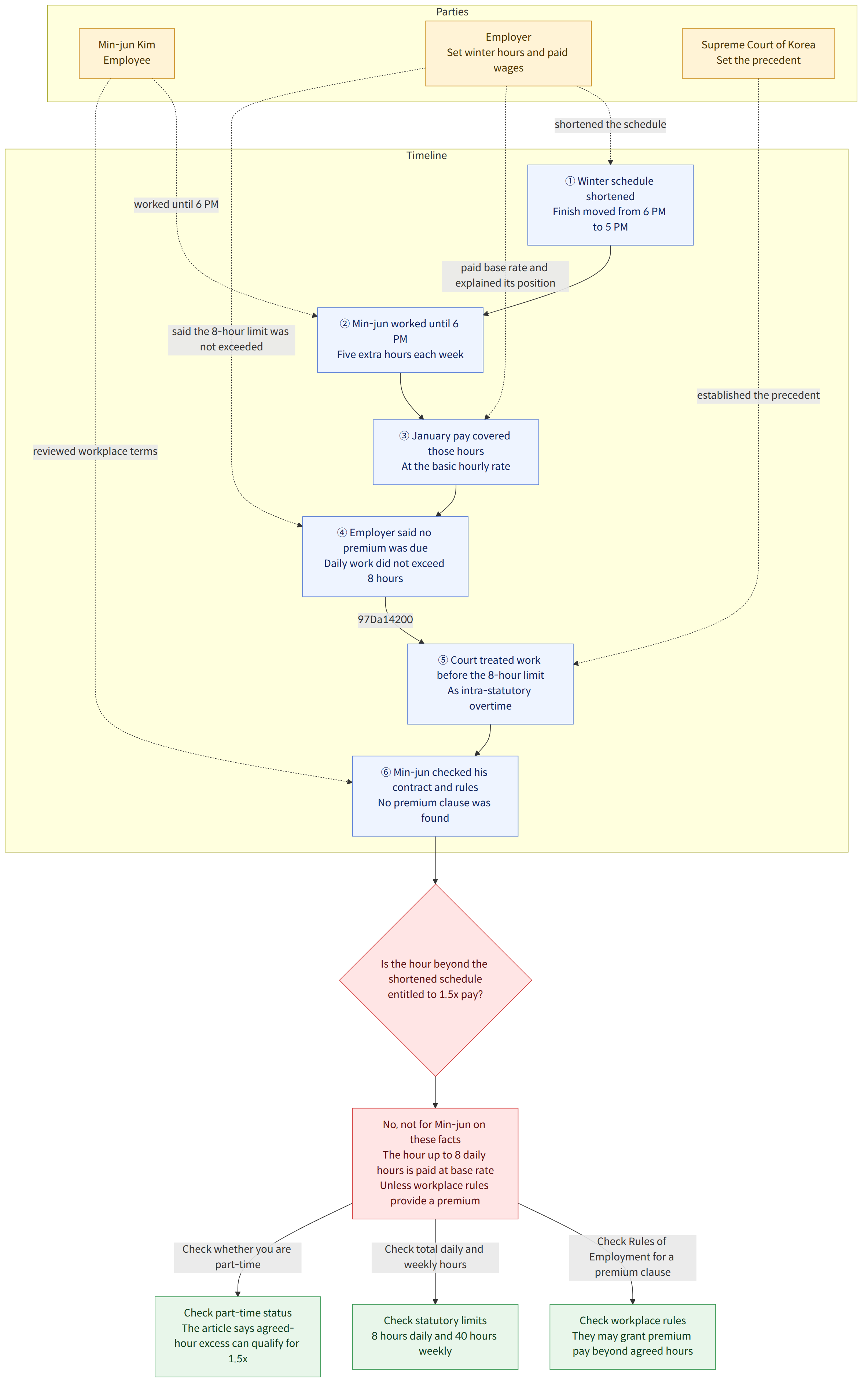
Min-jun Kim, a senior logistics coordinator, initially welcomed his company’s “Winter Energy Saving Policy.” From December to February, the standard 6 PM finish was moved up to 5 PM. On paper, it looked like a gift of an extra hour of personal time. In reality, the logistics of global shipping didn’t care about the seasons.
With the same workload and a shorter window to complete it, Min-jun found himself staying until his usual 6 PM every single day. When he received his January paycheck, he was shocked. The five hours he worked beyond the “shortened schedule” each week were paid at his basic hourly rate, not the 150% overtime rate he expected. The HR department's response was cold: “Since you didn't exceed 8 hours a day, it's not overtime pay territory.”
The Legal Question: Does Shortened Schedule Mean Faster Overtime?
Does work performed after a contractually shortened finish time, but before the 8-hour statutory limit, qualify for the 50% premium pay? This is a common point of friction in Korean labor law known as 'Intra-statutory Overtime' (법내 연장근로).
What Korean Law Says
The Korean Labor Standards Act (LSA) sets clear boundaries for what constitutes the "legal limit" of work.
Labor Standards Act Article 50 (Work Hours)1. Working hours per week shall not exceed 40 hours, excluding hours of rest.2. Working hours per day shall not exceed 8 hours, excluding hours of rest.
Labor Standards Act Article 56 (Extended, Night and Holiday Work)An employer shall additionally pay 50 percent or more of the ordinary wages for extended work.
Under these provisions, "Extended Work" (Overtime) is generally interpreted as work that exceeds the statutory limits of 8 hours a day or 40 hours a week.
How Korean Courts Approach This
The Supreme Court of Korea has established a clear precedent regarding work that falls between the "agreed hours" and the "legal hours."
- Statutory vs. Contractual Hours: If a company shortens the working day to 7 hours, that becomes the new "contractual" working hour. However, the "statutory" limit remains 8 hours.
- The Supreme Court Precedent (97Da14200): The Court ruled that even if work is performed beyond the shortened 7-hour mark, if it does not exceed the 8-hour statutory daily limit, it is considered 'intra-statutory overtime.'
- The Premium Rule: For intra-statutory overtime, the employer is only required to pay the standard 100% wage for that hour. The 50% premium mandated by Article 56 only kicks in once the 8th hour is passed, unless the company's own rules state otherwise.
Applying the Law to Min-jun's Case
Let’s look at Min-jun’s situation through this judicial lens. His company officially shortened the day to 7 hours (ending at 5 PM). When Min-jun worked until 6 PM, he was working exactly 8 hours that day.
Because his total daily hours did not exceed the 8-hour statutory threshold, his employer is not legally obligated to pay him the 1.5x premium. The 5 PM to 6 PM window is considered "intra-statutory." While the company must pay him for that hour (1.0x), the extra 0.5x premium is a matter of company policy, not a legal requirement under the Labor Standards Act.
Conclusion: What Happened, and What Should You Do?
Min-jun reviewed his employment contract and the company's internal "Rules of Employment." Unfortunately, there was no clause stating that "any work exceeding shortened hours shall be paid at a premium rate." Consequently, his claim for the 1.5x pay was legally groundless, though he did ensure he was at least paid his base rate for every extra minute worked.
If you find yourself in a similar "winter shortening" or "flexible work" scenario, here are two practical tips:
- Check the 'Rules of Employment' (취업규칙): Some progressive companies explicitly state that any work performed beyond the agreed schedule—even if it's within 8 hours—will be paid at 1.5x. If this is written in your rules, it becomes a binding contractual right.
- Distinguish 'Part-time' status: If you are a part-time worker (short-term/contract) whose agreed hours are less than the standard full-timer at your office, the "Act on the Protection of Fixed-term and Part-time Employees" does require 1.5x pay for any hours exceeding your agreed schedule, even if you are under the 8-hour mark. This is a special protection for part-timers that full-time employees like Min-jun do not have.
Understanding the difference between "contractual hours" and "statutory hours" is essential for managing your expectations—and your paycheck—during the winter season.
Disclaimer: This column provides general legal information and is not a substitute for professional legal advice. Outcomes may vary based on specific contractual terms and facts.