
1. Ji-won Lee’s Line in the Sand
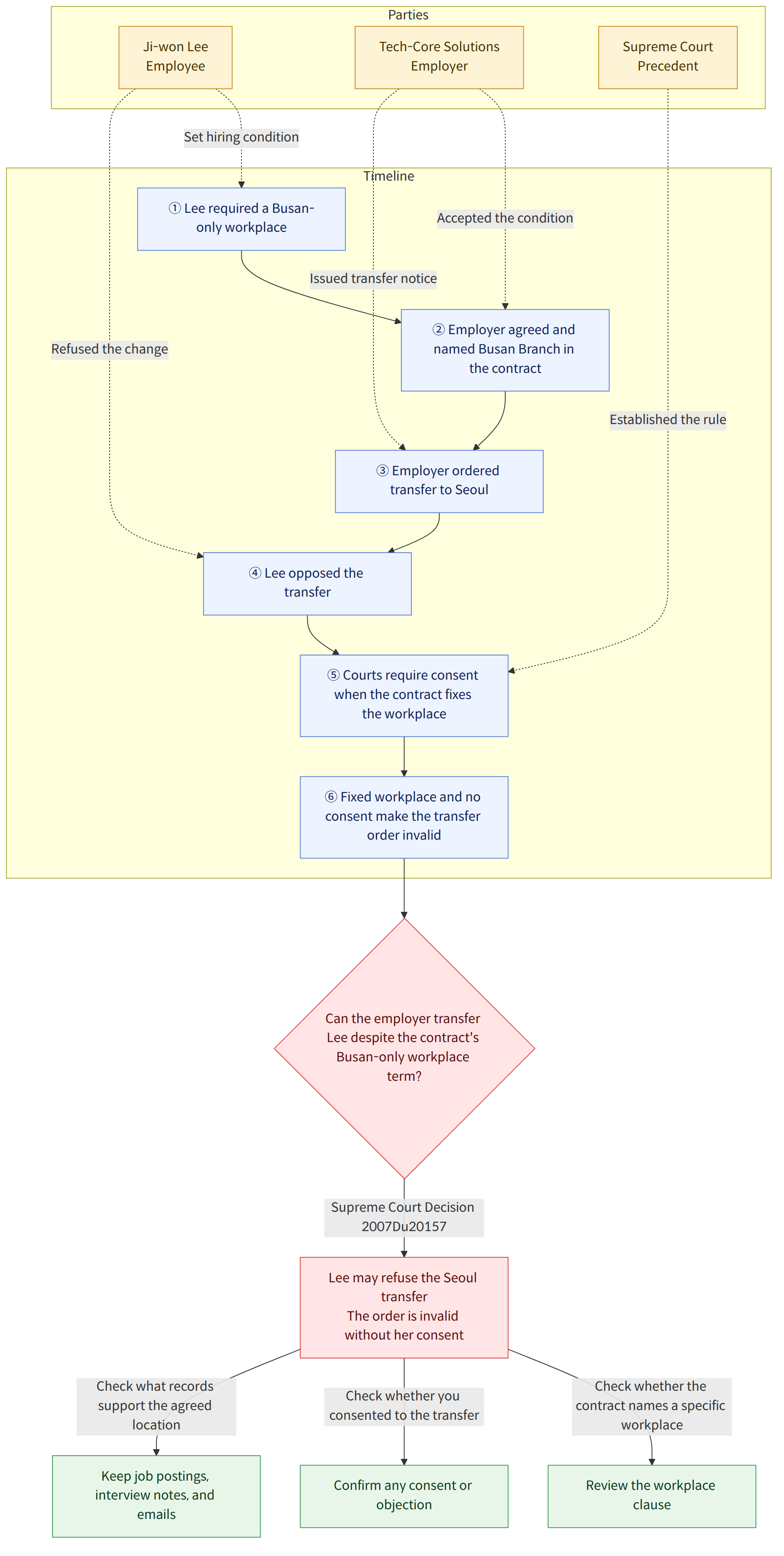
Three years ago, Ji-won Lee accepted a job at 'Tech-Core Solutions' under one non-negotiable condition. Because she needed to care for her aging parents, she insisted on working exclusively at the Busan branch. The company agreed, and her employment contract explicitly stated her workplace as the "Busan Branch."
However, the winds changed recently. Citing management restructuring and efficiency, Tech-Core announced a major personnel shake-up. Ji-won received a formal notice: she was to report to the Seoul headquarters starting next month. When she protested, citing her family situation and the original agreement, the HR manager was dismissive. "Personnel management is a management prerogative," they claimed. "Refusing a transfer is grounds for disciplinary action."
Ji-won found herself at a crossroads. Does she have to sacrifice her family life in Busan, or does her contract actually mean something?
2. The Legal Question
This case boils down to a fundamental question of Korean labor law: Does an employer's right to manage personnel override a specific workplace limitation in an employment contract?
3. What Korean Law Says
Under the Korean Labor Standards Act, employers are generally granted broad discretion regarding "personnel management rights" (인사권). This includes the right to transfer, relocate, or reassign employees to maintain business competitiveness.
General Principles of Personnel Transfers1. Employers have significant discretion in transfers within the scope of business necessity.2. Such transfers are valid unless they violate the Labor Standards Act or constitute an "abuse of rights" (e.g., when the employee's personal hardship significantly outweighs the business need).
However, there is a critical exception to this broad power. If the nature of the work or the workplace location is specifically limited or fixed within the employment contract, the legal landscape shifts entirely.
4. How Korean Courts Approach This
Korean courts, including the Supreme Court, have established a clear precedent for situations like Ji-won’s. While they acknowledge the employer's general authority, they set a firm boundary when it comes to specific contractual agreements.
According to Supreme Court Decision 2007Du20157:
"In cases where the nature of work or the place of work is specifically limited in the employment contract, the employer must, in principle, obtain the employee's consent to transfer or reassign the employee to a different type of work or a different location."
In short, if you and your employer signed a deal saying you work only in Busan, the employer cannot unilaterally tear up that page of the contract just because it’s convenient for them.
5. Applying the Law to Ji-won’s Case
When we apply these principles to Ji-won Lee, the legal outcome is in her favor for several reasons:
- Contractual Specificity: Her contract didn't just say "Workplace: To be determined." It explicitly named the Busan Branch. This constitutes a "special limitation" on the workplace.
- Lack of Consent: Ji-won did not agree to the change. In fact, she explicitly opposed it based on her initial hiring conditions.
- Invalidity of Order: Since the workplace was fixed by contract, Tech-Core’s unilateral order to move her to Seoul is a breach of contract. Without her consent, the transfer order is legally void, regardless of the company's internal restructuring needs.
6. Conclusion: What Happened, and What Should You Do?
For Ji-won Lee, the law serves as a powerful protector. She has the right to refuse the Seoul transfer. If the company attempts to fire or discipline her for refusing, she can file for a remedy through the Labor Relations Commission or seek an injunction in court. The court would likely rule that the transfer order was invalid.
If you find yourself facing an unwanted transfer, here are two practical tips:
- Audit Your Contract: Check if your contract uses broad language like "The workplace may change according to company needs" or specific language like "Assigned to the Gwangju Office." Specificity is your best defense.
- Document the 'Why': If you were hired specifically for a certain role or location, keep copies of the job posting, your interview notes, or any emails that confirm this was a condition of your employment.
In the realm of Korean labor law, your contract isn't just a formality—it is a binding promise that even the most powerful CEO cannot easily break.