1. The Disappearing Vacation: Mirae Kim’s Rude Awakening
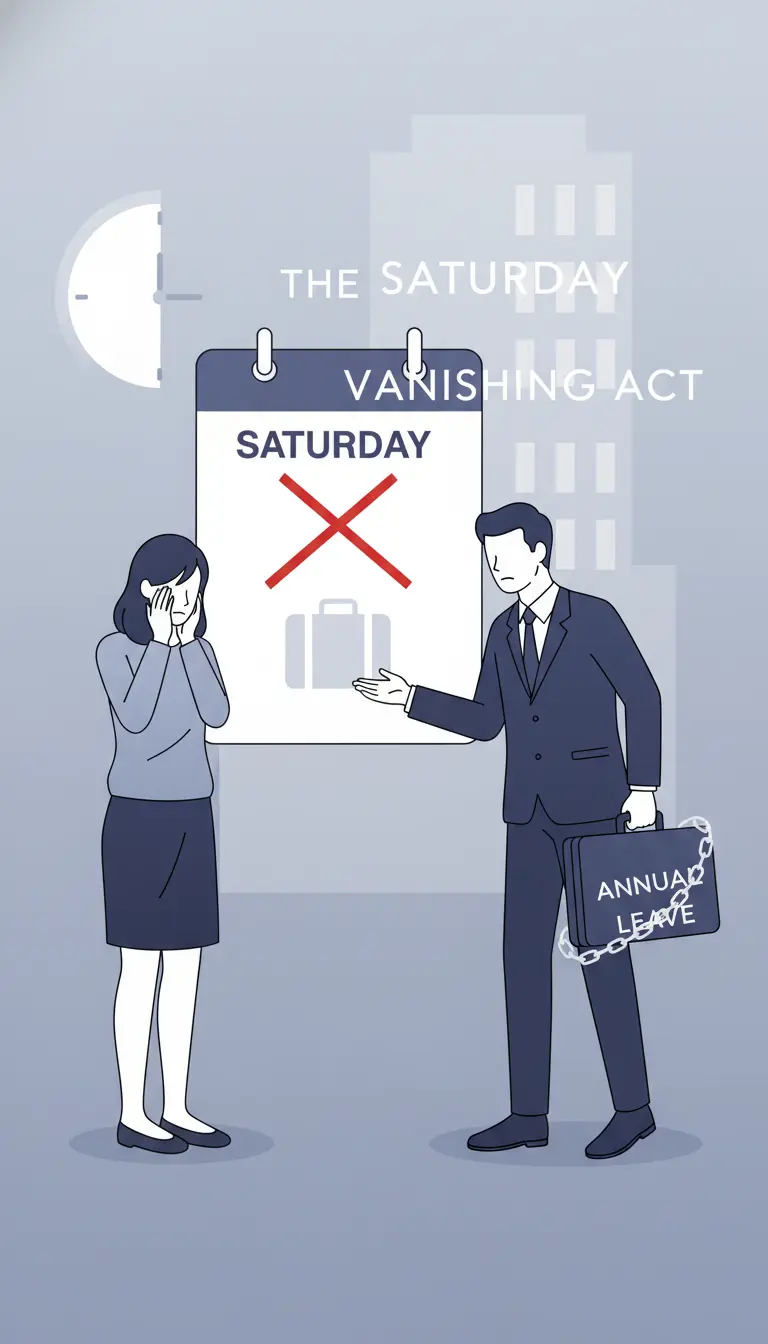
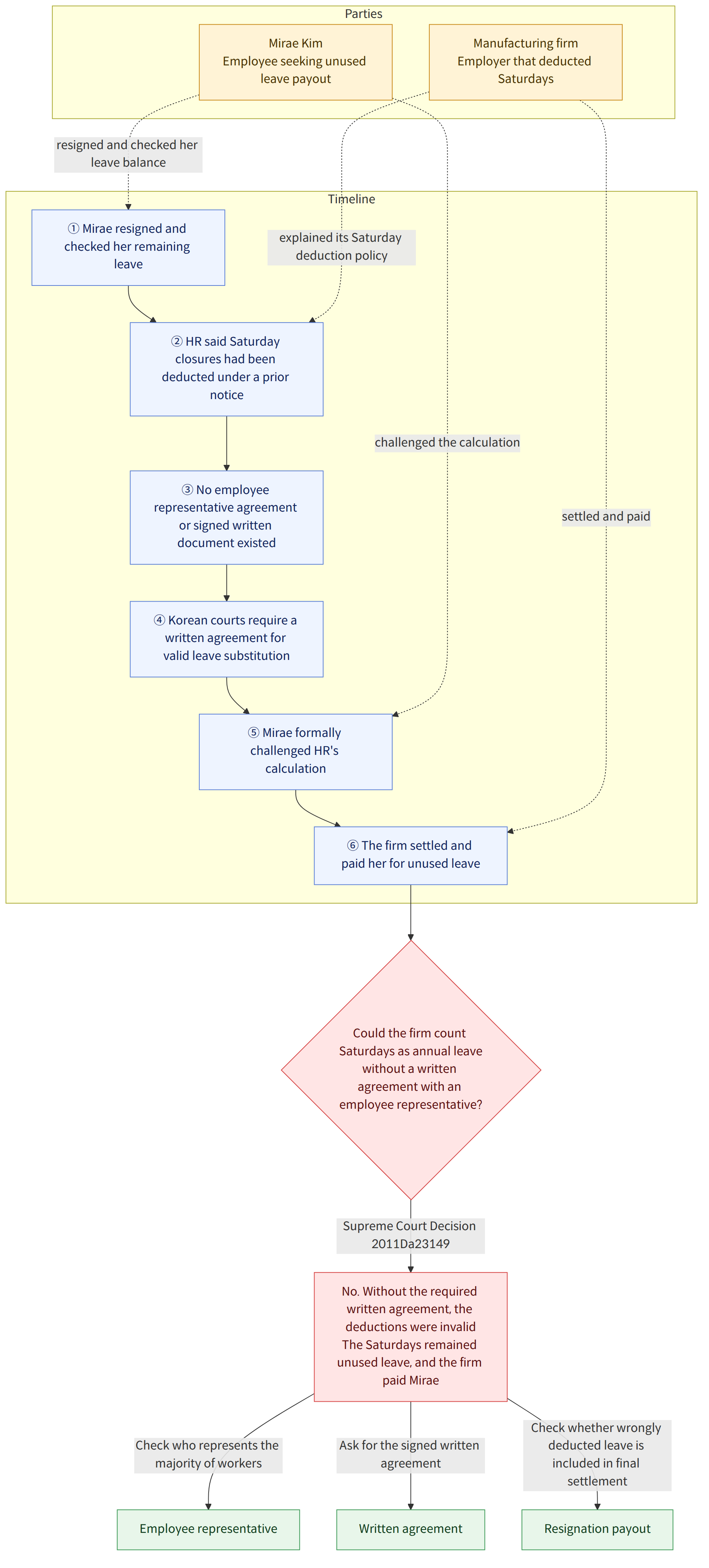
Mirae Kim, a dedicated employee at a mid-sized manufacturing firm for five years, recently decided to resign. While calculating her remaining annual leave for her final payout, she was shocked to find that her balance was nearly zero. When she questioned the HR department, the response was blunt: "Our company implemented a five-day work week years ago. We announced back then that taking Saturdays off would be deducted from everyone's annual leave."
Mirae recalled seeing a notice on the company bulletin board years ago, but she never signed any agreement, nor was there ever a vote among staff. She had assumed the Saturday closures were a company policy, not a direct withdrawal from her personal vacation bank. Now, facing the loss of weeks' worth of pay, she wondered: Is this practice even legal?
2. The Core Legal Question
The central issue in Mirae’s case is the legal validity of "Annual Leave Substitution." Specifically, can an employer unilaterally decide to trade specific working days (like Saturdays) for an employee’s annual paid leave without following strict statutory procedures?
3. What Korean Law Says: The Power of the Written Agreement
Under the Korean Labor Standards Act (Article 62), annual leave is treated as a fundamental right of the worker. Employers are not allowed to dictate when an employee uses their leave unless a very specific condition is met.
Article 62 (Substitution of Paid Leave)An employer may, by a written agreement with the employee representative, have employees take a holiday on a specific working day in substitution for the annual paid leave.
There are two non-negotiable requirements here:
- Employee Representative: The agreement must be made with a person representing the majority of the workers (or a labor union), not individual employees.
- Written Agreement: A formal, signed document is mandatory. Simple memos, oral promises, or handbook entries are insufficient.
4. How Korean Courts Approach This
The Supreme Court of Korea takes a very strict stance on this issue to protect workers' right to rest. The courts have consistently ruled that the "written agreement with an employee representative" is an essential requirement for the validity of leave substitution.
In landmark rulings (such as Supreme Court Decision 2011Da23149), the court established that even if employees actually did not work on those substituted days (like Mirae's Saturdays), the employer cannot claim those days were "annual leave" unless the formal written agreement exists. Without it, the deduction is legally non-existent, and the leave remains "unused."
5. Applying the Law to Mirae’s Case
In Mirae’s situation, the firm merely posted a notice on a bulletin board. There was no elected employee representative involved, and certainly no formal written contract signed between such a representative and the CEO.
Because the company skipped the mandatory legal steps, the "Saturday deduction policy" has no legal standing. The Saturdays Mirae had off were simply days the company chose to close; they cannot be legally counted as her used annual leave. Therefore, Mirae is legally entitled to the full payout for all the annual leave days the company erroneously deducted over the years.
6. Conclusion: What Happened, and What Should You Do?
After seeking legal counsel, Mirae Kim formally challenged the HR department's calculation. Faced with the reality that they lacked a valid written agreement, the company was forced to settle and pay her the full amount for her unused annual leave.
If you find yourself in a similar situation where your company claims your leave was used for bridge holidays or company-wide closures, take these steps:
- First, check for an Employee Representative. Ask who represents the workers in official negotiations with management.
- Second, demand to see the Written Agreement. If the company claims your leave is being substituted, they must be able to produce a signed document dated before the leave was taken.
- Third, know your rights at resignation. Unused leave is money. If it was deducted illegally, you can claim it as part of your final settlement.
Your annual leave is your right to rest and recharge. Do not let it vanish through procedural shortcuts.
* **This column is provided for general informational purposes only and does not constitute legal advice. For specific legal issues, please consult with a qualified legal professional.