1. Eight Years of Dedication, and an Empty Hand on the Last Day
Mirae Kim had been a devoted marketing manager at Alpha Tech, a mid-sized firm, for eight years. Having grown with the company from its early days, she often worked late nights and weekends. When she finally decided to move on to a new chapter in her life, she expected her severance pay to serve as a financial bridge for her transition.
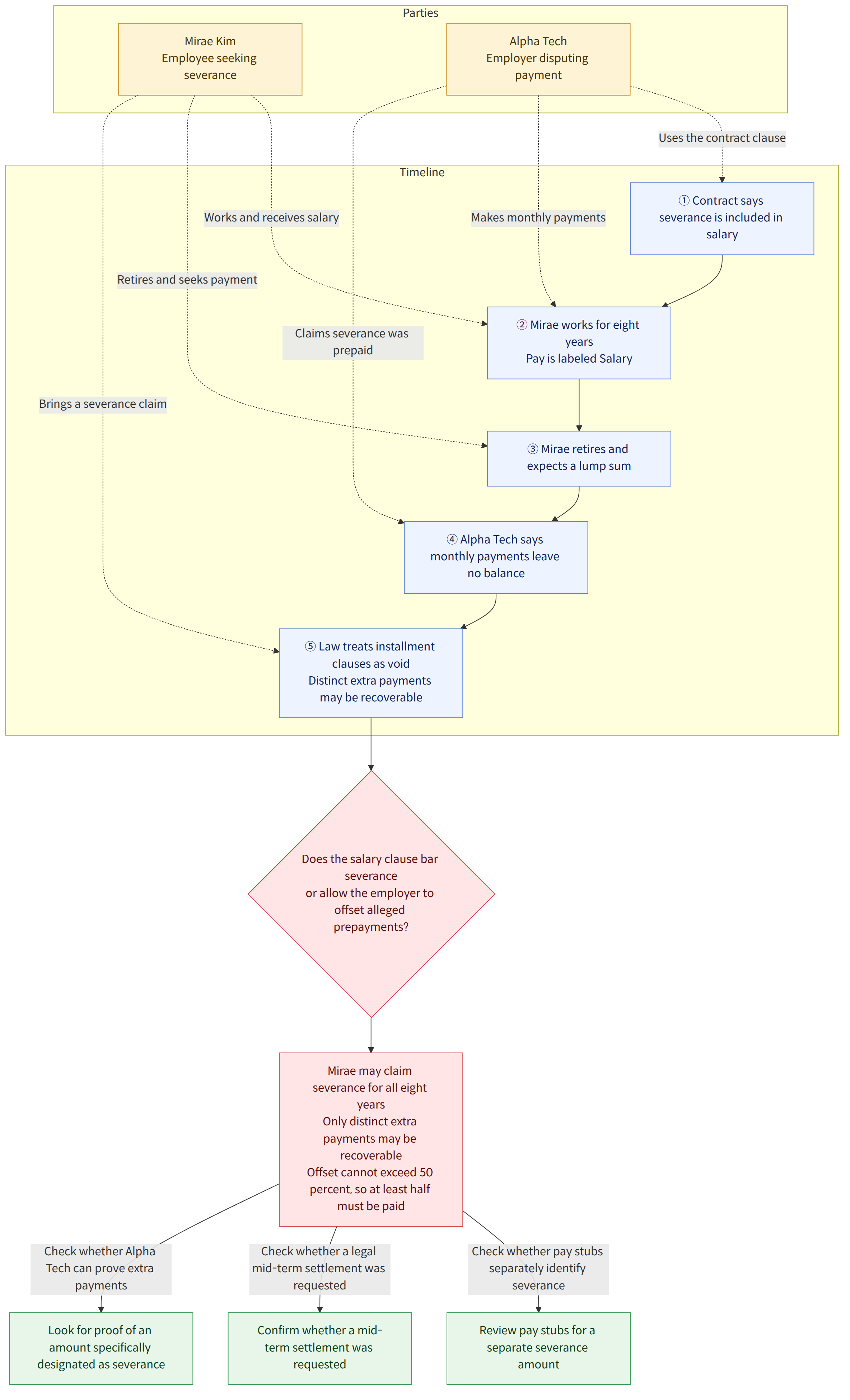
However, her exit interview took a cold turn. The HR manager pulled out the employment contract Mirae had signed years ago. It contained a clause stating, "Severance pay is included in the total annual salary and shall be distributed in monthly installments." The company argued that since they had already paid her a portion of her severance every month, there was nothing left to pay out.
Mirae looked back at her bank statements. She had only ever received a single sum labeled "Salary." To her, that money was simply the fair compensation for her daily labor. The realization that her retirement nest egg had supposedly been spent month by month left her stunned. Is Mirae truly barred from receiving her eight years' worth of severance pay?
2. The Core Legal Question
This case hinges on two critical questions: "Is a contract clause that includes severance pay within a monthly salary valid under Korean law?" and "If a company has already pre-paid such amounts, can they deduct them from the actual severance pay due at retirement?"
3. What Korean Law Says About Severance Pay
Korean labor law treats severance pay as a mandatory protection for workers' post-retirement livelihood, governed by strict regulations.
According to Article 8 of the Employee Retirement Benefit Security Act, an employer must provide a severance pay system that pays retiring employees at least 30 days' worth of average wages for every year of continuous service.
Key principles include:
- Timing of Occurrence: The right to severance pay is triggered only when the employment relationship ends (retirement).
- No Pre-emptive Waiver: Employees cannot legally waive their right to severance pay before they retire, nor can they agree to receive it in monthly installments during their employment.
- Annual Salary Systems: Even in an annual salary (Yeon-bong) system, severance pay must be handled separately. Simply bundling it into the monthly pay check does not satisfy the legal requirement for severance payment.
4. How Korean Courts Approach This
The Supreme Court of Korea maintains a very strict stance on "severance pay split-payment agreements."
The courts generally rule that any agreement to pay severance pay in installments before the actual termination of employment is void as a violation of mandatory law. Therefore, even if the employer claims to have paid severance pay every month, the law does not recognize those payments as valid "severance pay."
However, the court also considers the principle of fairness. If an employer actually paid an additional amount specifically labeled as "severance pay" on top of the base wage, the employee may be seen as having gained an "unjust enrichment" (receiving money without a legal basis). In such cases, the employee might be obligated to return that specific amount to the employer.
5. Applying the Law to Mirae’s Case
Let’s walk through Mirae's situation step-by-step:
- Invalidity of the Clause: The clause in Mirae’s contract stating that severance pay is included in her salary is legally void. Consequently, Mirae has a valid legal claim for the full amount of her severance pay for the past eight years.
- Unjust Enrichment: If Alpha Tech can prove they paid her an extra amount clearly designated as severance pay (separate from her base salary), they might claim that money back as unjust enrichment.
- Limits on Offsetting: Even if the company has a claim for unjust enrichment, they cannot simply refuse to pay her severance. Under the Civil Execution Act, to ensure the worker's survival, an employer is prohibited from offsetting more than 50% of the severance pay amount. This means Alpha Tech must, at the very least, pay Mirae 50% of her actual severance pay in cash immediately.
6. Conclusion: What Happened, and What Should You Do?
In the end, Mirae Kim is entitled to file a claim for her severance pay. Unless Alpha Tech clearly separated the "severance portion" from her "base wage" on her pay stubs, she may even be able to claim the full amount without any deductions. Even in the worst-case scenario, she is guaranteed at least half of her lump-sum payment.
For readers in similar situations, keep these 3 tips in mind:
- Analyze Your Pay Stubs: Ensure that "severance pay" is not being listed as a monthly item. If it is, and you haven't requested a legal mid-term settlement, the arrangement might be invalid.
- Understand Mid-term Settlements: Under current law, you can only receive severance pay early under very specific conditions (e.g., purchasing your first home). Random monthly distributions do not count.
- Seek Professional Help: If an employer refuses to pay, file a petition with the Ministry of Employment and Labor. Contractual language that violates the law cannot be used against you.
Your hard-earned retirement benefits are protected by law; don't let a single line in a contract take them away.
** *This column is provided for general informational purposes only and does not constitute legal advice. Actual legal outcomes may vary depending on specific factual circumstances.