Section 1 — A Human Story (Opening)
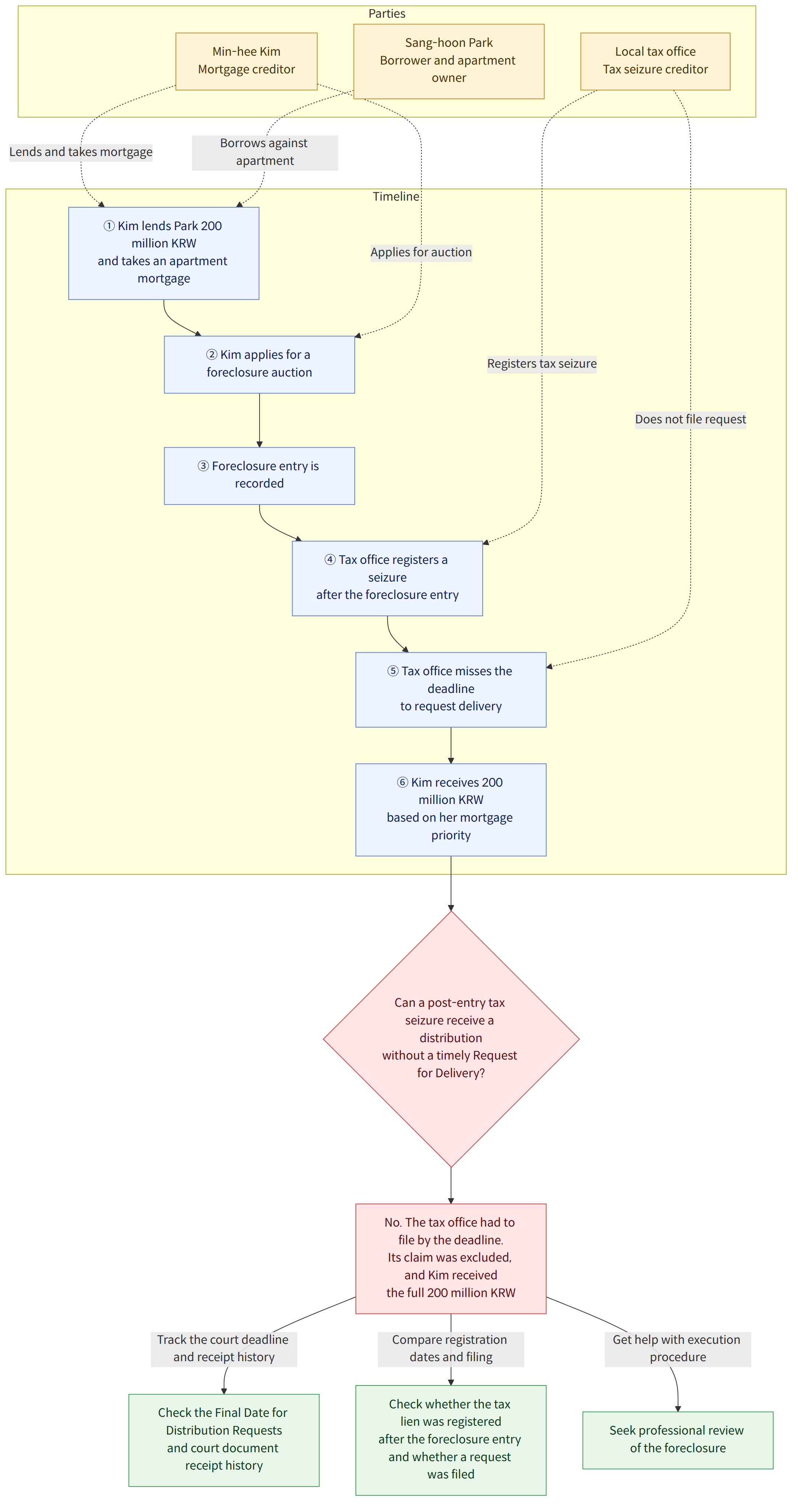
Three years ago, Min-hee Kim (a pseudonym) lent 200 million KRW to her high school friend, Sang-hoon Park (a pseudonym), who was desperate to open a cafe. To secure her money, she took a mortgage on Sang-hoon’s apartment. Unfortunately, the business failed, and Sang-hoon eventually stopped making interest payments. Left with no choice, Min-hee applied for a foreclosure auction to exercise her security interest. The court accepted the application and the foreclosure entry (registration) was recorded on the apartment's title deed.
As the auction progressed, Min-hee checked the real estate registry again and was shocked. She found that the local tax office had registered a seizure for unpaid taxes after her foreclosure process had already begun. Having heard that "taxes always come first," Min-hee began to lose sleep, fearing that the government would take the lion's share of the auction proceeds, leaving her with nothing.
Section 2 — The Legal Question
The core issue in this case is: If a tax seizure is registered after the entry of a foreclosure auction has been recorded, can the tax office still receive a distribution if it fails to file a formal 'Request for Delivery' (a type of distribution claim) by the court's deadline?
Section 3 — What Korean Law Says
While Korean law provides strong protection for tax claims, it also imposes procedural obligations to ensure the transparency and efficiency of civil execution processes.
- National Tax Collection Act, Article 56: States that the head of a tax office must file a Request for Delivery with the execution court or officer when a taxpayer is subject to compulsory execution or a foreclosure auction.
- Civil Execution Act, Article 88: Outlines who can request a distribution of proceeds, including creditors with priority rights under the Civil or Commercial Code.
- Civil Execution Act, Article 84: Requires the court to set a Final Date for Distribution Requests (the "deadline") and notify public institutions managing taxes to report their claims by this date.
Core Principle: To receive money in a foreclosure auction, a creditor must generally declare their rights to the court by the specified deadline. This allows the court to accurately identify all stakeholders before creating a distribution schedule.
Section 4 — How Korean Courts Approach This
To maintain predictability in auctions, the Supreme Court of Korea draws a sharp line based on when a claim becomes visible to the court.
If a tax seizure is registered before the foreclosure auction entry, the court automatically includes the state in the distribution, even without a formal request, because the claim is visible on the registry when the case starts.
However, for seizures registered after the foreclosure entry, the Supreme Court rules as follows:
"If a seizure for tax arrears is registered after the entry of a foreclosure auction, the state as a tax creditor must file a Request for Delivery by the final date for distribution requests to receive a distribution."
In essence, the court is not expected to monitor new registrations that occur after the auction has already been initiated. The state must proactively assert its rights.
Section 5 — Applying the Law to the Case
Let’s break down Min-hee’s situation step-by-step:
- The foreclosure entry for Min-hee’s claim was recorded first.
- The tax office’s seizure registration occurred later.
- The local tax office failed to file a Request for Delivery before the court-mandated deadline.
In this scenario, even though tax claims usually have priority over general debts, the tax office failed to follow the mandatory procedural step. Because they did not file the request by the deadline, the court has no legal obligation (or basis) to include them in the payout. The law assumes the tax office has either waived its right to this specific auction or has no valid claim to pursue here.
Section 6 — Conclusion: What Happened, and What Should You Do?
As it turns out, Min-hee Kim’s worries were unfounded. Because the tax office remained silent past the deadline, the court ignored the post-auction tax lien during the distribution. Min-hee received her full 200 million KRW based on her mortgage's original priority.
If you are a creditor navigating a foreclosure, keep these practical tips in mind:
- Watch the Final Date for Distribution Requests: This is the most critical date in a foreclosure case. Monitor the court's "document receipt history" (문건접수내역) to see which creditors have filed claims before this window closes.
- Check the Chronology: Always compare the date of your foreclosure registration with the date of any tax liens. If a tax lien appears after yours, check if they filed a formal request. If they didn't, they are out of the game.
- Seek Professional Review: Execution law is strictly procedural. Even a valid right can be lost if a deadline is missed. Have a legal expert review the distribution schedule (배당표) before it becomes final to ensure no "silent" creditors are unfairly taking your share.