1. A Human Story
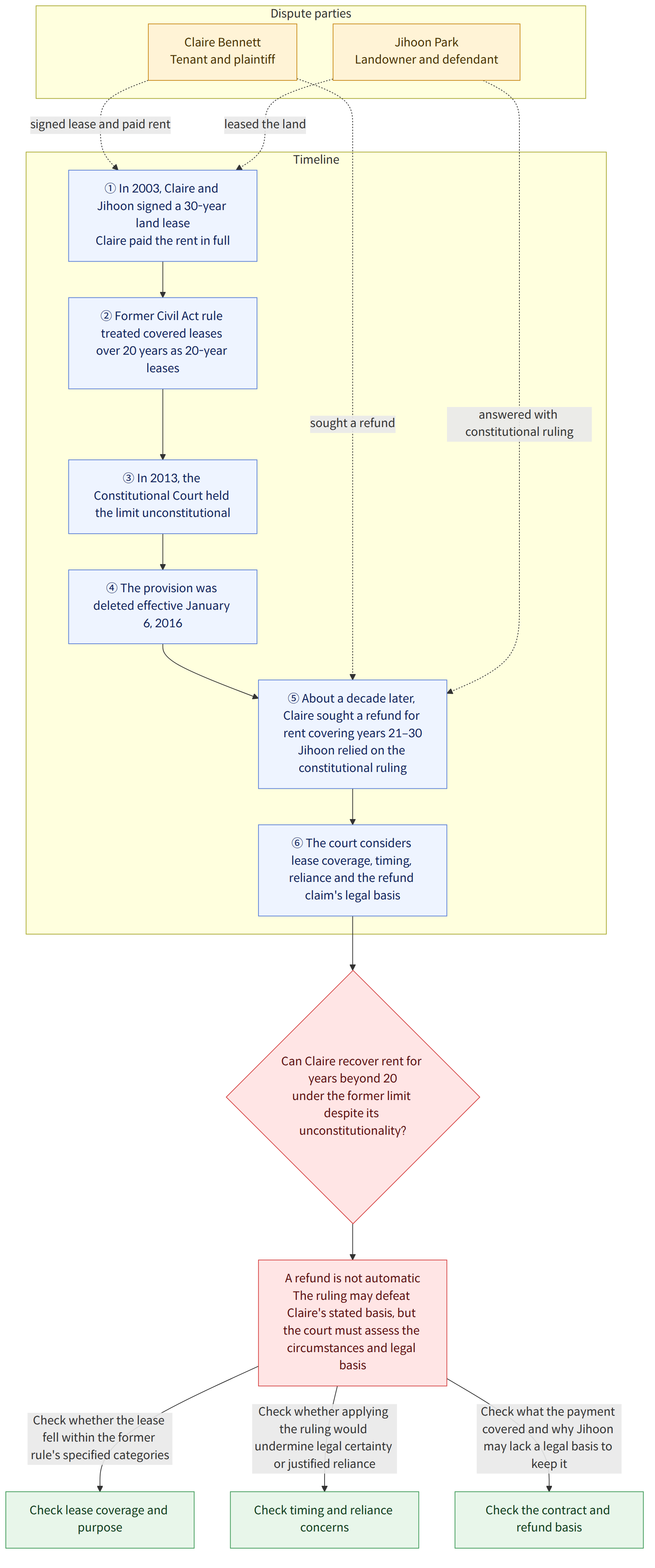
In 2003, Claire Bennett signed a 30-year lease with Jihoon Park, who owned a parcel of land in a growing Korean city. Claire planned to build and operate a small workshop there. The rent was substantial, but the long term gave her the security to invest. She paid the rent in full, and both parties treated the arrangement as a serious, long-term commitment.
A decade later, Claire’s business was struggling. She looked again at the contract and saw a possible way out: Korea’s Civil Act had once limited certain leases to 20 years, no matter what the parties had agreed. Claire sued Jihoon, arguing that the part of her advance payment covering years 21 through 30 had no legal basis and should be returned. Jihoon’s response was that the law imposing that limit had itself been held unconstitutional.
2. The Legal Question
Can a tenant recover rent allocated to the years beyond 20 of a 30-year lease by relying on a former statutory limit, when the Constitutional Court has ruled that limit unconstitutional? And can that ruling matter even though the lease was signed before the constitutional decision?
3. What Korean Law Says
Until it was deleted in 2016, Article 651(1) of the Korean Civil Act imposed a 20-year ceiling on certain land leases. The provision covered, among other things, leases of land for the purpose of owning certain buildings or structures, subject to specified exceptions. If the parties agreed to a longer term, the statute treated the term as shortened to 20 years. The Supreme Court had regarded the provision as mandatory: the parties could not simply contract out of it.
Under the former Article 651(1), a covered lease agreed for more than 20 years was treated as a 20-year lease.
In 2013, however, the Constitutional Court held that this limit violated the constitutional protection of contractual freedom. Its reasoning was practical as well as constitutional: parties can agree on ways to manage and improve leased property, so a blanket limit was not the least restrictive way to protect property from neglect or decline. The rule also reflected outdated assumptions about who could best manage land, created incentives for parties to use workarounds, and could lead to the removal of useful buildings or installations after 20 years.
The Constitutional Court concluded that the former limit imposed an excessive restriction on contractual freedom and did not adequately reflect changed social and economic conditions.
The provision was later deleted from the Civil Act, effective January 6, 2016. The constitutional ruling also raises a question about earlier contracts. As a general principle, the Supreme Court has held that a constitutional ruling may apply to ordinary cases brought after the ruling, even if the underlying events happened earlier. An exception may be necessary where legal certainty or protection of legitimate reliance requires a different result.
For a dispute like Claire and Jihoon’s, the key points are:
- The former 20-year rule applied only to specified kinds of leases, not every lease in Korea.
- The Constitutional Court found that the limit unconstitutionally restricted the parties’ freedom to agree on a term.
- The ruling may be relied on in a later-filed ordinary lawsuit concerning an earlier contract, subject to the circumstances of the case.
- A claim for repayment still requires a legal basis for saying that the landlord has received money to which they are not entitled.
4. How Korean Courts Approach This
Korean courts do not treat every constitutional ruling as an automatic answer to every dispute involving an earlier transaction. They consider the effect of the ruling in the case before them, including whether applying it would undermine legal certainty or unfairly defeat a party’s justified reliance. But the Supreme Court’s general approach is that, unless such concerns make it necessary to limit the effect, a constitutional ruling can govern ordinary cases filed after the ruling.
Courts also separate the constitutional issue from the private-law claim. Even if a statutory rule once appeared to shorten a lease, a tenant seeking money back must still show why the landlord lacks a legal basis to retain the payment. The court will examine the contract, what the payment covered, the kind of land lease involved, and the timing and nature of the lawsuit. A successful argument that the former cap does not govern the case may remove the tenant’s stated basis for a refund, but it does not settle every possible contractual dispute.
5. Applying the Law to the Case
First, the old rule must have covered the lease. Claire’s case concerns a land lease intended to support a building and business, so the former Article 651(1) could have been relevant when the parties signed. The precise purpose of the lease and the type of structure would matter. If the arrangement fell outside the provision, the 20-year limit would not have applied even under the former law.
Second, the contract plainly exceeded the former limit. Claire and Jihoon agreed to 30 years, and she paid the full rent in advance. Under the old text, a covered lease exceeding 20 years was treated as shortened to 20 years. That is the rule Claire invokes to say that the payment attributable to the final ten years should be returned.
Third, the constitutional ruling changes the legal landscape. The Constitutional Court found the limit an excessive restriction on contractual freedom, and the provision was subsequently removed. Claire’s lawsuit was filed after that constitutional ruling. Jihoon can therefore argue that the ruling applies to the later-filed case, despite the fact that the lease was signed earlier. Under the Supreme Court’s general principle, that is a substantial argument unless this particular dispute presents a reason to protect legal stability or reliance by limiting the ruling’s effect.
Fourth, the refund claim depends on the alleged lack of legal basis. Claire’s argument is not simply that she is now short of money; it is that the law deprived the 30-year term of effect and therefore made part of her payment recoverable. If the court applies the constitutional ruling and does not enforce the old cap against this case, the agreed 30-year term is not shortened on that ground. The central basis Claire offered for recovering the rent for years 21 through 30 would then fail.
That does not guarantee Jihoon victory on every issue. Claire could still raise an independent ground under the contract or other applicable law, and the court would need to assess the documents and evidence. But financial hardship alone does not establish that prepaid rent must be repaid. On the facts given, Jihoon’s constitutional argument is persuasive, and Claire’s claim appears weak if it rests only on the former 20-year ceiling.
If you are dealing with a similar issue, attorney Ji-sun Ahn of Ijun Law Firm can review the land register, agreements or permits affecting the property, and the dates when rights were registered or changed with you. These details can help clarify which options apply to your situation.
6. Conclusion: What Happened, and What Should You Do?
The likely result is that Jihoon can resist Claire’s refund claim by arguing that the 2013 constitutional ruling applies to her later-filed lawsuit. If the court accepts that argument, the former statutory cap does not provide a basis to treat the final ten years of the agreed lease as invalid. Claire would not be entitled to a refund merely because the old Civil Act once imposed a 20-year limit. The outcome could differ if the contract or other evidence supplies a separate legal reason to repay some or all of the money.
For anyone facing a similar dispute:
- Check the exact kind of lease and its purpose. The former cap did not cover every rental arrangement, and the property and intended use can matter.
- Gather the contract and payment records. Identify what the advance payment covered and keep any documents showing how the parties understood the term.
- Get advice before demanding or refusing a refund. The constitutional ruling’s effect can depend on when the lawsuit was filed and whether there are independent contractual grounds for repayment.