1. The Broken Dreams of Jin-soo Park
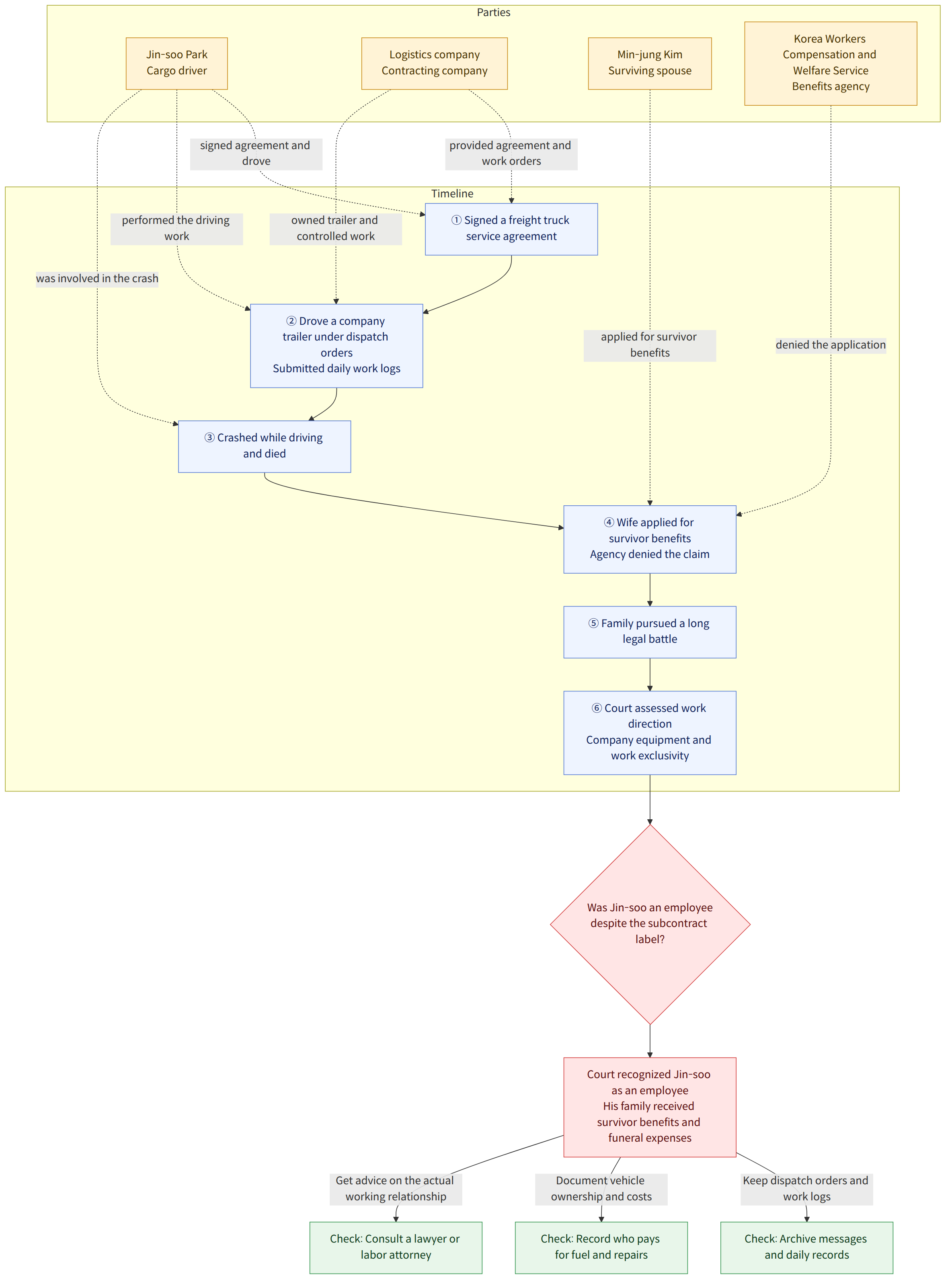
Three years ago, Jin-soo Park signed a "Freight Truck Driving Service Agreement" with a logistics company. On paper, he was an independent contractor. The contract explicitly stated that he was an "independent operator not subordinate to the company." Jin-soo drove a trailer provided by the company, traversing the country from dawn till dusk. Every morning, he followed dispatch orders sent via a group chat and submitted detailed daily logs upon finishing his shifts.
One winter night, exhausted by a grueling schedule, Jin-soo fell asleep at the wheel and crashed into a guardrail. He lost his life at the scene, leaving behind his wife, Min-jung Kim, and two young children. When Min-jung applied for survivor benefits through the Korea Workers' Compensation & Welfare Service, the response was cold: "The deceased was a business owner, not an employee, and therefore is not eligible for industrial accident compensation."
2. Independent Contractor or Subordinate Employee?
The core of this issue lies in the true nature of the 'service (subcontract) agreement' signed by cargo drivers like Jin-soo. If the contract says 'subcontract' and the person is registered as a business owner, does that automatically make them an independent entrepreneur? Or were they, in reality, providing labor under the company's direction for the purpose of earning wages?
3. The Legal Definition of 'Employee Status' in Korea
Korean labor laws prioritize 'substance over form.' The Supreme Court of Korea uses specific criteria to determine whether a worker is an employee regardless of what the contract is called.
Key Criteria for Determining Employee Status1. Does the employer determine the content of the work and apply internal rules/regulations?2. Does the employer exercise significant command and supervision during the work process?3. Does the employer designate the time and place of work, and is the worker bound by them?4. Who owns the equipment, raw materials, and tools (e.g., the truck)?5. Can the worker hire a third party to perform the work independently at their own expense?
Crucially, the court warns that the absence of a fixed base salary or the lack of social security enrollment should not be used to easily deny employee status, as these are often factors controlled by the employer's superior economic position.
4. How Korean Courts View Cargo Drivers
Recent judicial trends have become more protective of cargo drivers. Even if pay is performance-based (calculated by freight volume), the courts view this as a measure of the quantity and quality of labor—essentially a wage. Furthermore, if the vehicle belongs to the company and the company bears the maintenance costs, it is difficult to view the driver as an independent business owner taking their own financial risks.
5. Applying the Law to Jin-soo’s Case
When we analyze Jin-soo's situation through a legal lens, the case for his employee status is strong. First, the trailer he drove was owned by the company, and the company paid for fuel and maintenance. Second, the company strictly controlled his work through dispatch orders and mandatory daily reports. Third, he was practically restricted from working for other companies, indicating high exclusivity.
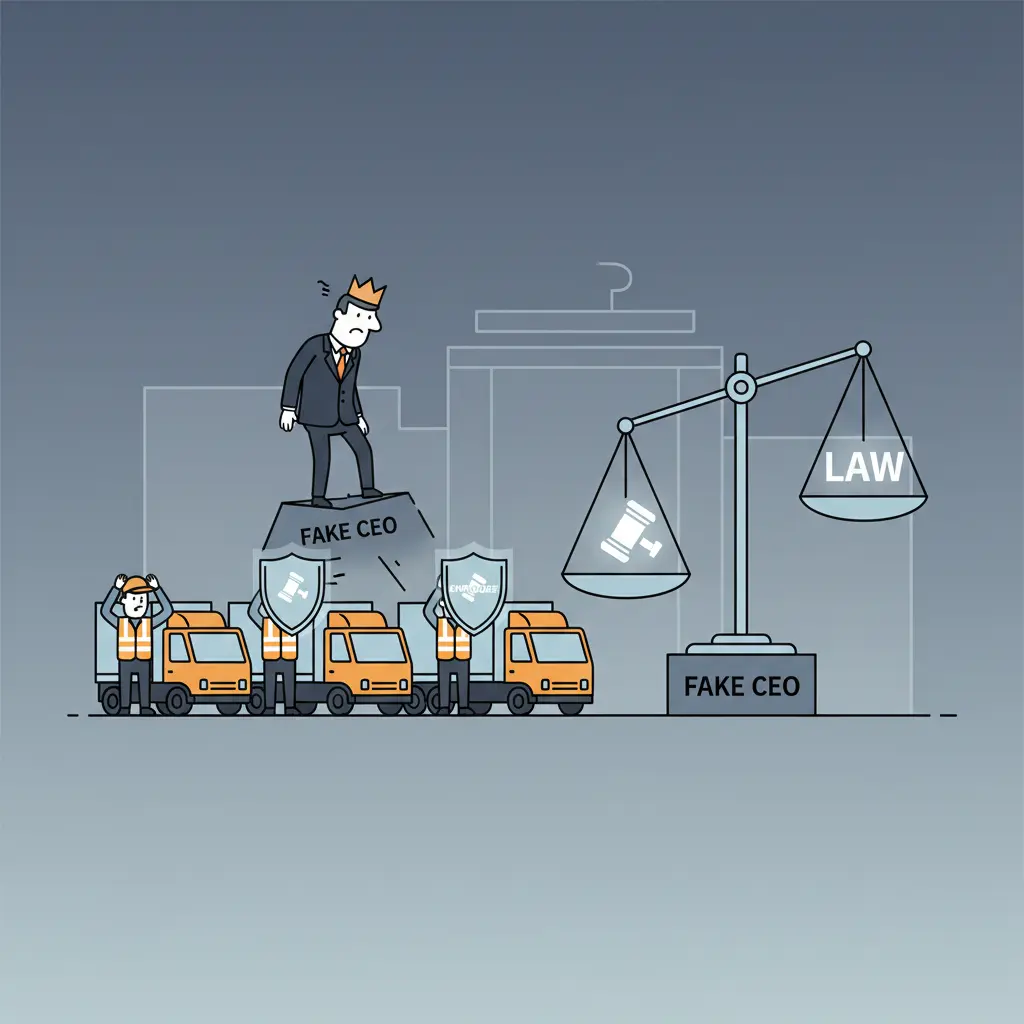
These facts prove that Jin-soo was not a "CEO" risking his own capital for profit, but an employee performing the company's core operations. The Supreme Court has ruled in similar cases that "drivers in such subordinate relationships provide labor for wages and are therefore employees under the Labor Standards Act."
6. Conclusion: Justice for Min-jung and Advice for Drivers
After a long legal battle, the court recognized Jin-soo Park as an employee. Min-jung was finally able to receive survivor benefits and funeral expenses, providing a lifeline for her family. This case serves as a vital precedent for many 'specialized employment' workers who are labeled as independent contractors but work like employees.
If you find yourself in a similar situation, keep these practical tips in mind:
- Archive all work orders: Keep logs of KakaoTalk messages, texts, or app-based dispatch orders. These are critical evidence of command and supervision.
- Identify who pays the bills: Document who owns the vehicle and who pays for repairs and fuel. This helps prove you are not an independent business owner.
- Seek professional help early: Don't be discouraged by the title of your contract. Consult a lawyer or labor attorney to analyze the actual nature of your working relationship.
This column is for general informational purposes only and does not constitute legal advice for specific cases.