1. A Rusty Scooter and a Misleading Label
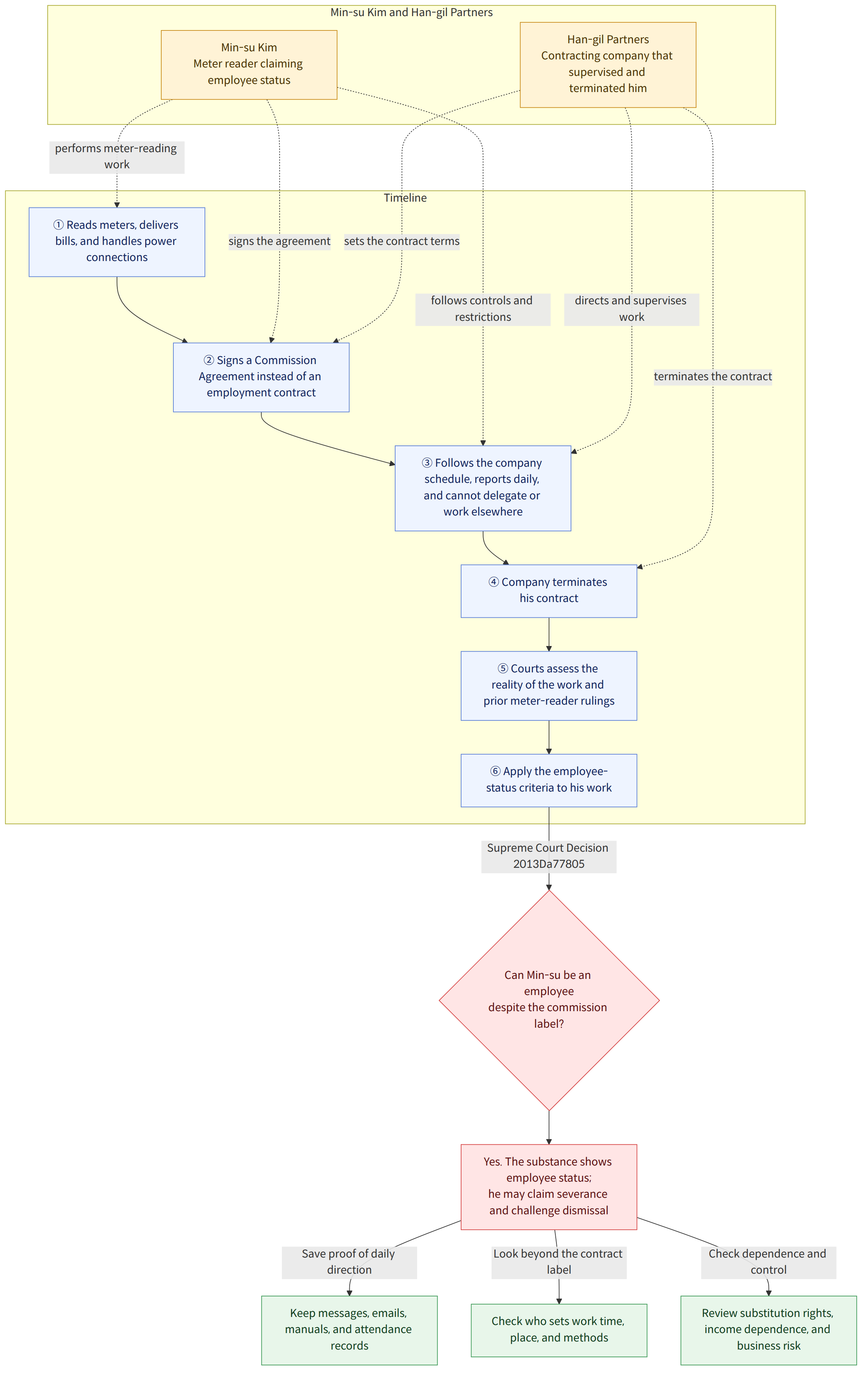
For the past three years, Min-su Kim started his day at 9:00 AM at 'Han-gil Partners,' a company contracted by the Korea Electric Power Corporation (KEPCO). His job involved reading electric meters, delivering bills, and handling the sensitive tasks of disconnecting and reconnecting power for delinquent customers. Min-su rode his own old scooter across his assigned district every day.
When Min-su started, he didn't sign an 'Employment Contract.' Instead, he signed a 'Commission Agreement.' The company called him a 'Commissioned Agent' and insisted he was an 'independent contractor.' However, Min-su’s life was far from independent. He followed a strict schedule set by the company, submitted daily reports, and was under constant supervision. When the company suddenly terminated his contract, Min-su wondered if he was entitled to the same severance pay as any other regular employee.
2. The Core Legal Question
The central legal issue here is: Can a meter reader who signed a commission contract be recognized as an 'employee' under the Labor Standards Act (LSA)? If recognized, Min-su would be entitled to severance pay, paid annual leave, and protection against unfair dismissal.
3. What Korean Law Says About Employee Status
In Korea, the Labor Standards Act does not define a worker simply by what is written on a piece of paper. The court looks at the reality of the working relationship.
Article 2 of the Labor Standards ActThe term "employee" means a person who offers work to a business or workplace for the purpose of earning wages, regardless of the kind of occupation.
The Supreme Court of Korea emphasizes 'substantive subordination.' Key criteria include:
- Does the employer determine the content of the work and exercise significant supervision?
- Are the time and place of work designated and controlled by the employer?
- Can the worker hire a third party to perform the work (substitutability)?
- Who owns the tools and equipment, and who bears the risk of profit and loss?
4. How Korean Courts Approach This Issue
The Supreme Court of Korea has previously ruled on the status of meter readers (Supreme Court Decision 2013Da77805). The court noted that meter reading and bill delivery are core and essential functions of the company’s business.
Because these tasks are vital, companies have a strong incentive to exercise 'significant direction and supervision' to ensure proper performance. Furthermore, if a worker cannot increase their income through their own independent marketing or business efforts, the court is less likely to see them as an independent entrepreneur.
5. Applying the Law to Min-su’s Case
Applying these legal principles to Min-su’s situation reveals a clear case of employment.
First, there is the exclusivity of service. Min-su was prohibited from working for other companies or delegating his tasks to someone else. He provided only his own labor to Han-gil Partners.
Second, there is economic dependence. Min-su relied entirely on the fees provided by the company for his assigned district. He had no opportunity to create profit or suffer loss through business judgment; he was simply being paid for his time and labor.
Third, there is the reality of supervision. Given the nature of disconnecting and reconnecting power—tasks that involve legal and safety risks—the company must have managed Min-su's work process strictly. This level of control is a hallmark of an employer-employee relationship.
6. Conclusion: What Happened to Min-su, and What Should You Do?
Ultimately, Min-su Kim is an employee under the Labor Standards Act. Despite the 'Commission Agreement' label, the substance of his work was that of a subordinate employee. Min-su is entitled to claim severance pay and can challenge his termination as a potential unfair dismissal.
For readers in similar situations, keep these two tips in mind:
- Do not be fooled by labels. Even if the company says you are an independent contractor or refuses to pay into the four major social insurances, you may still be an employee if you work under their direction.
- Collect evidence of control. Save text messages, emails, work manuals, and attendance records that show the company directing your daily tasks. These are crucial if you ever need to prove your status in court.
The law protects those who stand up for their rights. Understanding the reality of your legal status is the first step toward securing the protections you deserve.