1. A Fire Encountered in a Land of Dreams
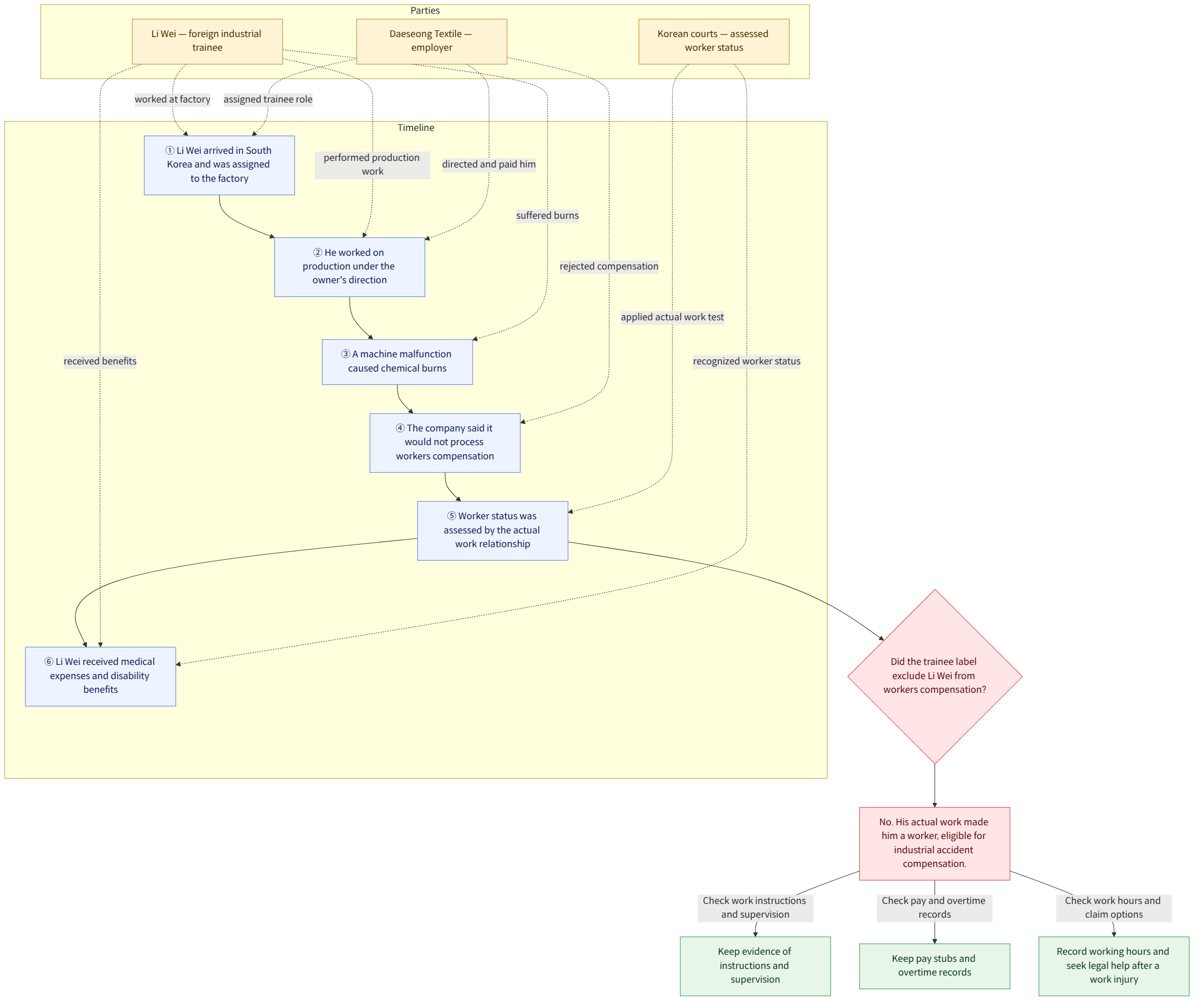
Li Wei, a young man from China, arrived in South Korea with high hopes of learning advanced industrial skills to bring back to his hometown. He was assigned to Daeseong Textile, a local dyeing company, under the title of an 'Industrial Technical Trainee.' Although his contract was labeled 'Technical Training,' the reality was far from the educational curriculum he had imagined.
Every day, from 8:00 AM until late into the evening, Li Wei worked alongside regular employees in a factory filled with scorching steam and chemical agents. He performed grueling labor under the owner's direct orders and received additional pay for overtime work. One afternoon, a machine malfunctioned, causing a sudden eruption of boiling chemical solution. Li Wei suffered severe third-degree burns to his face.
While he lay in the hospital worrying about mounting medical bills, the company's response was cold. "You are a 'trainee' here to learn, not a 'worker.' We cannot process workers' compensation for you," the owner claimed. Is Li Wei truly excluded from legal protection simply because of his trainee status?
2. The Legal Question: Is a Trainee a 'Worker'?
The core of this issue lies in whether a foreign national, contracted as an 'Industrial Technical Trainee' like Li Wei, qualifies as a 'worker' under the Korean Labor Standards Act and the Industrial Accident Compensation Insurance Act. If recognized as a worker, they are entitled to compensation for work-related injuries regardless of their nationality or visa type.
3. What Korean Law Says
Korean law defines a worker based on the substance of their relationship with the employer:
Labor Standards Act, Article 2, Paragraph 1, Clause 1: "The term 'worker' means a person who offers labor to a business or workplace for the purpose of earning wages, regardless of the kind of occupation."
Furthermore, Article 5, Clause 2 of the Industrial Accident Compensation Insurance Act stipulates that the definition of a 'worker' follows the Labor Standards Act. In essence, the key to the judgment is "whether labor was provided for the purpose of earning wages," regardless of whether the contract is called 'training' or 'internship.'
4. How Korean Courts Approach This
The Supreme Court of Korea has established consistent and clear criteria regarding the worker status of foreign industrial technical trainees. The court looks past the title of the contract to the 'actual labor relationship.'
- Direction and Supervision: Does the trainee perform specific tasks at designated times under the company's instructions?
- Nature of Labor: Does the trainee provide labor that directly contributes to the company's production activities, going beyond mere 'learning'?
- Remuneration for Labor: Does the person receive payments as a reward for labor (especially overtime pay) rather than as a simple training stipend?
The Supreme Court has ruled that even if a trainee contract follows government guidelines, the trainee is considered a worker under the Labor Standards Act if they practically provided labor under the company's direction and received wages or allowances for that labor.
5. Applying the Law to Li Wei's Case
Analyzing Li Wei's situation through this legal lens reveals several critical points:
First, he provided actual labor on the production line just like any other regular employee. This clearly exceeded the scope of simple 'learning.' Second, he performed his duties under the concrete direction and supervision of the factory owner. Third, and most importantly, he was paid 'overtime allowances' for work performed outside of standard hours.
These factors strongly support the conclusion that Li Wei was, in substance, a worker employed by Daeseong Textile, despite the 'trainee' label. Therefore, under the law, he is fully eligible to claim workers' compensation benefits for his injuries.
6. Conclusion: What Happened to Li Wei and What Should You Do?
Ultimately, Li Wei was recognized as a worker and was able to receive medical expenses and disability benefits through the industrial accident insurance system. His status as a foreigner and the 'trainee' label on his contract did not serve as barriers to his legal rights.
Foreign workers and employers in similar situations should keep the following in mind:
- Substance over form: Regardless of the contract title, if you are working and receiving pay under supervision, you have the rights of a worker.
- Secure evidence: Documentation of work instructions, pay stubs, and records of working hours are crucial evidence to prove your worker status.
- Workers' comp is a right: Even if you are a foreign national, you must immediately seek professional legal help to review a workers' compensation claim if you are injured on the job.
The law protects those who seek its protection. Ensure that your legitimate rights are not being hidden behind a mere 'title.'
This column is provided for general informational purposes only and does not constitute specific legal advice for individual cases.