A Bustling Cafe with a Hidden Headcount
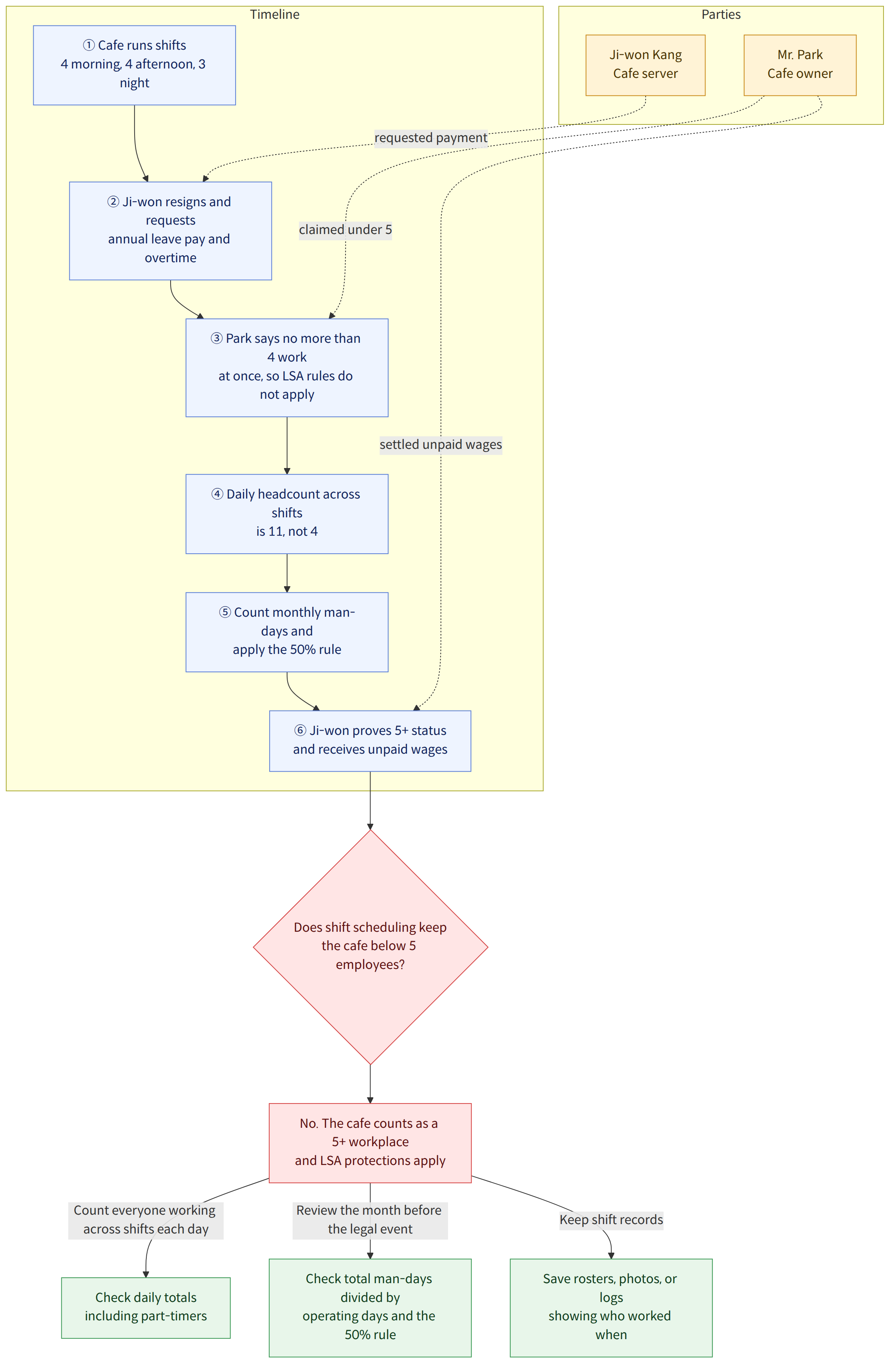
Ji-won Kang had been a dedicated server at 'Morning Glow,' a trendy 24-hour dessert cafe, for over a year. The cafe was always buzzing with energy. To keep up with the demand, the owner, Mr. Park, organized the staff into shifts: 4 people in the morning, 4 in the afternoon, and 3 for the late-night closing shift. When Ji-won recently decided to resign due to personal reasons, she requested her unused annual leave pay and inquired about overtime compensation.
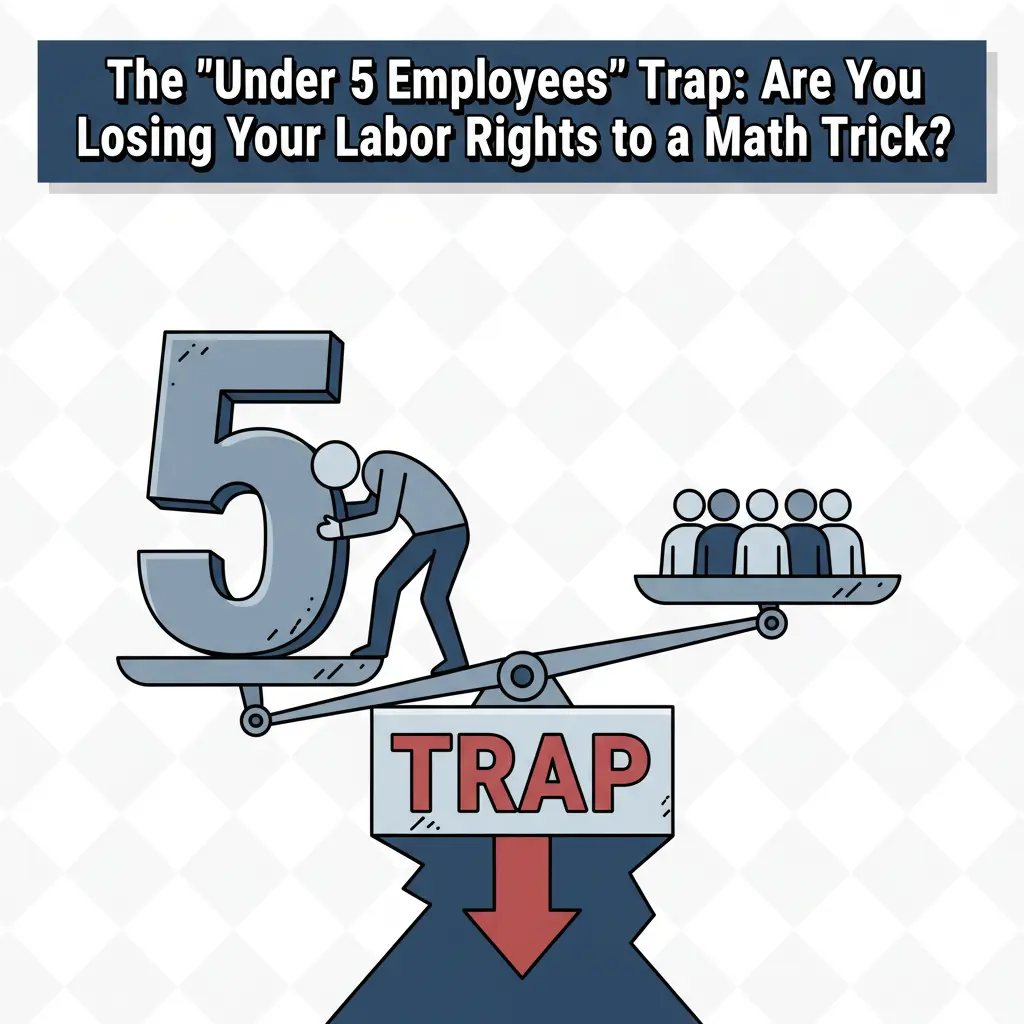
Mr. Park’s response was cold and dismissive. "Ji-won, look around. There are never more than 4 people working here at the same time. We are a 'small business with fewer than 5 employees.' The Labor Standards Act provisions regarding annual leave or overtime premiums don't apply to us." To Ji-won, it felt as if the dozen colleagues she saw every day didn't legally exist. Was she truly left outside the protection of the law?
The Legal Question: What Does 'Constant 5 Employees' Really Mean?
The core of this dispute lies in Article 11 of the Korean Labor Standards Act (LSA), which stipulates that most key labor protections apply to workplaces that 'constantly employ 5 or more employees.' Does this mean 5 people must be standing in the room simultaneously, as Mr. Park claims, or is there a different way to count?
What Korean Law Says About the Counting Method
Korean labor law uses a specific formula (Article 7-2 of the Enforcement Decree of the LSA) to determine workplace size. The keyword is 'state of being' (常態), referring to the typical scale of the business operation.
Principle of Calculating Constant EmployeesThe number of constant employees is calculated by dividing the 'total number of man-days' (the sum of employees used each day) during the one-month period preceding the date of the legal event by the 'number of operating days' in that same period.
- Total Daily Headcount: If 4 people work in the morning, 4 in the afternoon, and 3 at night, the total 'man-day' count for that day is 11. It does not matter that they were not there at the same time.
- The Average Rule: You add these daily totals for 30 days and divide by the actual days the business was open.
- The 50% Rule: Even if the average is slightly below 5, the workplace is still considered to have "5 or more" if the number of employees was 5 or more on at least half of the operating days during that month.
How Korean Courts Approach This
Korean courts interpret the term 'constant' as a reflection of the business's objective scale rather than a snapshot of a single moment. Judges look past the 'visual illusion' created by shift rotations or part-time schedules. To protect workers' rights, the judiciary prioritizes the actual total human resources utilized to run the business. If a business requires a total of 10 people to stay open 24/7, the law views it as a 10-person operation, even if only 2 people are on-site at 3:00 AM.
Applying the Law to the Case: Morning Glow is an 11-Person Workplace
Let’s apply this to Ji-won’s situation at 'Morning Glow.' While Mr. Park focused on the "4 people at a time" limit, the law sees the reality: 4 (Morning) + 4 (Afternoon) + 3 (Night) = 11 total employees per day.
Since this pattern continued throughout the month, the 'constant number of employees' for the cafe is 11. This means the cafe is legally a "5+ employee workplace." Consequently, Ji-won is entitled to the full protection of the LSA, including paid annual leave, a 50% premium for overtime/night work, and protection against unfair dismissal.
Conclusion: Don't Let Your Rights Be Erased by Shift Schedules
Ultimately, Ji-won was able to prove her status as an employee of a 5+ person workplace. Mr. Park was required to settle the unpaid annual leave and overtime wages, and Ji-won received the fair compensation she earned through her hard work.
If your employer tells you that the business is "too small" for labor laws to apply, keep these two tips in mind:
- Check the Daily Total, Not the Shift Size: Count every single person who works on a given day, including part-timers and overlapping shifts.
- Keep Records of the Schedule: Save photos of the weekly shift roster or keep a log of who worked when. This is the most critical evidence if you need to challenge the employer's math.
The threshold for '5 employees' is often much lower than it appears. Don't let your rights be discounted just because you work in shifts.
This column provides general legal information and does not constitute specific legal advice. For individual cases, please consult with a legal professional.