A Human Story: The Departure of Min-su Kang
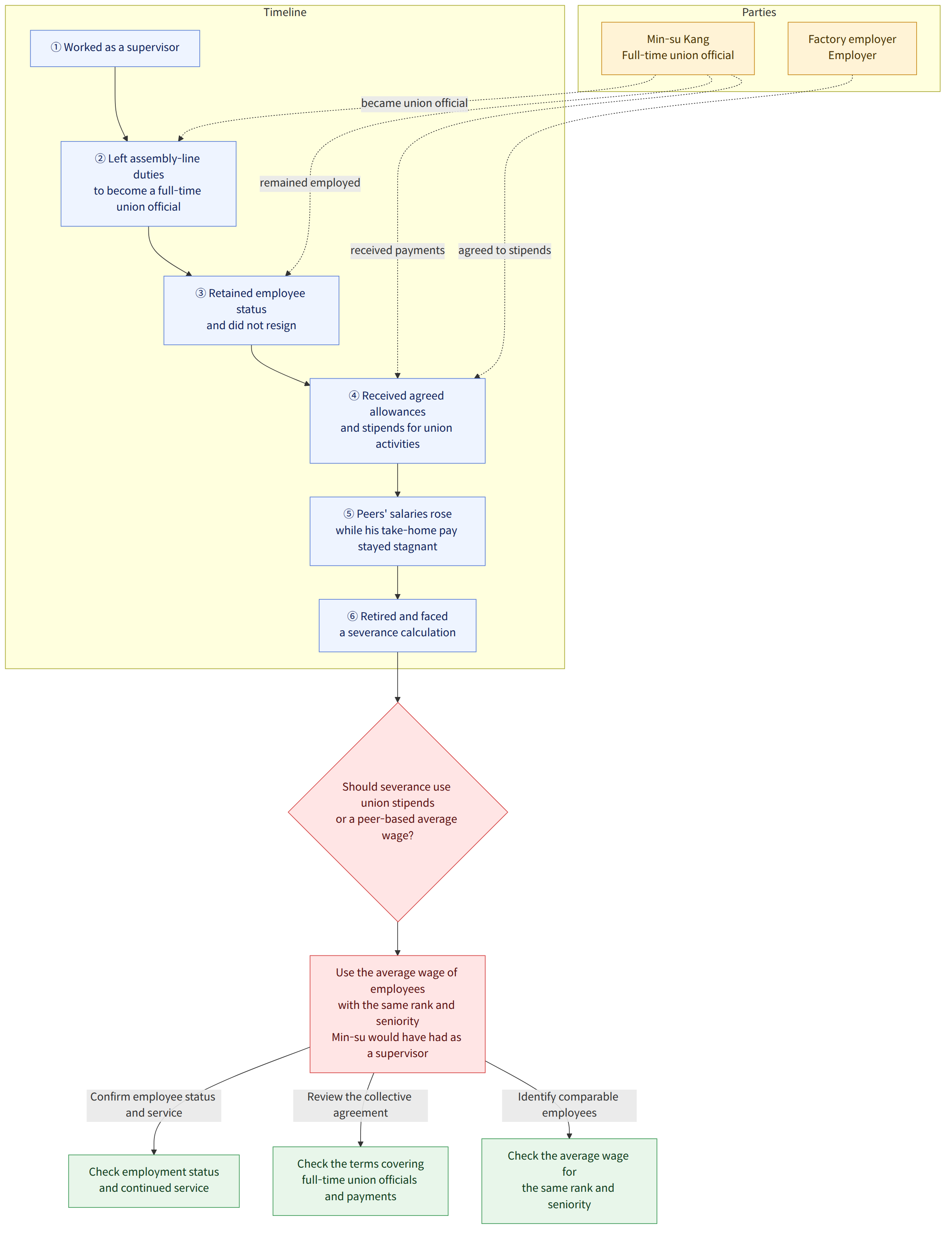
For the past five years, Min-su Kang has been the heartbeat of the workers' union at a large automotive parts factory in Gyeonggi Province. A once-respected floor supervisor, Min-su stepped away from the assembly line to become a full-time union official. He spent his days negotiating safety protocols, handling grievances, and fighting for better working conditions for his colleagues.
Throughout his tenure, Min-su did not receive a standard salary from the company, as he was no longer performing the operational duties of a supervisor. Instead, he received certain allowances and stipends agreed upon in the collective bargaining agreement to support his union activities. As the years passed, his colleagues’ salaries rose due to annual increments and promotions, while Min-su's actual take-home pay remained relatively stagnant.
Now, Min-su is retiring. As he prepares to leave, a wave of anxiety hits him. He looks at the payments he received during his five years as a union leader and realizes that if his severance pay is calculated based on those actual amounts, he will lose a significant portion of his retirement nest egg. He asks himself: "Did my dedication to the union cost me my financial security in old age?"
The Legal Question
When a full-time union official, who has been exempt from performing regular labor and has received payments different from standard wages, retires, what is the legal basis for calculating their severance pay?
What Korean Law Says
Under the Trade Union and Labor Relations Adjustment Act, specifically Article 24, full-time union officials are recognized as individuals who can engage exclusively in union activities without providing the labor prescribed in their employment contract, provided there is a collective agreement or employer consent.
Historically, the law strictly prohibited employers from paying wages to these officials to prevent the company from exerting undue influence over the union. However, a provision added in 2010 allows for "Time-off Systems," where officials can perform union duties without loss of pay within a specific time limit.
Despite these nuances, the core principle regarding severance pay remains rooted in the nature of the employment relationship:
"A full-time union official maintains the basic labor-management relationship and keeps their status as an employee of the company. However, since their obligation to provide labor is waived and the employer's obligation to pay wages is generally waived, their status is similar to that of an employee on a leave of absence."
How Korean Courts Approach This
Korean courts emphasize that the primary purpose of severance pay is to guarantee that a worker can maintain their standard of living after leaving the company.
If a union official's severance pay were calculated based only on the actual stipends they received during their union term, it would unfairly penalize them for taking on a leadership role for the benefit of the collective. Therefore, the judiciary generally rules that payments made to union officials are not "wages for labor" in the traditional sense, but rather support for union activities. To ensure fairness, the court looks at what the worker would have earned had they remained in their professional track.
Applying the Law to the Case
In Min-su Kang's case, the analysis follows these steps:
- Status Confirmation: Even though Min-su wasn't on the assembly line, he never resigned from the company. He remained an employee in status, meaning his tenure continued to accumulate.
- Characterizing the Payments: The stipends Min-su received during his five years of union leadership are viewed as support for union activities, not as "wages" tied to labor productivity. Therefore, these amounts should not be the sole basis for the average wage calculation.
- Finding the Benchmark: To determine the fair amount, the company must look at the average wage of employees who hold the same rank and seniority (pay grade/step) as Min-su would have had if he had continued as a supervisor.
- Calculation: The severance pay is then calculated based on this "hypothetical" average wage of his peers, ensuring his five years of service are valued at the current market rate of his professional grade.
Conclusion: What Happened, and What Should You Do?
For Min-su Kang, the law provides a safety net. He does not have to settle for a low severance payment based on his union stipends. Instead, his retirement package will be calculated based on the average wage of supervisors with his level of experience, ensuring his transition into retirement is financially stable.
Practical Advice for Union Leaders and Members:
- Review the Collective Agreement: Ensure that the agreement clearly defines the status of full-time officials and refers to the maintenance of employee status for benefit purposes.
- Track Your Peer Group: If you are a union official, keep a record of the salary scales and promotions of your peers in the same rank. This serves as critical evidence if a dispute arises regarding the "average wage" of your grade.
- Consult Early: Because the "Time-off System" (introduced in 2010) adds a layer of complexity, officials should consult a legal expert to determine if their specific payments fall under the "wage-exempt" category or the "time-off" category, as this may influence the final calculation.