
A Human Story: The Debt That Threatened a Future
Julian Park had spent fifteen years climbing the corporate ladder at a leading logistics firm in Seoul. He was a dedicated employee, known for his reliability and meticulousness. However, a series of unfortunate personal events—a failed business venture with a friend and mounting medical bills for an elderly parent—had left him buried under a mountain of private debt.
For years, Julian had found solace in knowing that his company’s retirement pension fund was growing. To him, this wasn't just a financial asset; it was his only safety net, the promise of a dignified life once he finally stepped away from the grind. It was the one thing he had managed to keep separate from his financial turmoil.
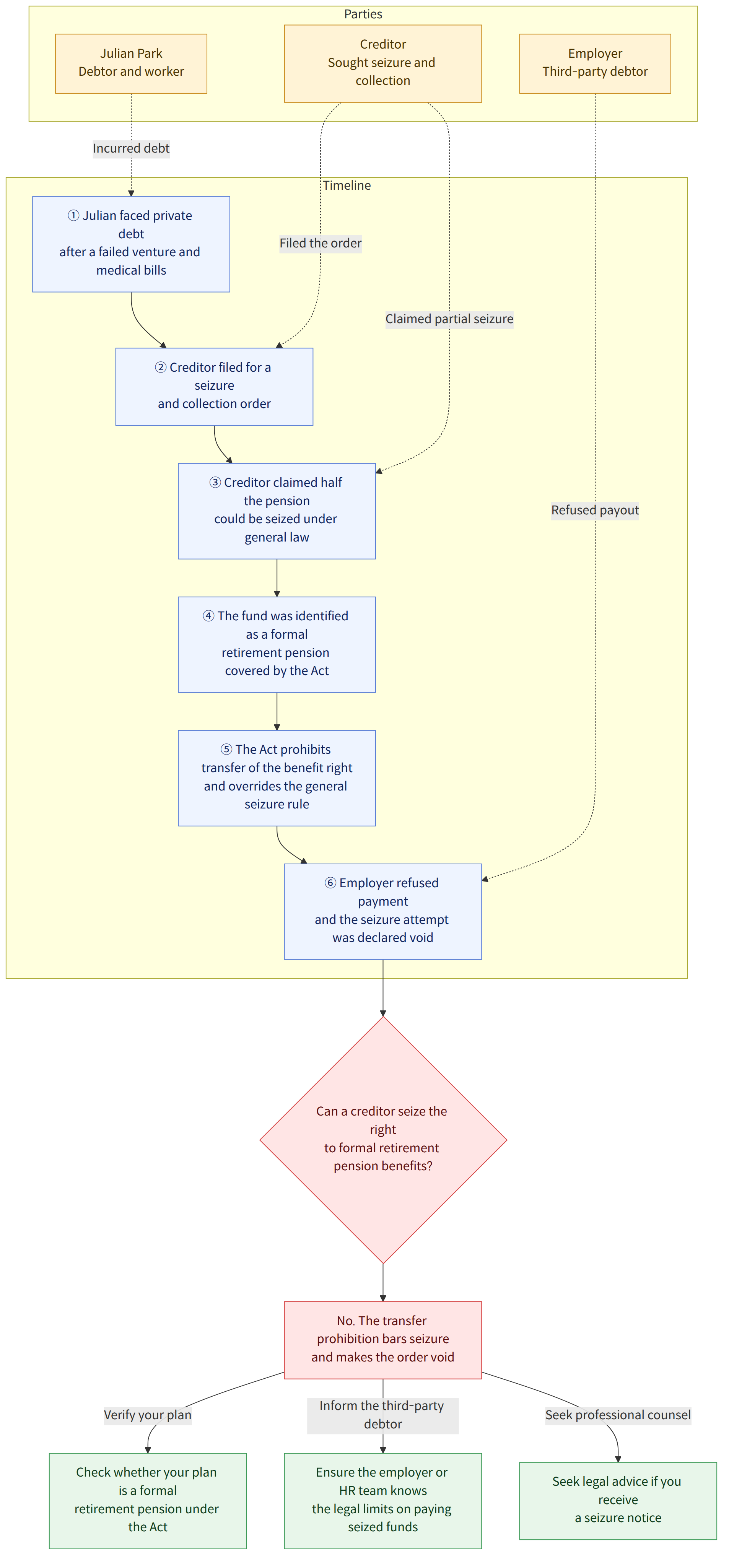
Everything changed on a rainy Tuesday when Julian received a formal notification. A creditor, seeking to recover an old debt, had filed for a seizure and collection order. The creditor claimed that according to general laws, half of Julian's retirement pension could be seized to satisfy the debt. Panicked, Julian felt the ground slip from beneath him. Could his lifelong security be sliced in half by a court order?
The Legal Question
The core issue in Julian's case is whether a retirement pension—specifically the right to receive benefits under a formal retirement pension system—can be partially seized and collected by a creditor to satisfy a debt.
What Korean Law Says
To understand Julian's situation, we must look at two competing pieces of legislation: the Civil Execution Act and the Employee Retirement Benefit Security Act.
- The Civil Execution Act: This general law typically protects a portion of a debtor's income, stating that only a certain percentage (often half) of salaries or similar benefits can be seized, while the rest is preserved for the debtor's basic living expenses.
- The Employee Retirement Benefit Security Act: This is a specialized law designed specifically to ensure the stability of workers' lives after retirement.
Crucial Legal Provision: The Employee Retirement Benefit Security Act explicitly prohibits the transfer of the right to receive benefits from a retirement pension system.
Because this prohibition is considered a "mandatory provision" (강행법규), it is not a suggestion; it is a strict legal barrier intended to protect the worker's survival in old age.
How Korean Courts Approach This
Korean courts have had to decide which law takes precedence: the general Civil Execution Act or the specific Employee Retirement Benefit Security Act.
The judiciary has consistently ruled that the Employee Retirement Benefit Security Act acts as a "special law" that overrides the general Civil Execution Act. The courts reason that if the law prohibits the transfer of the pension right, it logically follows that the right cannot be seized and converted into cash for a creditor.
Essentially, the courts view the retirement pension as an untouchable sanctuary. Any seizure order that contradicts the prohibition of transfer is viewed as legally void from the start.
Applying the Law to the Case
In Julian Park's case, the creditor is relying on the general rule that 50% of similar benefits can be seized. However, this logic fails when applied to a formal retirement pension system.
- Step 1: Identification of the Asset. Julian's fund is a retirement pension governed by the Employee Retirement Benefit Security Act.
- Step 2: Application of the Transfer Prohibition. Under this Act, the right to these benefits cannot be transferred to anyone else.
- Step 3: Legal Precedence. Since the transfer prohibition is a mandatory law, it overrides the Civil Execution Act's allowance for partial seizure.
- Step 4: Validity of the Order. Because the law prohibits the seizure of the entire amount, the creditor's request to seize half of the pension is a violation of mandatory law and is therefore null and void.
Conclusion: What Happened, and What Should You Do?
In the end, Julian Park breathed a sigh of relief. His employer, acting as the third-party debtor, legally refused the creditor's request for payment, citing the mandatory provisions of the Employee Retirement Benefit Security Act. The creditor's attempt to seize the pension was declared void, and Julian's nest egg remained intact.
For those facing similar threats from creditors, keep these three points in mind:
- Verify Your Plan: Confirm whether your retirement benefit is a "Retirement Pension" (퇴직연금) under the formal Act, as this provides stronger protection than a simple severance pay arrangement.
- Inform the Third-Party Debtor: If you are an employer or an HR manager, ensure you are aware that paying out seized pension funds to a creditor could actually be a violation of the law.
- Seek Professional Counsel: If you receive a seizure notice, do not panic. Consult a legal expert to file a formal objection based on the mandatory nature of the retirement benefit laws.