
A Shadow Employee with Clear Instructions: Mirae Kim's Story
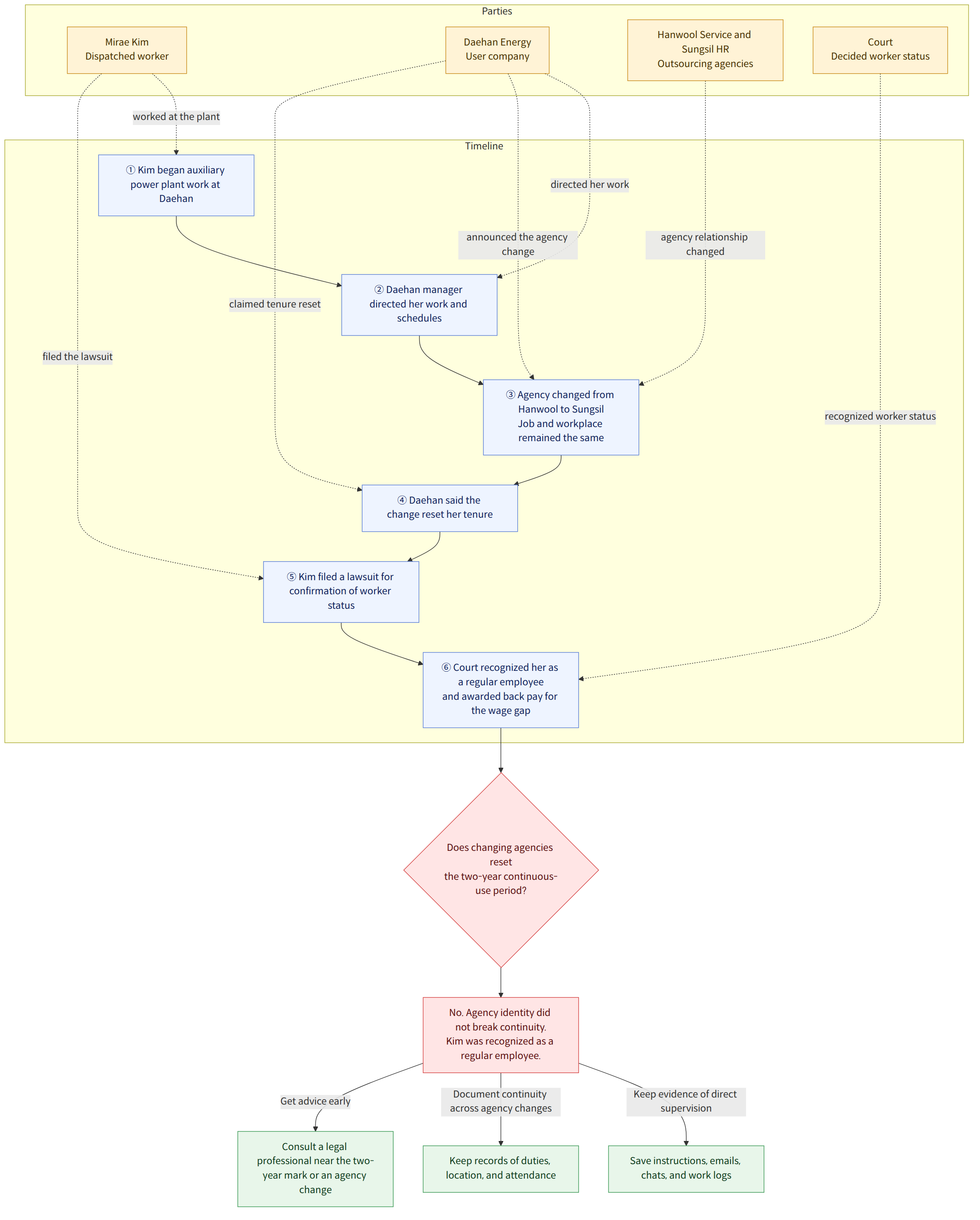
For the past three years, Mirae Kim has been working as an auxiliary power plant worker at Daehan Energy. While her ID badge bore the name of an outsourcing agency, "Hanwool Service," her daily life was governed by Junho Park, a manager at Daehan Energy. Every morning, Mirae attended meetings with Daehan Energy's regular staff and received direct training from Manager Park on chemical sampling and substation maintenance.
Even her shift schedules and sudden changes in work methods were decided by Daehan Energy, not Hanwool Service. To Mirae, Hanwool was merely the name on the bank account that sent her monthly paycheck. One day, Daehan Energy announced it was switching its outsourcing partner to "Sungsil HR." Although Mirae continued doing the same job at the same desk, Daehan Energy told her, "Since the agency has changed, your tenure starts at zero. You have no right to ask for a regular position."
The Legal Question: Does a New Agency Reset the Two-Year Clock?
The core issue in this case is whether the "direct employment obligation" under the Act on the Protection, etc., of Dispatched Workers (the "Dispatched Worker Act") is interrupted when the dispatch agency (the outsourcing company) is replaced. The question is whether a worker like Mirae, who has effectively been under the command of the user company (Daehan Energy) for over two years, loses her rights simply because of an administrative change in the middleman.
What Korean Law Says: The Protection of Dispatched Workers
Korean law mandates that if a user company utilizes a dispatched worker for more than a certain period, that company must take responsibility and hire them directly.
Article 6-2 (Obligation to Employ) of the Dispatched Worker ActWhere a user employer has continuously used a dispatched worker for more than two years, the user employer shall directly employ the dispatched worker.
This provision is designed to prevent the long-term use of unstable dispatched labor and to ensure the job security of workers. If a company fails to fulfill this duty, the worker has the legal right to seek a court judgment that replaces the employer's expression of intent to hire.
How Korean Courts Approach This
The Supreme Court of Korea prioritizes the reality of who actually used the labor over the formal identity of the dispatch agency.
- Substance Over Form: Even if the outsourcing agency changes, if the worker continues to work at the same workplace under the direction of the same user company, it is regarded as "continuous use."
- Irrelevance of Agency Identity: Article 6-2 governs the legal relationship between the user company and the worker. Therefore, a change in the dispatch agency does not exempt the user company from its obligation to hire the worker directly.
- Liability for Damages: During the period when the company fails to fulfill its direct employment duty, the user company must pay the worker damages equivalent to the difference between the wages they received and the wages they would have earned as a regular employee.
Applying the Law to Mirae's Case
In Mirae's situation, she spent three years under the same user company, Daehan Energy. Although the name of the agency changed from "Hanwool Service" to "Sungsil HR," the nature of her work, the person giving instructions (Manager Junho Park), and her work location all remained identical.
Therefore, contrary to Daehan Energy's claim, Mirae's tenure was not reset. She had already acquired the right to be directly employed at the two-year mark. The court would likely rule in favor of Mirae, confirming her status as a regular employee or ordering Daehan Energy to fulfill its hiring obligation.
Conclusion: What Happened, and What Should You Do?
Mirae Kim successfully filed a "lawsuit for confirmation of worker status" and was recognized as a regular employee of Daehan Energy. She also received back pay for the wage gap she endured since the day her direct employment should have begun.
If you find yourself in a similar situation, keep these practical tips in mind:
- Gather Evidence of Direct Supervision: Save emails, messenger chats, and work logs that show you received direct instructions from the user company's (the prime contractor's) staff.
- Document Your Continuity: Even if the agency changes, keep records showing your job duties and location remained the same (such as attendance records or security logs).
- Consult a Professional Early: Labor laws regarding illegal dispatch are complex. If your two-year mark is approaching or your agency is being replaced, consult a legal expert immediately to build a strategy.
This column is provided for general informational purposes only and does not constitute specific legal advice. For your specific case, please consult with a qualified legal professional.