1. A Human Story
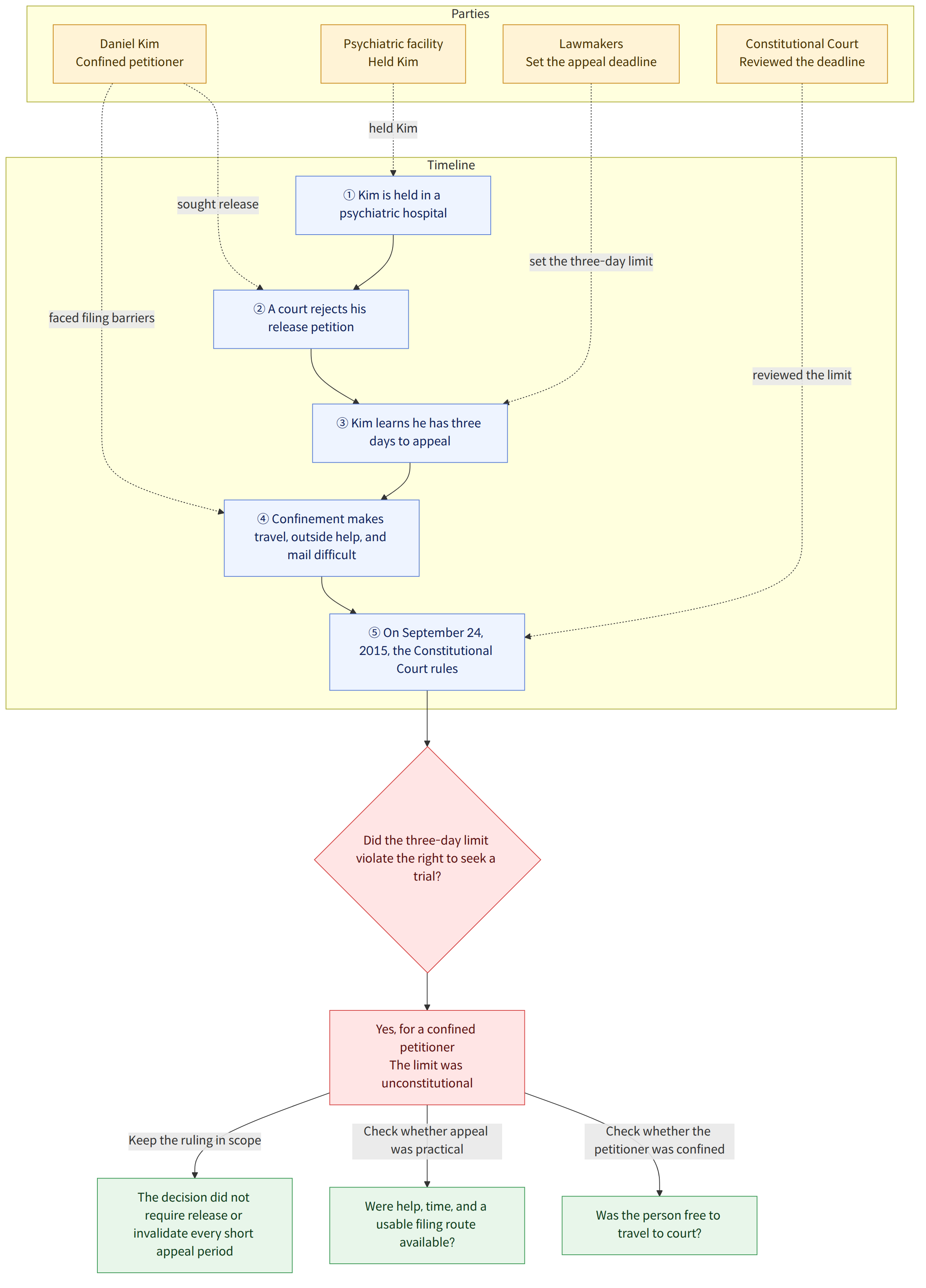
When Daniel Kim learned that a court had rejected his request to be released from a psychiatric hospital, he did not have the ordinary freedom to respond. He was being held against his will, and the courthouse where he needed to file an appeal was beyond the hospital gates.
A staff member told Daniel that the law gave him three days. He could try to find someone outside the hospital willing to help, or write an appeal and send it by post. But either option required time—and relied on assistance he could not command. Daniel’s predicament raises a basic question: can the law set an appeal deadline so short that a person in confinement may be unable to use it in practice?
2. The Legal Question
The issue is whether giving a person held in a facility just three days to appeal a court’s rejection of a petition for release violates the right to seek a decision from a court under the Korean Constitution.
3. What Korean Law Says
The In Habeas Corpus Act provides a court procedure for a person who believes they are being unlawfully confined in a facility to ask for relief. In the version examined by the Constitutional Court, Article 15 set a three-day period for an immediate appeal from the relevant court decision.
The former Article 15 allowed the petitioner and the facility to file an immediate appeal against the decision within three days.
That rule applied to the petitioner even when the petitioner was the person confined. The constitutional difficulty was not simply that three days sounds brief. It was how the deadline worked for someone whose liberty was already restricted.
The Constitutional Court identified several practical barriers:
- A confined petitioner could not necessarily travel to court and submit an appeal personally.
- Filing through someone outside the facility depended on that person’s willingness and ability to help.
- Preparing an appeal and sending it by mail took time, including the time for the document to reach the court.
- The possibility of appointing a court-appointed lawyer did not solve the problem: it was not clear that the lawyer necessarily had authority to appeal, and the law did not provide an extension mechanism that would make the three-day period workable.
- Filing a new petition was not the same as appealing the decision. The availability of one procedure did not make an unduly restrictive deadline for the other acceptable.
The right to seek justice does not mean every deadline is unconstitutional. It does mean that a procedural rule must leave a real, usable opportunity to bring a claim before a court. The state may pursue prompt decisions, but the restriction must not make the right largely theoretical for the people expected to use it.
4. How Korean Courts Approach This
Korean constitutional review looks beyond the words of a deadline to the circumstances of the people bound by it. A filing period that might be manageable for someone free to travel, use a phone, and consult counsel may operate very differently for someone confined in an institution.
A court-access guarantee must be practical, not merely formal. A remedy on paper is not enough if the person entitled to use it cannot reasonably reach the court in time.
In its September 24, 2015 decision, the Constitutional Court held that the three-day period for a confined petitioner to bring an immediate appeal violated the right to seek a trial. The Court accepted that the legislature had a legitimate interest in resolving a person’s detention status promptly. But it reasoned that allowing somewhat more time would not significantly frustrate that aim, while three days imposed a severe burden on a petitioner who could not freely act for themselves.
The decision was a simple unconstitutionality ruling about this particular three-day limit. It did not hold that all short appeal periods are invalid, nor did it decide that every person whose petition is rejected must be released.
5. Applying the Law to the Case
Daniel’s situation shows why the deadline failed when measured against the reality of confinement.
- His ability to file was restricted. Unlike a person at liberty, Daniel could not simply go to the courthouse. A deadline must account for that practical obstacle, not assume that filing is equally easy for everyone.
- Outside assistance was uncertain. Daniel might have asked a friend or relative to deliver the appeal, but the law could not assume that a helper would be available, willing, and able to act within three days. Depending on another person’s goodwill was not a reliable substitute for a usable procedure.
- Mail did not make the deadline adequate. Daniel would need time to learn of the decision, prepare the appeal, and send it. The court also had to receive the filing. The Constitutional Court concluded that the three-day period was not sufficient simply because postal filing was technically possible.
- A lawyer did not necessarily cure the problem. The possibility of appointing a lawyer did not establish that the lawyer automatically had authority to appeal. And even if the lawyer could appeal, the relevant procedure lacked the kind of special extension provision that could address the difficulty of meeting a short deadline.
- A fresh petition was not an equivalent appeal. Daniel could potentially make another request, but a new petition and an appeal serve different procedural purposes. The existence of the former did not justify making the latter practically inaccessible.
The balance therefore came out in Daniel’s favor on the constitutional question. The public interest in reaching a prompt decision was real, but the Court concluded that a modestly longer period could serve that interest without placing such an excessive burden on a confined person’s ability to challenge the decision.
6. Conclusion: What Happened, and What Should You Do?
The Constitutional Court’s ruling resolved the central issue in Daniel’s story: the former three-day deadline, insofar as it applied to a confined petitioner seeking to appeal, violated the constitutional right to seek a trial. That ruling did not determine the underlying merits of Daniel’s request or guarantee his release. It addressed whether he had a fair and usable opportunity to challenge the court’s decision.
For anyone facing a similar situation:
- Act immediately, but check the current law. The ruling concerned an earlier version of the statute; do not assume that the former three-day period is the rule today.
- Keep a record of key dates and obstacles. Note when the decision was received, attempts to obtain legal help, and any restrictions on communicating or filing.
- Ask for legal assistance promptly. Contact a lawyer, legal aid service, or trusted person who can confirm the applicable deadline and filing method. A constitutional ruling about an old deadline is not a substitute for checking the procedure that applies now.