
A Sudden Ticket to Busan: Mr. Park’s Dilemma
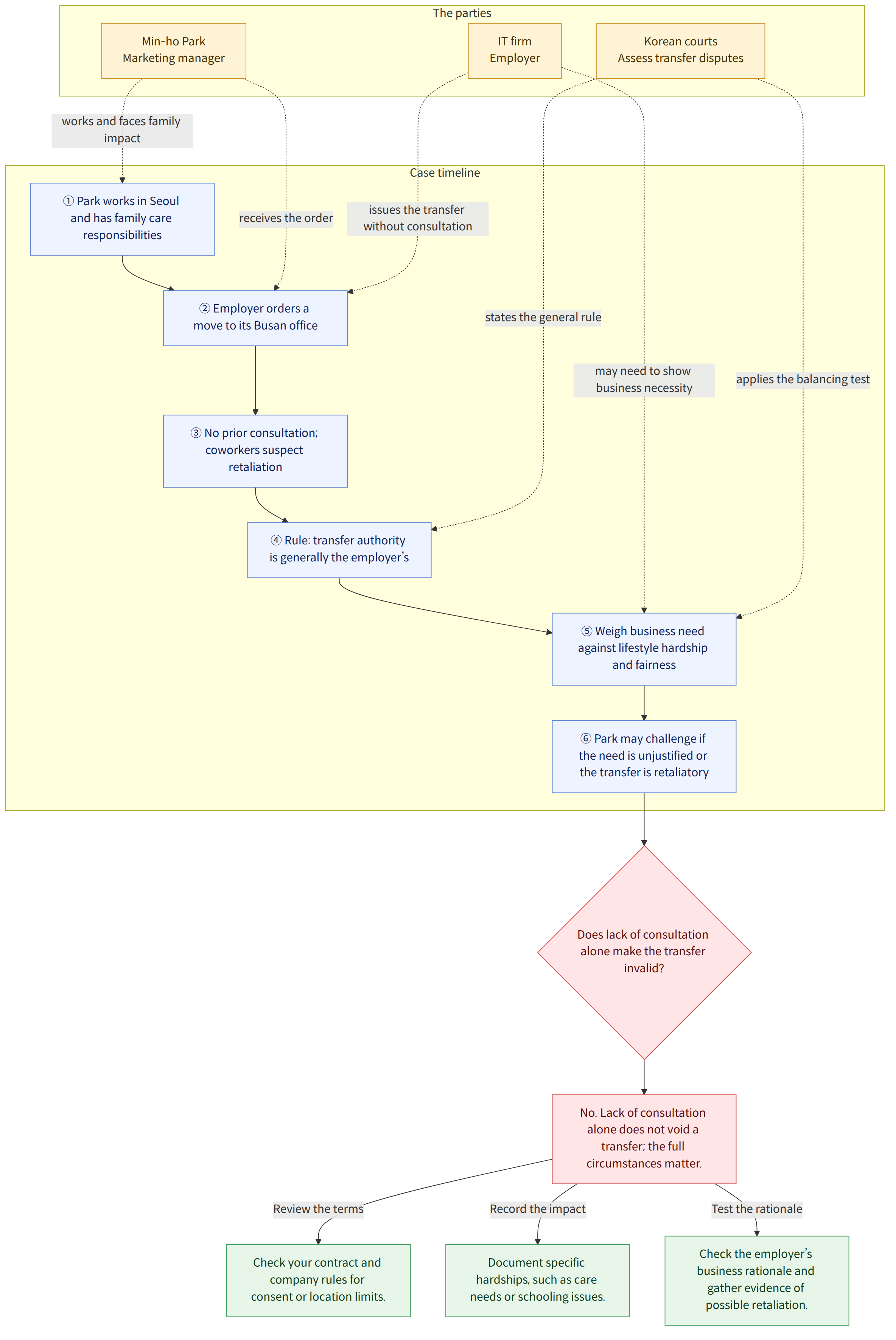
Min-ho Park, a marketing manager with seven years of service at a mid-sized IT firm in Seoul, received a life-altering notification last Friday just before clocking out. Starting next month, he was to report to the company’s regional office in Busan. For Min-ho, who lives with his primary-school-aged daughter and an elderly mother with mobility issues, this move wasn't just a change of scenery—it was a total upheaval of his family’s stability.
What stung more than the distance was the company’s cold approach. There had been no prior meetings, no feedback sessions, and certainly no request for his consent. Rumors swirled in the office that this was a 'punishment transfer' because Min-ho had recently challenged a senior executive’s proposal. Indignant, Min-ho wondered, "Can they really move my entire life without even asking me? Isn't a transfer without consultation naturally void?"
The Legal Question: Validity of Non-Consensual Transfers
The core legal issue here is whether a personnel transfer decided unilaterally by an employer—without any prior consultation or agreement with the employee—is automatically invalid due to this procedural lapse.
What Korean Law Says About Personnel Authority
Under Korean labor law, the authority to transfer or relocate employees is fundamentally recognized as an inherent right of the employer to manage their workforce.
General Principle of the Supreme Court:"Personnel transfers or relocations fall within the inherent authority of the employer. Therefore, the employer possesses significant discretion within the scope of business necessity, and such orders are valid unless they violate the Labor Standards Act or constitute an abuse of rights."
For a transfer to be considered a legitimate exercise of this authority, it must generally meet these criteria:
- No violation of the Labor Standards Act or specific terms in the employment contract.
- No abuse of rights by the employer.
- Presence of a legitimate business necessity.
How Korean Courts Approach This
Korean courts do not look at procedural consultation in isolation. Instead, they apply a "Balancing Test" to determine if an abuse of rights has occurred. This involves weighing the business necessity of the transfer against the disadvantage to the employee’s lifestyle.
If the transfer is deemed necessary for the company’s operations and the resulting lifestyle disadvantage (such as separation from family) does not significantly exceed what a typical employee is expected to endure, the court will likely uphold the order.
Regarding the lack of consultation, the Supreme Court has clarified its stance: While whether an employer engaged in sincere consultation is a factor in determining if the personnel authority was exercised fairly, the mere failure to go through such a procedure does not, in itself, render the transfer void as an abuse of rights.
Applying the Law to Mr. Park’s Case
In Min-ho’s case, the lack of communication, while frustrating, is not a "silver bullet" to cancel the order.
- Procedural Aspect: Unless Min-ho’s specific employment contract or the company’s Rules of Employment (취업규칙) explicitly state that "prior consent is required for relocation," the company has the legal right to issue the order without his agreement.
- Substantive Aspect: If the company can prove that the Busan office desperately needs a marketing expert and Min-ho is the best fit, his family obligations will be weighed against this need. Unfortunately, standard family hardships are often viewed by courts as "bearable" unless they are extreme (e.g., being the sole caregiver for a critically ill family member with no alternatives).
- Potential for Abuse: If Min-ho can prove the transfer was purely retaliatory due to his disagreement with the executive, the court might find it to be an abuse of rights, but the burden of proof lies heavily on him.
Conclusion: What Happened, and What Should You Do?
For Min-ho, the path forward is not just to complain about the lack of talk, but to prove the disproportionate hardship the move causes. If the company cannot justify the business need for him specifically to be in Busan, he may have a case at the Labor Relations Commission.
Practical Tips for Readers:
- Check Your Contract: Always review your employment contract and company bylaws for clauses regarding "consent for relocation." If your contract limits your work location to a specific city, the company cannot move you without an amendment.
- Document Everything: If you believe a transfer is unfair, document the specific hardships it will cause (medical records of dependents, schooling issues) and send a formal letter/email to the company requesting a reconsideration based on these facts. This creates a paper trail of the "lifestyle disadvantage."
- Consultation as a Factor: While not a deal-breaker, if the company failed to consult you and the business necessity is weak, the lack of consultation becomes a stronger argument for an abuse of rights.