
The Cog in the Hospital Machine: The Case of James Kim
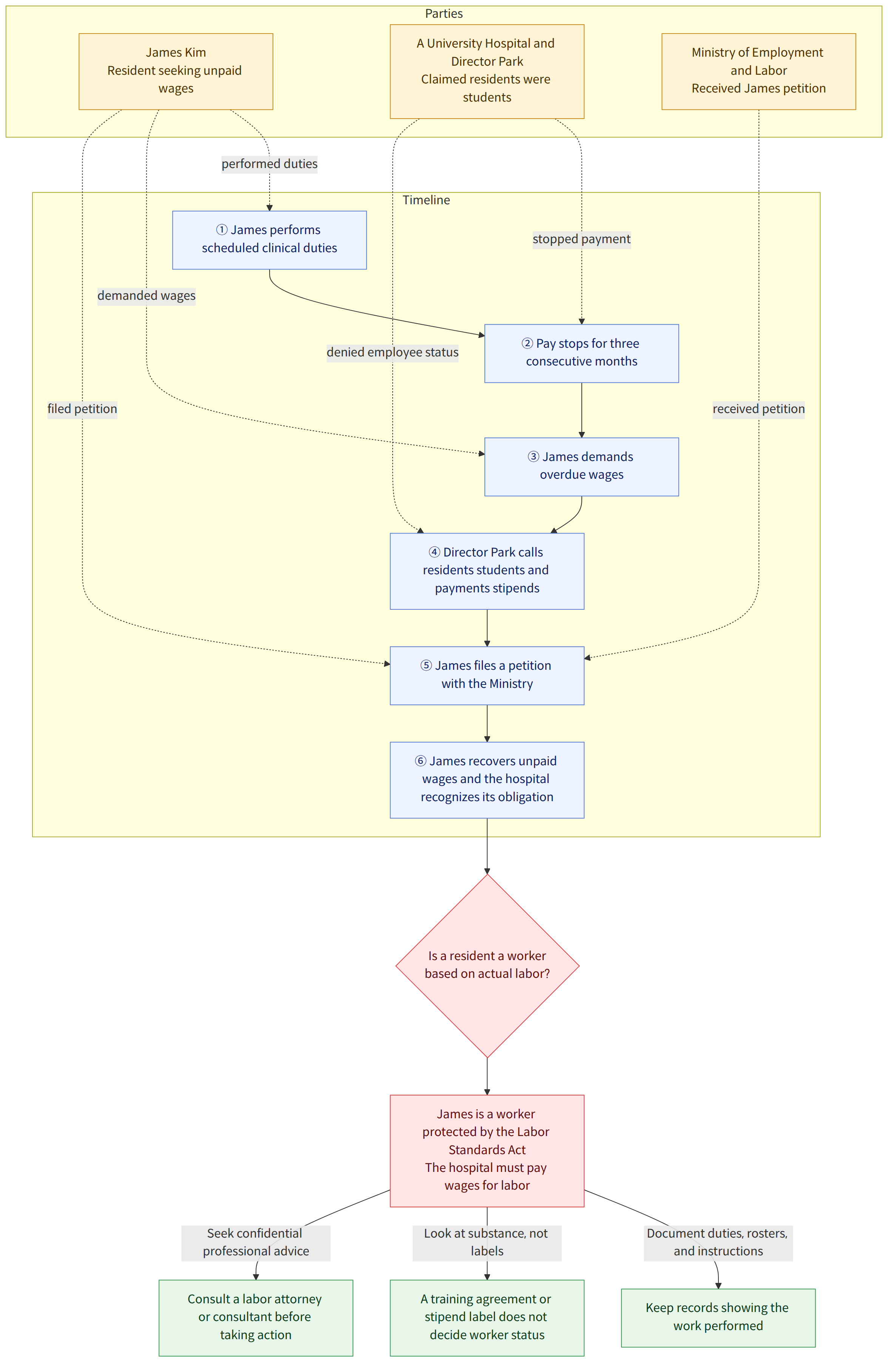
For James Kim (a pseudonym), a third-year internal medicine resident at the prestigious A University Hospital, the day begins at 5 AM. From checking on patients who arrived in the ER overnight to preparing for the professor's rounds, his schedule is packed with prescriptions and surgical assistance. He endured this grueling routine, believing it was the 'training' necessary to become a specialist. However, his patience reached its limit when his paycheck stopped appearing for three consecutive months.
When James finally approached the hospital administration to demand his overdue wages, Director Park gave an unexpected response: "Residents are students in a learning process, not employees. The money we gave you before was a 'scholarship' or a stipend to support your studies out of goodwill. It's inappropriate to demand wages for an educational course, don't you think?"
Fearful that challenging this might jeopardize his future career, James found himself at a crossroads. Was he a 'worker' entitled to legal protection, or merely a 'student' as the hospital claimed?
The Legal Question: What is the Legal Status of a Resident?
The core of this issue lies in whether a medical resident (intern or resident) undergoing training to obtain a specialist license qualifies as a 'worker' under the Labor Standards Act. While hospitals often emphasize the 'educational' nature of residency to deny employment status, the legal determination depends on the actual nature of the services provided.
What Korean Law Says
Korean law prioritizes the reality of the working relationship over the formal title of the contract.
Article 2, Paragraph 1, Clause 1 of the Labor Standards Act"The term 'worker' means a person, regardless of the kind of occupation, who provides labor to a business or workplace for the purpose of earning wages."
To determine if a resident is a worker, the following factors are considered:
- Is the work performed under the direction and supervision of the hospital?
- Is the work performed according to a schedule set by the hospital?
- Is money paid as compensation for the labor provided?
How Korean Courts Approach This: The 'Dual Status' Principle
The Supreme Court of Korea recognizes the unique position of residents but has consistently ruled in favor of their status as workers. The court holds that residents possess a 'dual status': they are both 'trainees' and 'workers'.
Key principles from judicial precedents include:
- Subordinate Relationship: Residents perform medical duties under the hospital's command and supervision, establishing an employer-employee relationship.
- Value of Labor: The medical services provided by residents—such as patient care—constitute essential labor required for the hospital's operation.
- Nature of Payments: Even if payments are labeled as 'scholarships' or 'living expenses,' they are legally viewed as wages if they are paid in exchange for labor.
Applying the Law to James’s Case
In James Kim’s case, although he is in a training program for his specialization, he provided specific labor such as hospital rounds, patient treatment, and ER shifts according to a schedule dictated by the hospital. This work was performed under the authority of Director Park and the institution.
Therefore, the hospital's argument that the money was a 'goodwill scholarship' does not hold water legally. James is a worker protected by the Labor Standards Act. He has the right to claim his unpaid wages, and the hospital's refusal constitutes a violation of labor laws.
Conclusion: Your Labor Cannot Be Erased in the Name of Education
Ultimately, James filed a petition with the Ministry of Employment and Labor. Based on Supreme Court precedents, he was able to recover all his unpaid wages. The hospital was also forced to recognize its legal obligation to treat residents as employees.
For residents or interns in similar situations, here are a few practical tips:
- Document Your Work: Keep detailed records of your clinical duties, duty rosters, and specific instructions received. These serve as evidence of the 'reality' of your labor.
- Substance Over Form: Do not be discouraged if your contract is called a 'Training Agreement' or your pay is called a 'Stipend.' If you are providing labor, the law recognizes you as a worker.
- Consult Professionals: If you fear retaliation within the hospital, seek confidential advice from a labor attorney or a consultant to understand your rights before taking action.
Your hard work is both an educational journey and a noble labor. The law ensures that the value of that labor is protected.