1. A Designer's Dilemma During the Job Hunt
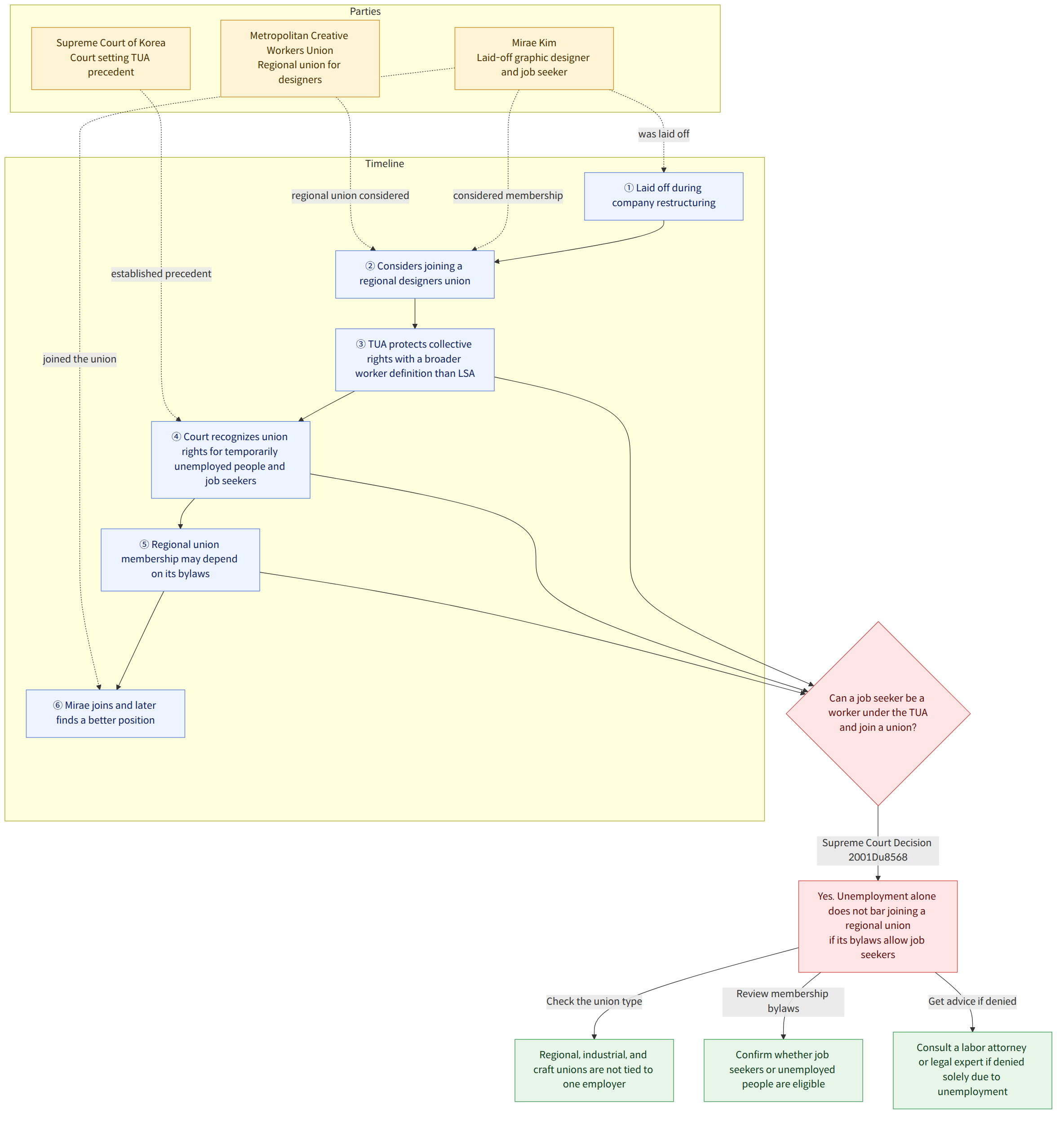
Mirae Kim, a graphic designer with five years of experience, found herself at a crossroads after being laid off due to a sudden company restructuring. Overnight, her identity shifted from a busy professional to a job seeker. Despite the shock, she wanted to stay connected to her industry and protect her professional standing during this transition.
She discovered the 'Metropolitan Creative Workers Union,' a regional organization advocating for designers and IT workers. The idea of professional networking and legal support while job hunting was appealing. However, Mirae hesitated at the door of the union office. "I don't have an employer or a monthly salary right now," she thought. "Am I even considered a 'worker' who is legally allowed to join a union?"
2. The Core Legal Question
This case hinges on a vital question: Can an unemployed individual or a job seeker be legally recognized as a 'worker' under the Trade Union and Labor Relations Adjustment Act (TUA) to exercise their right to join a union?
3. What Korean Law Says: Two Definitions of 'Worker'
South Korean labor law employs two distinct definitions of a "worker," depending on the legislative purpose.
First, there is the Labor Standards Act (LSA) definition:
"A worker means a person, regardless of the type of occupation, who provides labor to a business or workplace for the purpose of earning wages." This definition governs the individual relationship between an employer and an employee, focusing on those currently performing work.
Second, there is the Trade Union and Labor Relations Adjustment Act (TUA) definition:
"A worker means a person who lives on wages, salary, or other equivalent income, regardless of the type of occupation." This law aims to guarantee the 'Three Labor Rights' (the right to associate, collective bargaining, and collective action). Consequently, it adopts a broader interpretation to protect collective interests.
- Key Differences:
- LSA: Requires an active employment relationship and wage payment (Individual Protection).
- TUA: Focuses on the necessity of protecting labor rights regardless of current employment status (Collective Protection).
4. How Korean Courts Approach This
The Supreme Court of Korea has established a clear precedent regarding the union rights of the unemployed (e.g., Supreme Court Decision 2001Du8568, Feb 27, 2004).
The court distinguishes between enterprise-based unions (limited to employees of a specific company) and industrial, craft, or regional unions. While enterprise unions generally require current employment at that specific firm, regional and industrial unions are not inherently tied to a single employer.
The Judiciary's principle is as follows:
"The term 'worker' under the TUA includes not only those currently employed by a specific employer but also those who are temporarily unemployed or seeking work, as long as there is a need to guarantee their Three Labor Rights."
5. Applying the Law to Mirae’s Case
Analyzing Mirae’s situation through these legal lenses yields a clear result.
First, the union Mirae wishes to join is a 'regional union' for designers. Such unions are designed to protect workers within a specific trade across a geographic area, rather than within a single company.
Second, although Mirae is not currently receiving a paycheck, she is someone who lives on the prospect of wages and has a history of wage-based labor. Under the TUA, she maintains her status as a 'worker' because she still needs the collective power to negotiate fair standards for her future employment and to improve her social and economic status.
Therefore, if the union’s own bylaws allow for the inclusion of job seekers, there is no legal barrier preventing Mirae from becoming a member.
6. Conclusion: What Happened, and What Should You Do?
In the end, Mirae Kim successfully joined the union. She found that her status as a job seeker did not strip her of her fundamental labor rights. Through the union, she gained access to industry-specific legal advice and a network that eventually helped her secure a new position with better working conditions.
For readers in a similar situation, here are practical tips:
- Identify the Union Type: Your right to join while unemployed is most strongly protected in regional, industrial, or craft-based unions rather than company-specific ones.
- Review the Union Bylaws: Check if the union's internal rules explicitly list 'job seekers' or 'unemployed' individuals as eligible for membership. Most modern regional unions do.
- Understand Your Rights: Remember that the 'Three Labor Rights' are constitutional. If you are unfairly denied membership in a regional union solely based on your unemployment status, consult a labor attorney or a legal expert to challenge the decision.
Your professional identity and your rights as a worker do not vanish the moment you leave a workplace. As Mirae discovered, the law provides a safety net for collective action even in the gaps between jobs.