The Sudden Desk-Clearing of Team Leader David Harrison
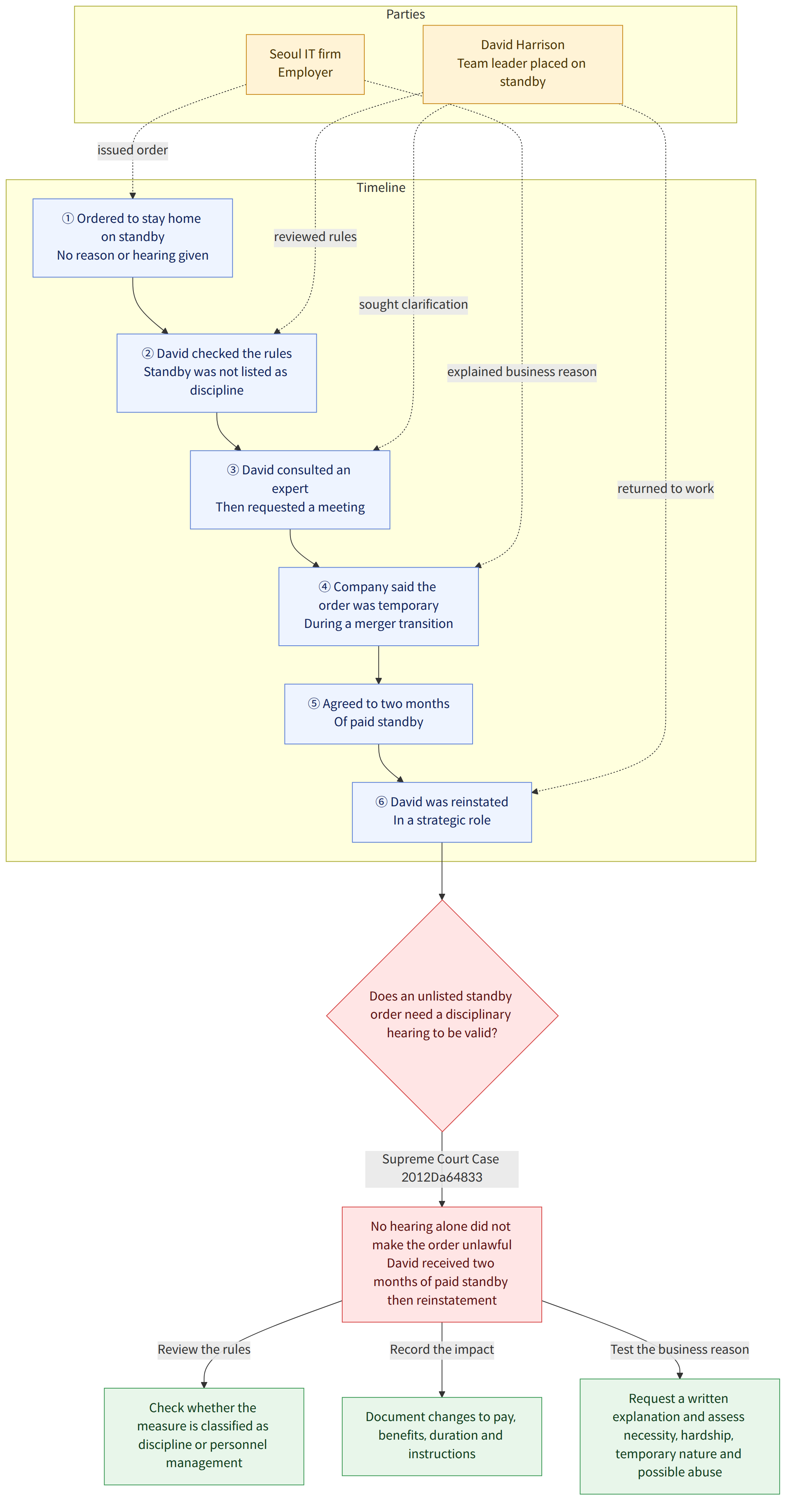
David Harrison, a dedicated team leader at a mid-sized IT firm in Seoul, arrived at work one Tuesday to find a chilling memo on his desk. He was being placed on "standby status" (waiting for assignment) effective immediately. He was told to stay at home until further notice. No explanation was given, and no disciplinary committee had been convened.
David was stunned. He reviewed the company’s internal personnel regulations and noticed that while "suspension" and "dismissal" were listed as disciplinary measures, "standby for assignment" was nowhere to be found in the disciplinary section. "How can they effectively suspend me without even a hearing?" he wondered. Feeling humiliated as he packed his belongings under the gaze of his colleagues, David decided to investigate whether this move was a legitimate exercise of management authority or a violation of his rights.
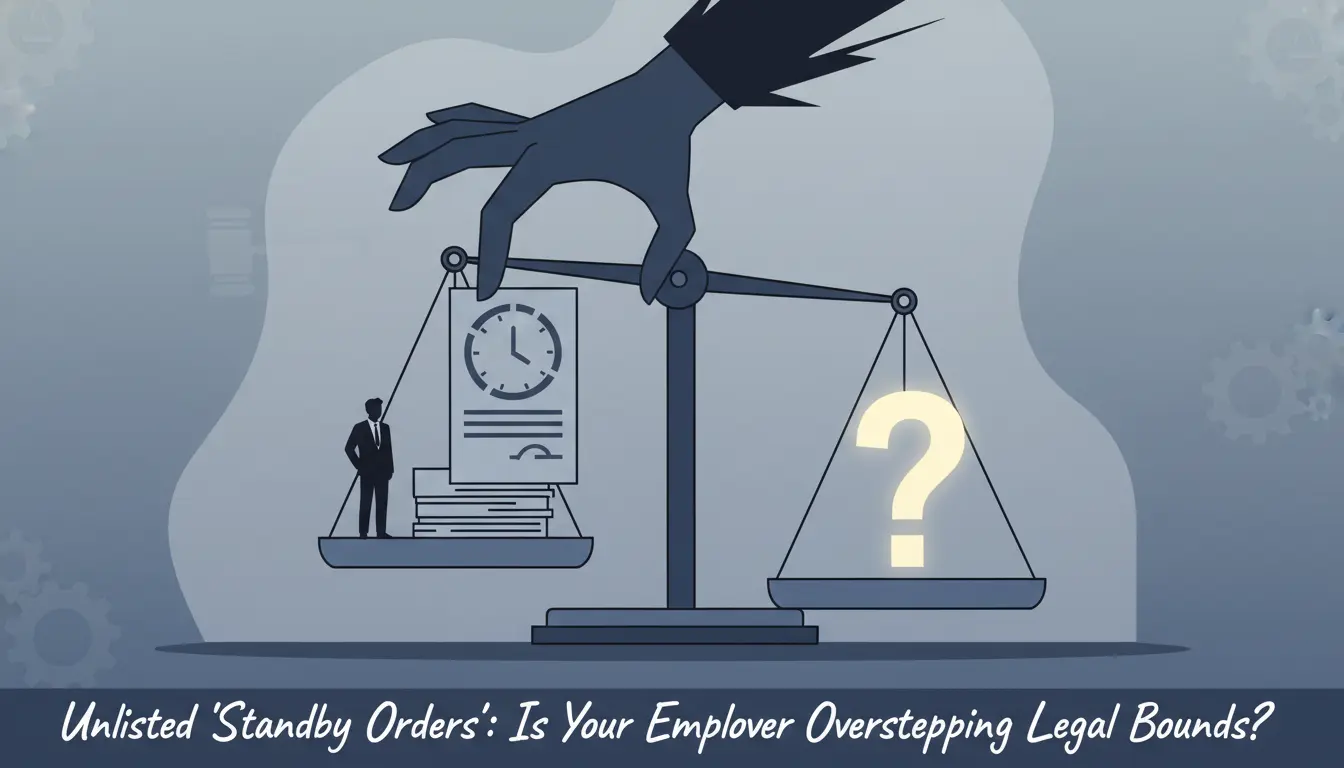
Is an Unlisted Standby Order Legally Valid?
The core of David’s dilemma lies in whether a company can issue a standby order that isn't explicitly listed as a disciplinary measure in its internal rules, and whether such an order is valid even if no disciplinary procedures—like a chance to defend oneself—were followed.
What Korean Law Says About Management Prerogatives
Under Korean law and Supreme Court precedents, the authority to manage personnel is recognized as an inherent right of the employer. Even if an order is disadvantageous to the employee, it is often categorized as a "personnel order" rather than a "disciplinary action."
"Even if a measure is disadvantageous to an employee, if it is not defined as a disciplinary action in the employment rules or personnel regulations, it should, in principle, be viewed as a personnel order within the employer's inherent authority."
In this context, personnel orders are granted:
- Substantial Discretion: Employers are allowed significant leeway to make decisions deemed necessary for business operations.
- Procedural Flexibility: Unlike formal disciplinary actions, which must strictly follow the procedures outlined in company rules (such as holding a committee meeting), personnel orders often do not require such formalities unless specified.
How Korean Courts Approach This Issue
The Korean Supreme Court (e.g., Case 2012Da64833) holds that the mere lack of a disciplinary process does not make a standby order illegal. However, this doesn't mean an employer has a blank check. The court examines the substance of the situation rather than just the name of the order. Key factors include:
- Business Necessity: Is there a legitimate operational reason to remove the employee from their current post?
- Degree of Disadvantage: Does the order cause excessive professional or financial hardship to the worker?
- Provisional Nature: Is the order a temporary measure meant to resolve a specific situation, or is it a disguised permanent dismissal?
- Abuse of Rights: Is the order being used as a tool for harassment or to unfairly pressure the employee to resign?
Applying the Law to David’s Case
In David’s situation, the fact that the company did not hold a disciplinary hearing is not, in itself, a legal violation. Since "standby for assignment" is not categorized as a disciplinary measure in the company's rules, it is treated as a personnel order.
If the company can show that David’s removal was necessary for a pending reorganization or a temporary project shift, the order is likely legal. However, if David was ordered to stay home indefinitely with a massive pay cut for no clear reason, he could argue that the company is abusing its managerial rights. The legality hinges on the balance between the company's business needs and the impact on David's livelihood.
Conclusion: What Happened to David, and What Should You Do?
After consulting with a legal expert, David realized that the lack of a hearing didn't automatically make his situation illegal. Armed with this knowledge, he chose to negotiate rather than sue immediately. He requested a meeting to clarify the duration of his standby status. The company eventually admitted the order was a temporary measure during a merger transition. They agreed to a two-month paid standby period, after which David was successfully reinstated in a new strategic role.
If you find yourself in a similar situation, consider these practical tips:
- Review Your Employment Rules: Check if the specific measure (standby, relocation, etc.) is listed under 'Discipline' or 'Personnel Management.'
- Document the Impact: Keep records of any salary changes, loss of benefits, or the specific instructions given to you during the standby period.
- Assess Business Necessity: Ask the company for a written explanation of the business reason for the order. If the reason is vague or non-existent, you may have grounds to claim an abuse of power.
Understanding these legal distinctions can help you navigate the complex waters of Korean labor relations with clarity and confidence.