On October 9, 2026, the Democratic Party of Korea (더불어민주당) pushed back against the U.S. official-duty travel visa for Representative Jung Cheong-rae being put on hold, saying it was “not how one treats an ally” and “completely unacceptable.” Jung was unable to take part in the National Assembly audit (국정감사) in the United States, and his assigned region for the Foreign Affairs and Unification Committee (외교통일위원회) audit of overseas missions was changed to Europe. However, reports described the visa as delayed or still under review; there is no confirmation that the United States has definitively refused to issue it.
Background and context
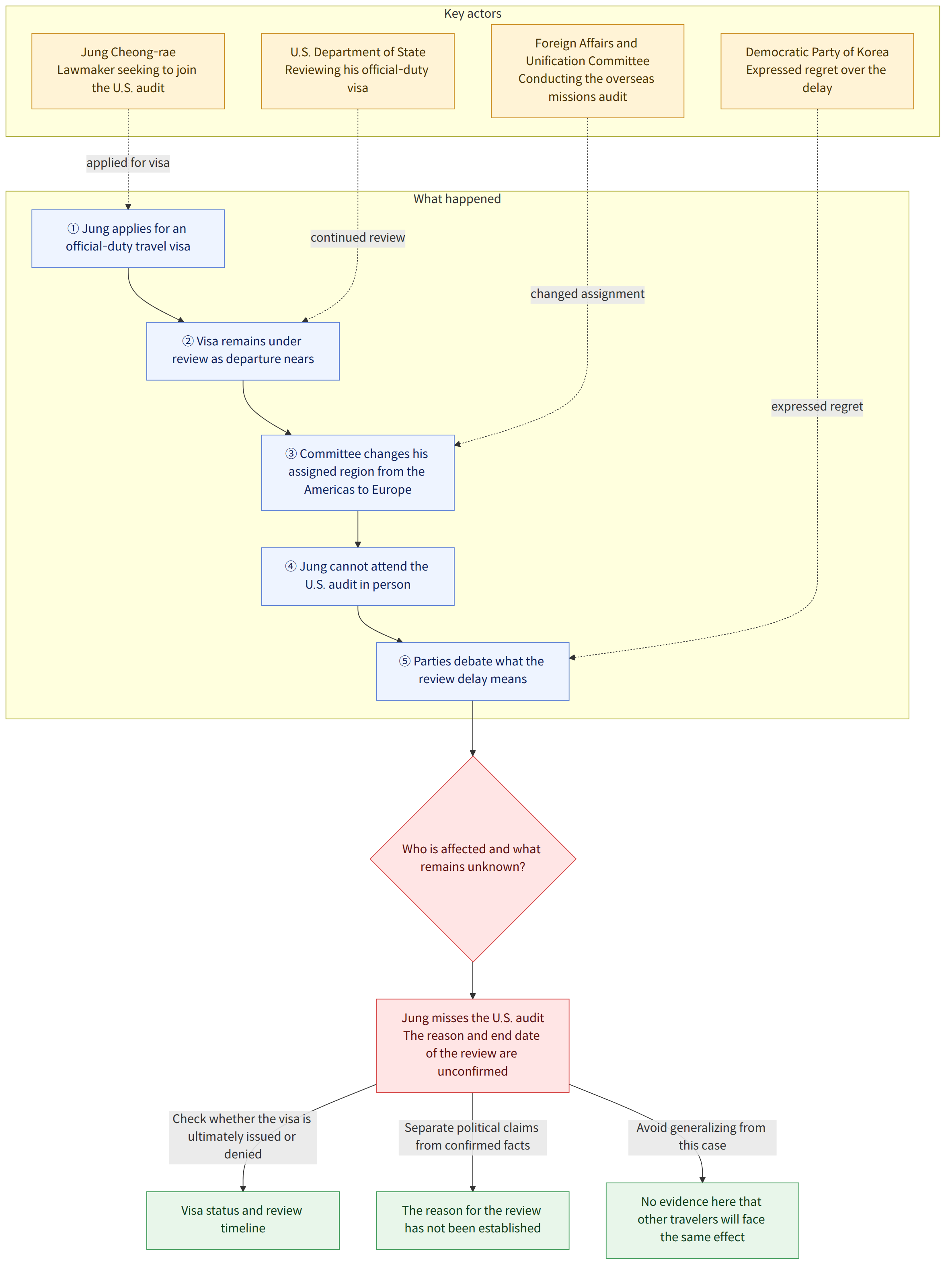
Jung applied to the U.S. Department of State (미국 국무부) for an official-duty travel visa to take part in the Foreign Affairs and Unification Committee’s audit of overseas missions. But he had not received the visa three days before departure, so he was moved from the committee’s Americas team (미주반), which covers the United States and other countries in the Americas, to its Europe team (구주반). The direct consequence was a change to the region he was scheduled to visit for the audit, preventing him from attending the U.S. portion in person.
In a written briefing, Park Sung-joon, the Democratic Party’s senior spokesperson, expressed deep regret. He described Jung as a four-term lawmaker, a former leader of the ruling party, and a lawmaker who had maintained regular communication with the United States. Park said he hoped the South Korean and U.S. foreign affairs authorities would work quickly and actively to resolve the issue.
Jung said he did not know the reason for the review and urged restraint, saying extreme claims that harm the national interests of either South Korea or the United States were unhelpful. He also said that although he would be unable to take part in the U.S. audit, his commitment to serving South Korea’s national interests and promoting friendship between the two countries remained unchanged. Reports also said that Jung’s U.S. visa was denied during a 2013 National Assembly audit, leading him to change his assigned region then as well.
What this news means
The immediate impact was not only on Jung’s personal travel but also on the National Assembly audit scheduled to take place in the United States. This case shows that if a lawmaker’s official-duty travel visa review is not completed in time, the assigned region or plans to participate in person may have to change. However, there is no basis for concluding from this one case that other lawmakers or ordinary visitors will face the same effect on their visa applications.
Politically, the review delay became the subject of debate about the state of South Korea-U.S. relations. People Power Party (국민의힘) lawmakers linked it to a possible rift in bilateral relations or a failure of the government’s diplomacy with the United States, while the Democratic Party said legitimate parliamentary duties had been obstructed and called for a swift resolution. These are the parties’ assessments; they do not mean that the reason for the visa review has been established.
For example, if another lawmaker’s official-duty travel visa review were still unfinished by the scheduled departure date, that lawmaker might have to change the region they planned to visit or miss scheduled in-person events. This is a hypothetical illustration of the possible effects of the schedule change in Jung’s case, not a claim about the actual outcome of any other case.
Points reported differently
Reports used different terms to describe the visa’s status. Some described it as “on hold” or “delayed,” while opposition figures also used the word “denied.” Jung, however, said the U.S. Department of State had told him the visa was “under continued review” at the time. The reports do not confirm whether it was ultimately denied.
The opposition’s interpretation should also be distinguished from established facts. Representative Na Kyung-won claimed that the episode branded Jung a “person diplomatically shunned,” while Representative Ahn Cheol-soo said it was tantamount to refusing entry to an important government figure. However, the available information does not reveal the specific reason for the visa review or the basis for the U.S. decision.
What is confirmed and what remains unknown
Confirmed facts
- Representative Jung Cheong-rae applied to the U.S. Department of State for an official-duty travel visa, but his application was still under review as of October 8, ahead of his departure.
- The visa delay prevented him from taking part in the U.S. National Assembly audit, and his assigned region was changed to Europe.
- The Democratic Party leadership expressed regret and called on the South Korean and U.S. foreign affairs authorities to resolve the issue quickly.
- Jung urged people to refrain from extreme claims and said he remained committed to promoting friendship between South Korea and the United States.
- Opposition figures interpreted the episode as a warning sign in South Korea-U.S. relations, but that is their claim.
What remains unknown
- The specific reason the U.S. official-duty travel visa review was put on hold and the basis for the U.S. decision have not been disclosed.
- It has not been confirmed when the review will be completed or whether the visa will ultimately be issued.
- It is not known what discussions took place between the foreign affairs authorities of the two countries or how their outcome affected the schedule change.
What readers should watch for
- Follow-up announcements should be checked to see whether they distinguish between “under review” and “finally denied.”
- Readers can watch for whether the foreign affairs authorities disclose the course of the review and any discussions, and whether Jung’s U.S. schedule is changed again.
- Political interpretations by the parties should be distinguished from the confirmed status of the visa review. On the evidence currently available, it is not possible to conclude that the visa delay resulted from a specific diplomatic dispute or Jung’s history in the democratization movement.
References
- Other coverage consulted: chosun.com
- Other coverage consulted: hani.co.kr