1. A Human Story
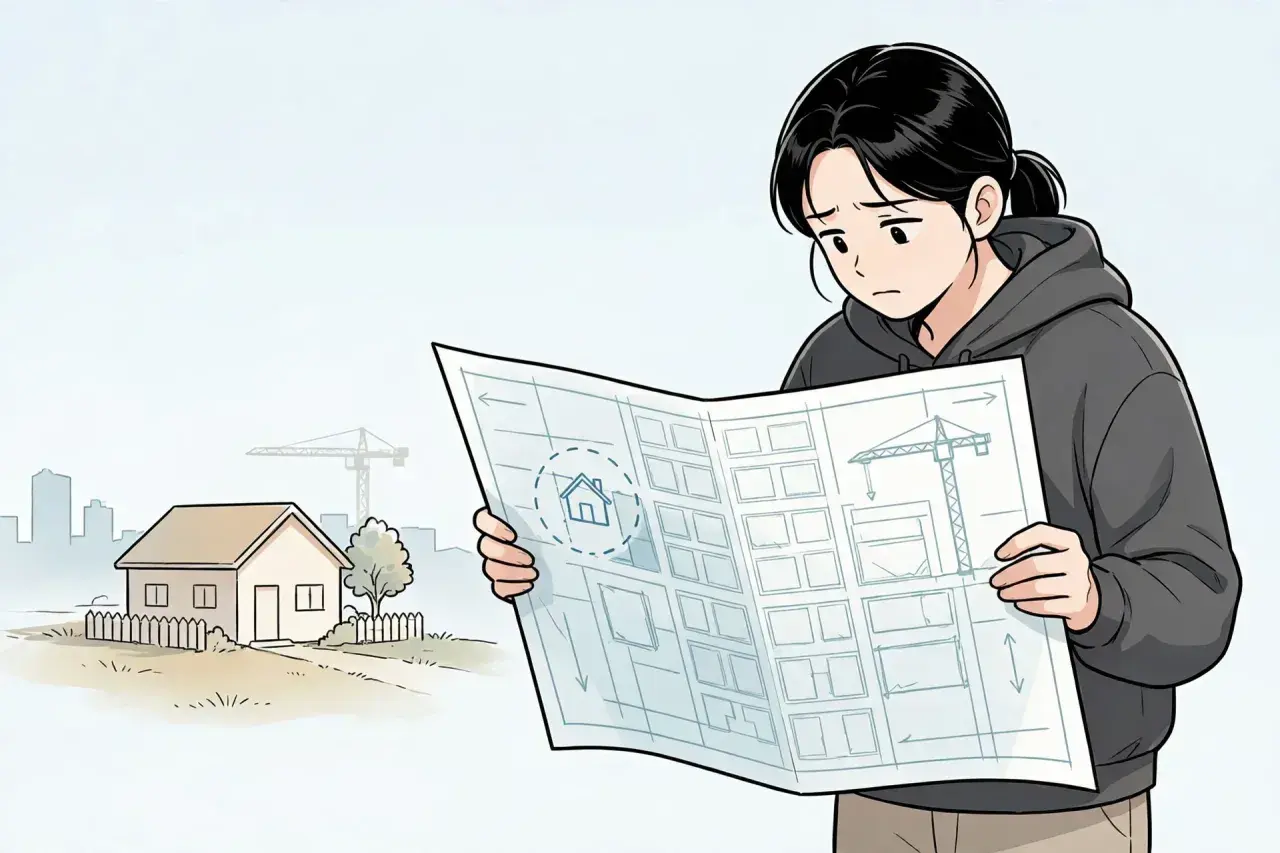
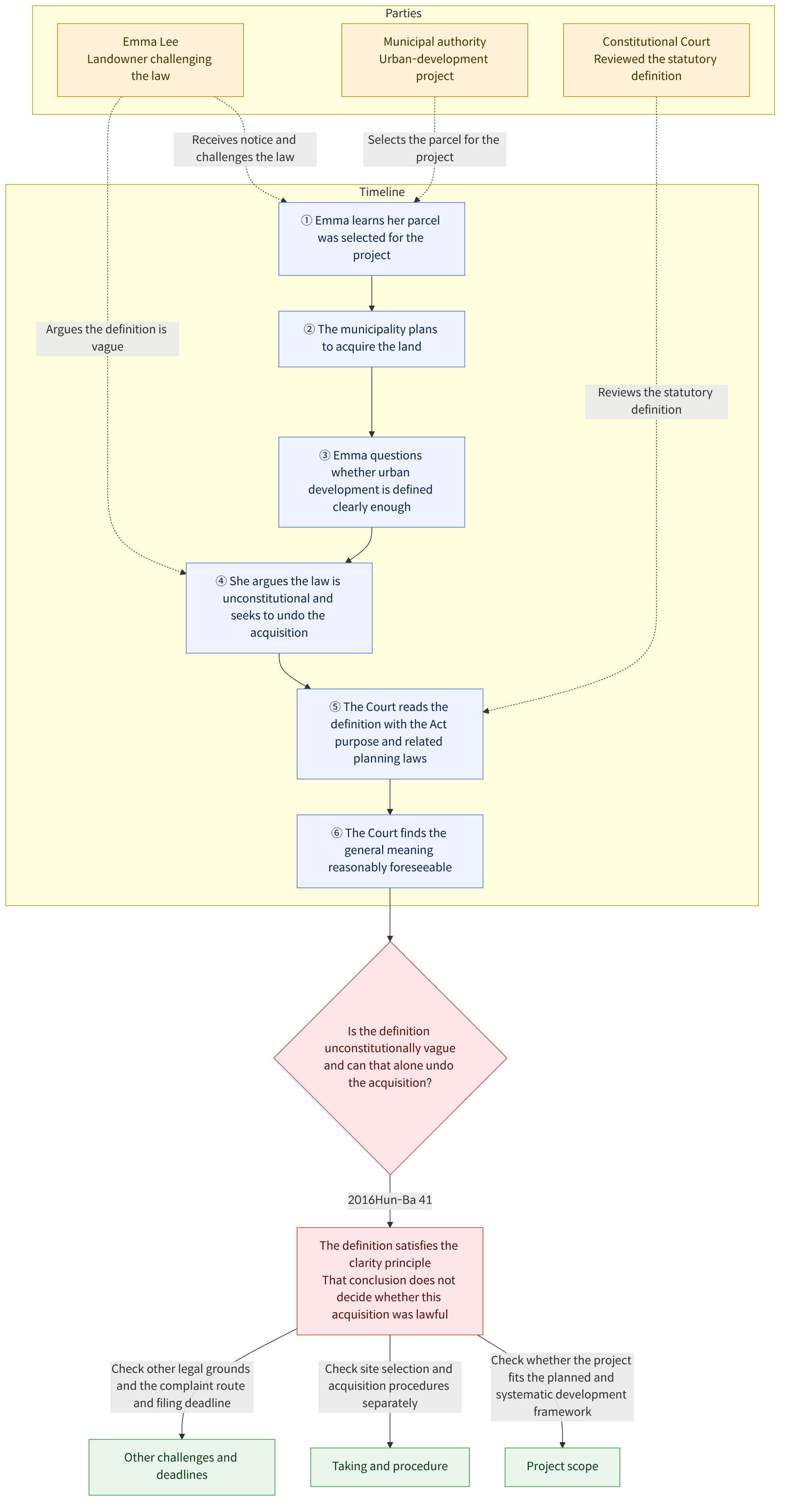
When Emma Lee learned that her family’s parcel had been selected for a municipal urban-development project, the notice felt both official and impossible to comprehend. The land was to be acquired for the project, and Emma wanted the decision undone. But the statute behind it seemed to her to rest on a phrase with no firm edges: urban development.
She began to wonder whether a government could take private land under a law whose central definition was so broad. If the law did not clearly say what counted as an urban-development project, she reasoned, perhaps the law itself was unconstitutional—and the acquisition should be cancelled.
2. The Legal Question
The central question is whether the Urban Development Act’s definition of an urban-development project is so vague that it violates the constitutional principle of clarity—and, if so, whether that argument can undo the acquisition of Emma’s land.
3. What Korean Law Says
Korean law requires legislation to be clear enough for people to understand what it regulates and to foresee, within reasonable limits, how public authorities may apply it. The principle matters especially when a law can affect important rights, including property rights.
But clarity does not require a statute to list every possible project or to define each term with mathematical precision. Courts read statutory language in context, considering its purpose, legislative intent, and relationship to other laws.
In its 2016 decision 2016Hun-Ba 41, the Constitutional Court considered the Urban Development Act’s definition and explained the kind of project the provision covers:
Read together with the Act’s wording and purpose, and with related legislation, an urban-development project means a project that, under the framework of metropolitan or urban and county plans, develops a defined area in a planned and systematic way to create a district or urban area with residential, industrial, or combined functions. A person of ordinary understanding can reasonably foresee that meaning.
In practical terms, the relevant principles are:
- A statutory definition is assessed as part of the legal framework, not in isolation.
- The law can use broad terms if its purpose and surrounding provisions give them an understandable meaning.
- A finding that a definition is constitutional does not, by itself, establish that every project or land acquisition carried out under it is lawful.
A constitutional complaint under Article 68(2) of the Constitutional Court Act is also tied to court proceedings: generally, it may be brought when a court rejects a request to refer the challenged law for constitutional review, subject to the statutory filing period. The procedural route and deadline should be checked promptly in the individual case.
4. How Korean Courts Approach This
Korean courts do not usually strike down a law simply because its language is open-textured or leaves room for judgment. The question is whether, considering the text and the surrounding legal scheme, people can understand the law’s essential scope and public authorities are given a workable standard to follow.
The Constitutional Court applied that contextual approach to the Urban Development Act. It looked beyond the words of the definition to the Act’s purpose and to the planning framework established under the National Land Planning and Utilization Act. That framework helped explain that the statute concerns coordinated development of an area into a district or urban setting—not any activity that happens to change land.
The constitutional question is whether the law’s meaning can reasonably be anticipated from its context, not whether every borderline case is answered by the definition alone.
That conclusion addresses the law’s clarity. It does not decide whether a particular site was properly selected, whether required procedures were followed, or whether the acquisition can be challenged on other legal grounds.
5. Applying the Law to the Case
Emma’s argument can be examined in several steps.
- Identify what the law covers. The definition is not read as an isolated phrase. In light of the statutory purpose and related planning laws, it refers to planned, systematic development of a defined area to create a district or urban area with residential, industrial, or similar functions.
- Ask whether that meaning is reasonably foreseeable. The Constitutional Court concluded that a person with ordinary understanding can anticipate the provision’s general scope. The fact that officials must apply it to specific projects does not, by itself, make the law unconstitutionally vague.
- Separate the constitutional challenge from the acquisition dispute. Even if Emma cannot invalidate the definition on clarity grounds, she may still have questions about the decision affecting her own land. For example, she would need to examine whether the project and land-selection measures complied with applicable plans, statutory procedures, and other legal requirements. The facts given do not establish whether any such separate defect exists.
- Use the proper route and act on time. A challenge to an administrative disposition and a constitutional complaint are distinct legal avenues. Emma would need to identify the decision she is challenging, obtain the relevant notices and project documents, and confirm the applicable filing periods. Missing a deadline can prevent a court from considering the merits.
If you are dealing with a similar issue, attorney Ji-sun Ahn of Ijun Law Firm can review the land register, agreements or permits affecting the property, and the dates when rights were registered or changed with you. These details can help clarify which options apply to your situation.
6. Conclusion: What Happened, and What Should You Do?
Emma’s vagueness argument would not succeed under the Constitutional Court’s approach in 2016Hun-Ba 41. The Court has held that the statutory definition is sufficiently understandable when read alongside its purpose and the broader urban-planning framework. That ruling does not, however, establish that the municipality’s particular acquisition of Emma’s land was lawful. Whether the decision can be cancelled depends on separate facts and legal grounds that are not resolved by the clarity ruling.
If you face a similar situation:
- Collect the paperwork immediately: keep the selection and acquisition notices, project plans, maps, and any explanations from the local authority.
- Check deadlines with a Korean administrative-law lawyer promptly: the time limits for challenging an administrative measure or pursuing constitutional review can be short and depend on the procedural posture.
- Look beyond vagueness: ask whether the project complied with the relevant plans and procedures and whether the specific land-selection or acquisition decision can be challenged on its own grounds.