1. A Human Story
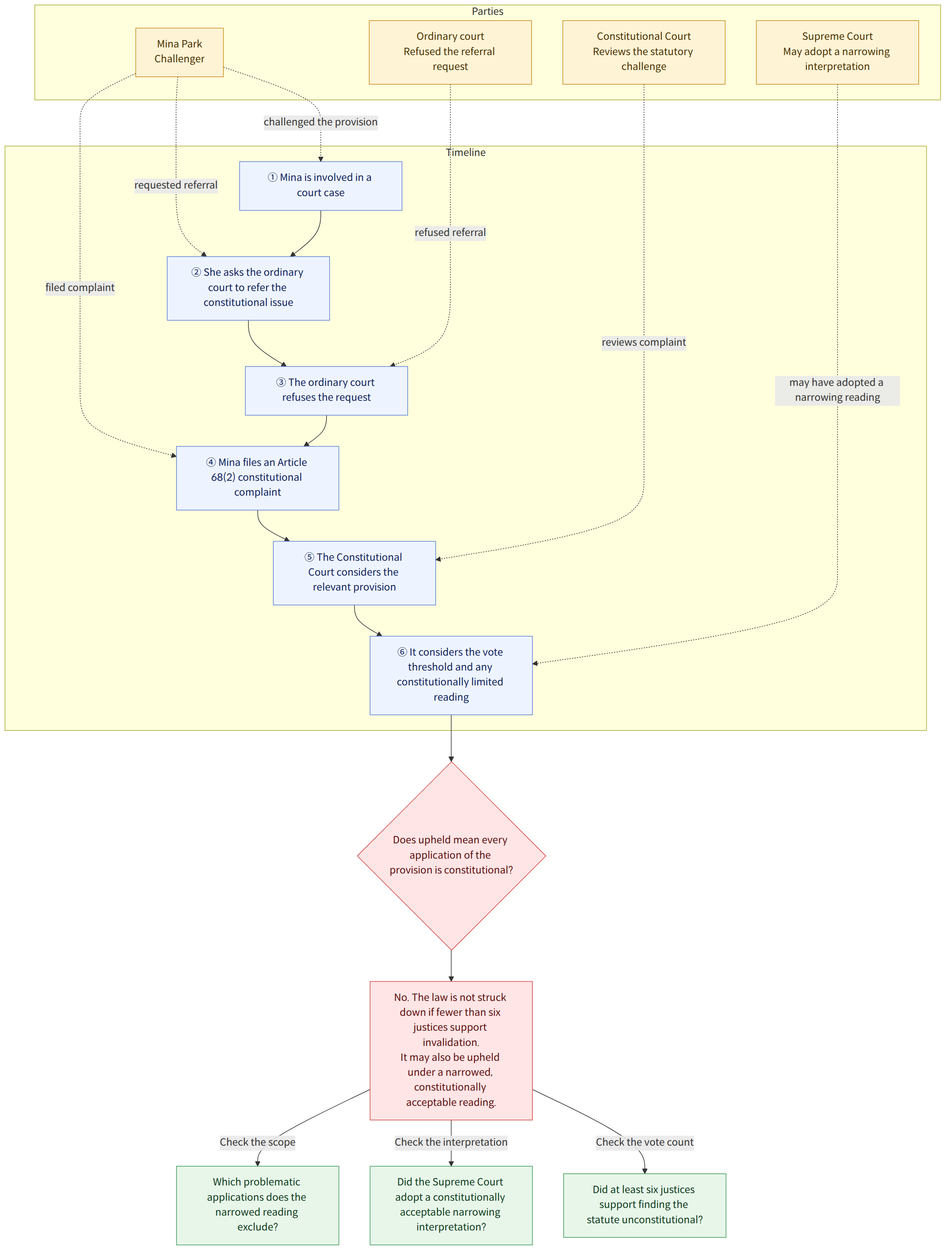
Mina Park had spent months trying to resolve a dispute in court. At its center was a statutory provision that the other side said applied to her. Mina believed the provision, at least as it was being used against her, violated her constitutional rights.
Her lawyer asked the court hearing the case to refer the constitutional issue to the Constitutional Court. The request was refused. Mina then filed a constitutional complaint under Article 68(2) of the Constitutional Court Act, hoping the Constitutional Court would strike down the provision. But a constitutional complaint does not guarantee that result. The law may be upheld even when a challenge raises serious concerns.
2. The Legal Question
When can the Constitutional Court of Korea decide that a statute challenged under Article 68(2) is constitutional? In particular, what happens when fewer than the required number of justices support invalidating it, or when the Supreme Court has already adopted a constitutionally acceptable interpretation that limits how the provision can be applied?
3. What Korean Law Says
Article 68(2) provides a route to the Constitutional Court for a person involved in a court case whose request for a constitutional review referral has been rejected. The complaint concerns the constitutionality of the statute relevant to that case; it is not simply another appeal about how the ordinary court decided the dispute.
The number of votes matters. Under the Constitutional Court Act, at least six justices must support a decision that a statute is unconstitutional. If the Court considers the issue but the proposal to find the law unconstitutional does not receive six votes, it may issue a decision stating that the statute does not violate the Constitution.
A failure to obtain six votes for invalidation means the law is not struck down. It does not necessarily mean that every justice agreed with every possible application of the law.
A statute may also be upheld on the basis of a constitutionally acceptable interpretation. This occurs where the provision can be read in a way that avoids an unconstitutional result, and the problematic applications are excluded. If the Supreme Court has already adopted an interpretation of that kind, the Constitutional Court may uphold the provision on the same understanding.
In practical terms, a constitutional decision may rest on either of these grounds:
- Insufficient votes for invalidation: fewer than six justices support finding the statute unconstitutional.
- A constitutionally limited interpretation: the provision is upheld as understood in a way that excludes its unconstitutional reach, consistent with the Supreme Court’s approach.
4. How Korean Courts Approach This
The Constitutional Court’s decision is governed by the statutory voting threshold. The justices consider whether the challenged provision is unconstitutional, but a finding of unconstitutionality requires at least six votes. If that threshold is not met, the provision is not invalidated through that proceeding.
Courts also distinguish between a law’s text and the way it is interpreted and applied. Where a provision can be given a constitutionally acceptable meaning, a court may preserve that meaning while excluding an impermissible application. The Supreme Court’s prior interpretation can matter: if it has already adopted a narrowing interpretation that keeps the law within constitutional bounds, the Constitutional Court may issue a decision upholding the provision on that basis.
An “upheld” decision should therefore be read carefully. It may preserve a provision only within a constitutionally acceptable interpretation, rather than approving every broad reading a litigant might encounter.
5. Applying the Law to the Case
Mina’s complaint followed the route described in Article 68(2): she was involved in a court case, asked the ordinary court to refer the constitutional question, and filed a constitutional complaint after that request was rejected. The Constitutional Court could therefore consider whether the relevant statutory provision was compatible with the Constitution.
Suppose the Supreme Court had already interpreted the provision to exclude the very kind of application Mina feared. That would give the Constitutional Court a basis to uphold the provision on the same narrowed understanding. The question would not be whether every imaginable use of the provision was acceptable, but whether it could remain in force under that constitutionally limited reading.
The Court could also consider the number of votes for invalidation. If fewer than six justices supported finding the provision unconstitutional, the required threshold would not be met and the Court could state that the law did not violate the Constitution. That voting outcome is distinct from a decision based on a narrowed interpretation, though both can result in the provision being upheld.
For Mina, the decisive point is the scope of the ruling. If the provision is upheld consistently with the Supreme Court’s limiting interpretation, the ordinary court should address her underlying dispute using that interpretation—not an unrestricted reading that the constitutional approach excludes. The constitutional complaint itself would not automatically decide the facts or outcome of her original case.
6. Conclusion: What Happened, and What Should You Do?
Mina’s constitutional complaint did not cause the statute to be struck down. The Constitutional Court upheld the provision on the understanding that it must be applied within the constitutionally acceptable limits already recognized by the Supreme Court. Her original case then continued, with the ordinary court required to consider the provision through that narrower lens.
For readers facing a similar situation:
- Identify the exact interpretation at issue. Explain not only why a statute is unconstitutional, but also which application or reading creates the problem.
- Check the procedural route and deadline promptly. An Article 68(2) complaint follows the rejection of a referral request in an ongoing court case; obtain legal advice as soon as that request is denied.
- Read an “upheld” decision for its limits. Find out whether the Court upheld the provision broadly or only under a particular constitutionally acceptable interpretation.