1. A Human Story
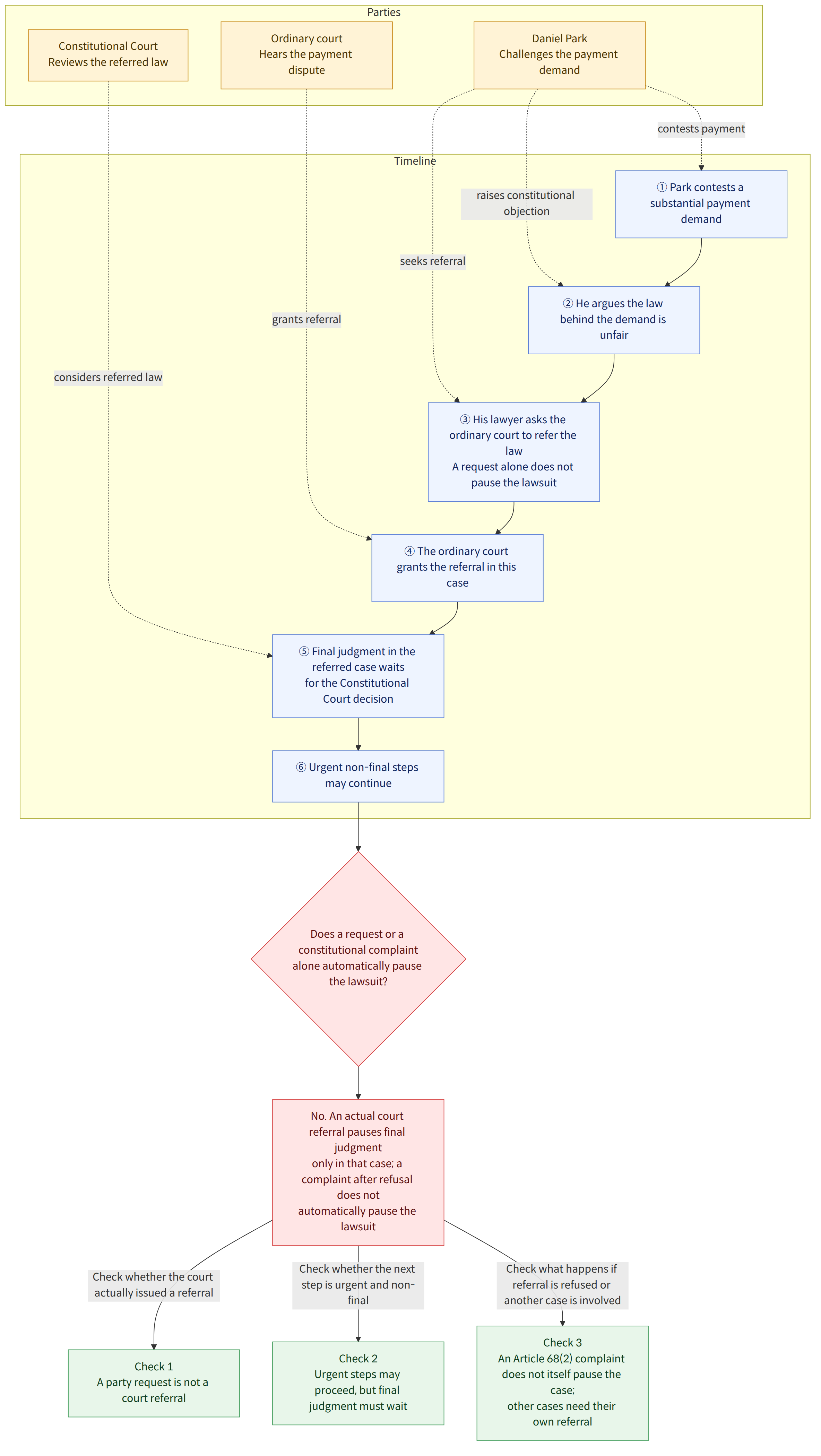
Daniel Park had spent months contesting a substantial payment demanded from his small construction company. The demand rested on a provision of Korean law that, Daniel argued, treated businesses like his unfairly. His lawyer asked the court hearing the dispute to refer that provision to the Constitutional Court for a ruling on whether it was constitutional.
Then Daniel began to worry. The ordinary lawsuit was still moving forward, and he feared the judge might issue a final decision before the constitutional question was answered. His concern was understandable—but the answer turned on a procedural detail he had not yet learned: asking the court to refer a law is not the same as the court making the referral.
2. The Legal Question
When a party asks a Korean court to seek constitutional review of a law relevant to their lawsuit, does the lawsuit automatically stop? And what happens if the court refuses the request and the party instead files a constitutional complaint?
3. What Korean Law Says
Korean law distinguishes between a party’s request that a court refer a law for review and an actual referral issued by the court. The suspension rule applies when the court makes the referral.
The Constitutional Court Act provides:
“When a court requests adjudication on the constitutionality of a statute, proceedings of the relevant case shall be suspended until the Constitutional Court renders a decision. However, if the court deems it urgent, it may proceed with proceedings other than the final judgment.”
In practical terms, the key points are:
- A request alone does not trigger the statutory pause. The court must decide to refer the constitutional question.
- Once the court refers the law, the final judgment in the case before that court is suspended while the Constitutional Court considers the issue.
- Urgent, non-final steps may still go ahead. The court may continue other parts of the proceedings if it considers them urgent, but it may not bring the case to a final judgment while the suspension applies.
- The pause is case-specific. It applies to the lawsuit pending before the court that made the referral, not automatically to other cases involving the same law.
- If the court rejects a party’s request, that party may, in the circumstances permitted by law, file a constitutional complaint under Article 68(2) of the Constitutional Court Act. That complaint does not itself suspend the ordinary lawsuit. The lawsuit may therefore reach a final decision while the constitutional complaint is pending.
4. How Korean Courts Approach This
The rules separate two proceedings: the ordinary case, which resolves the parties’ dispute, and the constitutional review, which determines whether the challenged statute is valid. A court referral connects the two by placing the ordinary case on hold until the constitutional question is answered.
But courts do not treat a party’s request as if a referral had already been made. The court first decides whether to refer the question. Until it does, the ordinary case is not suspended merely because one party has raised a constitutional objection.
The suspension also does not spread to every lawsuit involving the same statute. It is tied to the case in which the referring court acted. Another court handling a separate dispute must make its own referral if it is to suspend that case on this basis.
The practical dividing line is the court’s action: an actual referral pauses final judgment in the referred case; a rejected request followed by an Article 68(2) complaint does not automatically do so.
5. Applying the Law to Daniel’s Case
Daniel’s situation can be assessed in a sequence of steps:
- Has the court merely received his request, or has it issued a referral? At first, Daniel’s lawyer had only asked the court to refer the law. That request by itself did not require the judge to stop the lawsuit.
- If the court makes the referral, what must stop? Once the referral is made, the final decision in Daniel’s case must wait for the Constitutional Court’s ruling. The judge may still take urgent steps that do not amount to a final judgment.
- What if the court refuses? Daniel may be able to pursue a constitutional complaint under Article 68(2), subject to the applicable requirements. But filing that complaint would not automatically halt the payment dispute. The ordinary court could still issue a final judgment.
- Would other cases involving the same statute also pause? No. The referral would suspend the proceedings in Daniel’s case, not separate cases before other courts. Each court would need to make its own referral for the same suspension effect to arise there.
In Daniel’s fictional case, the court ultimately granted the referral. From that point, it could not issue a final judgment in his payment dispute until the Constitutional Court decided the constitutional question. The court could, however, continue any urgent procedural work that fell short of a final decision.
6. Conclusion: What Happened, and What Should You Do?
Daniel’s immediate fear—that his case would end before the constitutional review simply because he had asked for a referral—was not quite right. His request alone did not stop the lawsuit. But once the court actually referred the law, the final judgment in his case had to wait. Had the court rejected the request and Daniel filed an Article 68(2) complaint, the ordinary lawsuit could have continued and become final.
For readers facing a similar situation:
- Confirm the court’s procedural decision. Ask whether the court has formally made the referral; do not assume that submitting a request has suspended the case.
- If the request is denied, act promptly. Discuss the requirements and deadlines for an Article 68(2) constitutional complaint with a Korean lawyer, while recognizing that the ordinary case may continue.
- Track the case itself. A referral in one lawsuit does not automatically pause a separate case, even if both involve the same statute.