
1. A Human Story
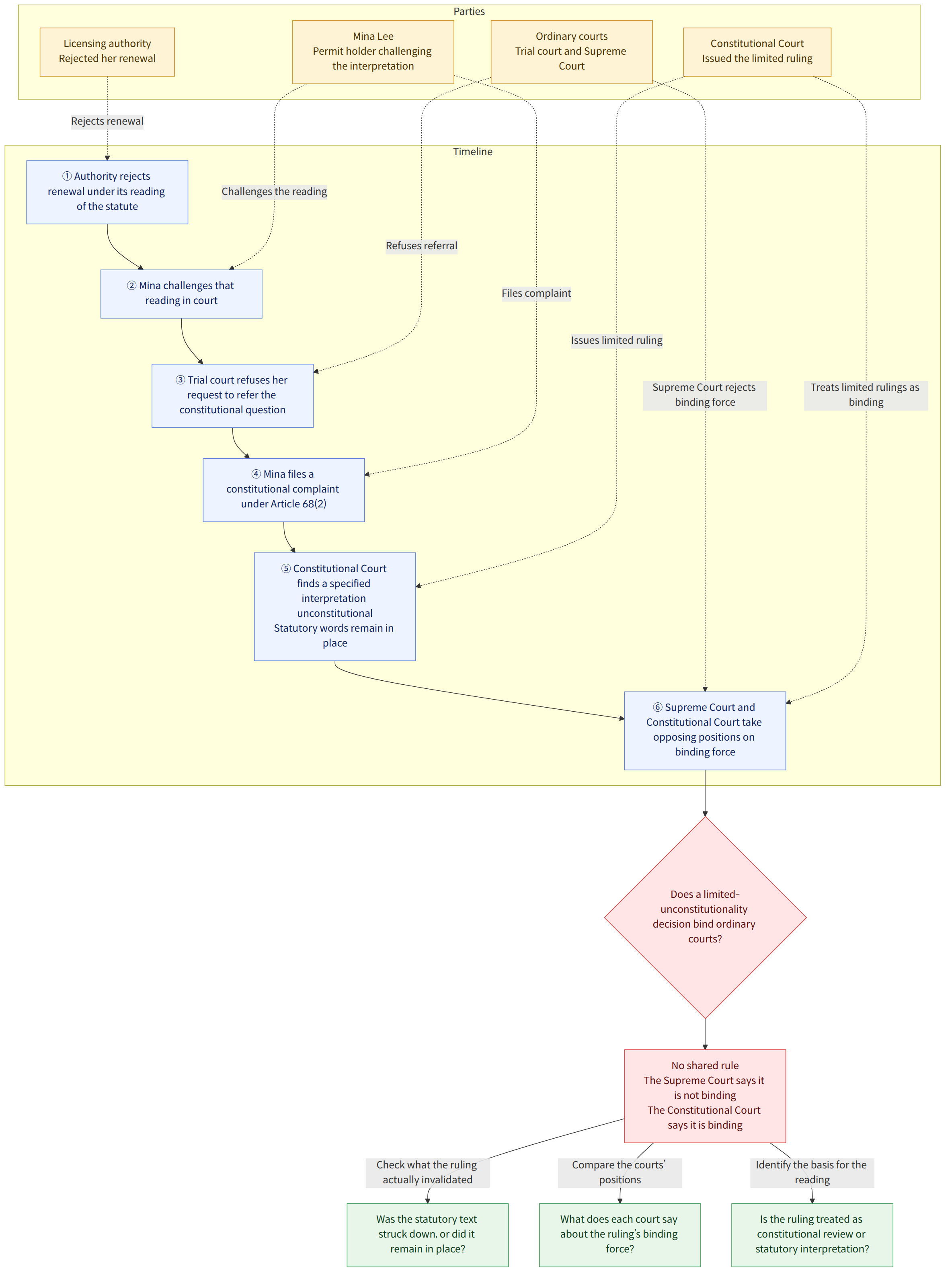
Mina Lee had spent years building a small business around a professional permit. When the licensing authority rejected her renewal, it relied on a clause in a statute that, in its view, disqualified anyone in Mina’s circumstances. Mina believed the authority had read the clause too broadly. The dispute moved into court, where the same interpretation threatened to decide whether she could keep working.
Mina asked the trial court to refer the constitutional question to the Constitutional Court. The trial court refused. Under the special procedure available when a court declines such a request, Mina filed a constitutional complaint under Article 68(2) of the Constitutional Court Act. The Constitutional Court then issued a limited-unconstitutionality decision: it said the provision was unconstitutional if understood in a particular way, but it did not strike the statutory words from the statute book.
Mina expected the decision to settle her case. Instead, she faced a difficult institutional question. Did the trial court have to follow the Constitutional Court’s interpretation, or could it continue to interpret the statute for itself?
2. The Legal Question
When the Constitutional Court declares a statute unconstitutional only under a specified interpretation, does that limited-unconstitutionality decision bind the ordinary courts handling the underlying case?
The answer is contested. The Constitutional Court and the Supreme Court have taken opposing positions on the binding force of this kind of decision.
3. What Korean Law Says
A constitutional complaint under Article 68(2) is available in a particular setting: a person is already involved in a court case, asks that court to refer a statute’s constitutionality to the Constitutional Court, and then challenges the refusal to make that referral. It allows the constitutional question to be considered even though the ordinary trial continues to be the immediate dispute.
A limited-unconstitutionality decision differs from a straightforward decision striking down a law. Rather than declaring the entire provision—or a separable part of it—invalid, the Constitutional Court identifies an interpretation under which the provision violates the Constitution. The statutory text remains in place, and the dispute is over what that text can properly mean.
That distinction has produced two competing views:
The Supreme Court’s position: Because the provision’s wording remains unchanged, a limited-unconstitutionality decision functions as a view about the provision’s meaning and scope. Interpreting and applying statutes in individual cases is part of the judicial power entrusted to the courts, with the Supreme Court at their head. On this reasoning, the Constitutional Court’s interpretation in a limited decision does not bind the ordinary courts.
The Supreme Court has connected this reasoning to the constitutional structure of judicial power and judicial independence:
Constitutional Articles 101 and 103: Judicial power belongs to the courts, and judges decide independently according to the Constitution and laws, guided by their conscience.
The Constitutional Court has taken the opposite view:
The Constitutional Court’s position: Binding force is not confined to decisions that simply strike down statutory language. It also extends to limited-unconstitutionality decisions, as well as limited-conformity and nonconformity decisions.
The disagreement turns on how to classify the decision. If it is treated as a constitutional ruling about the validity of a law under a defined interpretation, it can be understood as binding. If it is treated as an interpretation of statutory language in a particular case, the Supreme Court’s view is that the ordinary courts retain the final say on applying it.
4. How Korean Courts Approach This
Korean courts have not expressed one shared rule on this point. The Supreme Court has emphasized that the ordinary courts must retain authority to interpret and apply statutes in the cases before them. In its view, a limited decision does not change the statute’s words or formally remove the provision, so the Constitutional Court’s stated interpretation cannot control the ordinary court’s judgment.
The Constitutional Court has emphasized a different principle: constitutional review would lose much of its force if a ruling limiting an unconstitutional interpretation could be disregarded in the very cases affected by it. It has therefore treated limited-unconstitutionality decisions as binding, alongside other forms of unconstitutionality decision.
The practical warning is that a limited-unconstitutionality decision should not be confused with an automatic deletion of the statute. The two courts disagree about its binding effect, and the ordinary court may continue to decide how the provision applies in the case before it.
For a litigant, that means the constitutional decision matters—but it does not guarantee that the pending case will immediately end in their favor. The legal argument must still be presented in the ordinary proceedings, and the court’s response may need to be challenged on appeal.
5. Applying the Law to Mina’s Case
Mina’s situation can be assessed in several steps.
- Her complaint was tied to an ongoing case. Mina did not ask for an abstract opinion about the statute. She filed under Article 68(2) after the trial court refused her request to refer the constitutional question. The underlying permit dispute therefore remained before the ordinary court.
- The Constitutional Court did not erase the clause. Its limited decision identified a constitutionally impermissible interpretation, but left the provision’s wording in force. Mina could not treat the clause as though it had simply been repealed.
- The decision gave Mina a substantial constitutional argument. She could contend that the authority’s interpretation was the very reading the Constitutional Court had found unconstitutional. The decision would be relevant to how her dispute should be resolved, even under the Supreme Court’s approach, which treats it as a constitutional interpretation rather than a binding instruction to the trial court.
- The trial court’s obligation is the disputed point. If the trial court follows the Constitutional Court’s position, it must give the limited decision binding effect and reject the prohibited interpretation. If it follows the Supreme Court’s stated approach, it may regard the Constitutional Court’s reasoning as persuasive but not controlling, and decide the statute’s meaning independently.
- The statute’s continued existence does not settle how it applies. Even if the provision remains on the books, Mina can argue that the particular reading used against her is unconstitutional. The central issue is not simply whether the clause exists, but whether the authority and court have applied it in the constitutionally forbidden way.
In this fictional account, the trial judge followed the Supreme Court’s approach. The judge declined to treat the limited decision as automatically controlling, interpreted the clause independently, and ruled against Mina. That result did not mean the Constitutional Court’s ruling had disappeared; it meant the institutional disagreement had a concrete consequence for her case. Mina appealed, arguing that the trial court had adopted precisely the interpretation the Constitutional Court had rejected.
6. Conclusion: What Happened, and What Should You Do?
Mina did not win simply by obtaining a limited-unconstitutionality decision. The statute remained in force, and the trial court—following the Supreme Court’s position—did not consider itself bound by the Constitutional Court’s interpretation. Her next step was to challenge the trial court’s reading through the ordinary appeal process and explain why it fell within the interpretation the Constitutional Court had found unconstitutional.
For anyone facing a similar dispute:
- Read the exact wording of the decision. Identify the interpretation the Constitutional Court found unconstitutional and compare it carefully with the interpretation being used against you.
- Raise the ruling in the pending case. Ask the ordinary court to apply it, and explain how the facts and the disputed statutory interpretation match. Do not assume the provision has been erased.
- Preserve the issue for appeal. If the court declines to follow the decision, make a clear record of your objection and seek advice promptly about the available procedural steps and deadlines.
A limited-unconstitutionality decision can be a powerful constitutional safeguard, but its effect in an individual case remains entangled in the disagreement between Korea’s two highest courts. For Mina, that meant the ruling opened an important argument—not an automatic victory.