
1. A Human Story
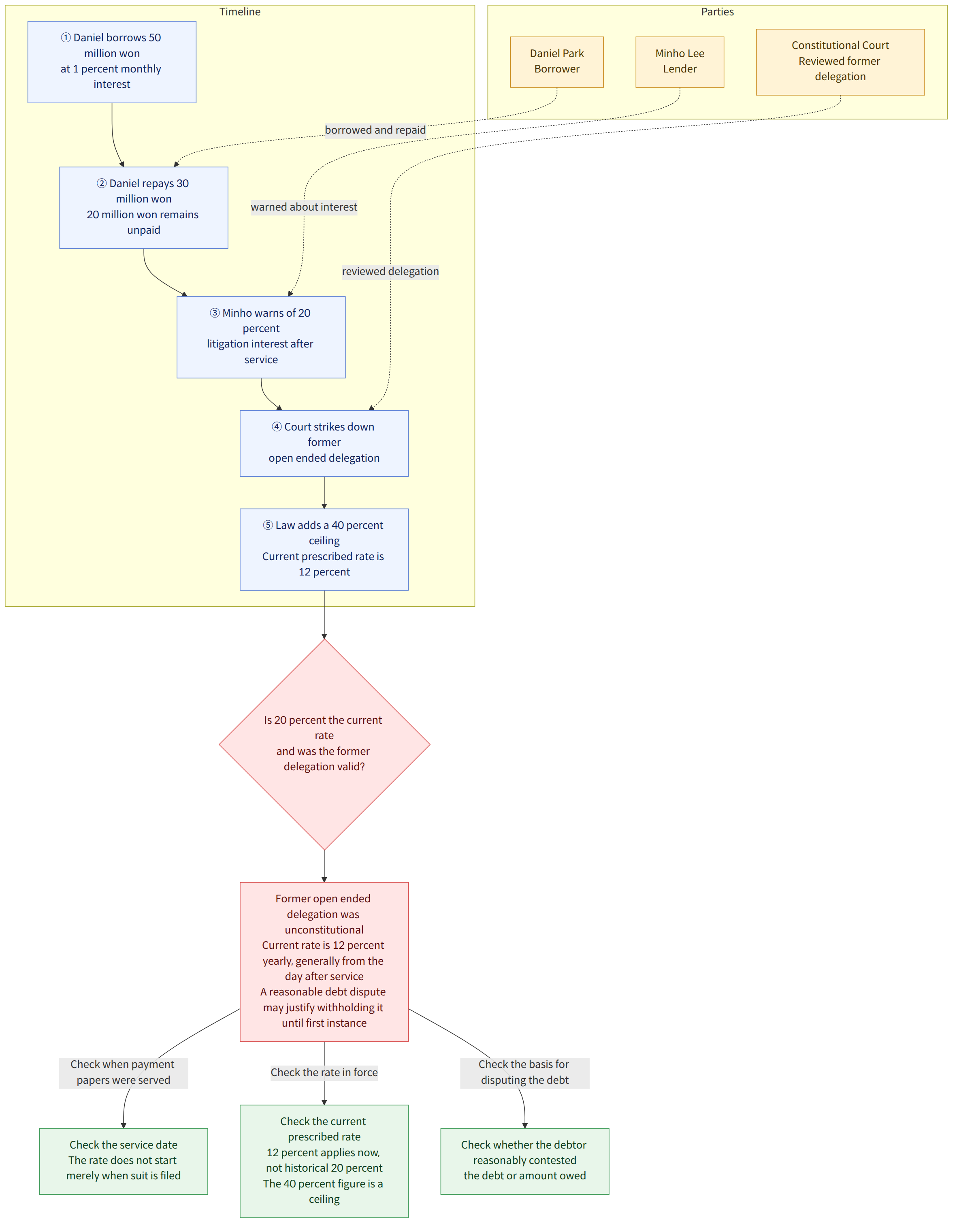
Daniel Park borrowed 50 million won from his longtime friend, Minho Lee, agreeing to pay interest at 1% a month. He managed to repay 30 million won, but a business downturn left him unable to pay the remaining 20 million by the agreed date. The debt was real; what Daniel disputed was how quickly the balance could grow once lawyers and court papers entered the picture.
Minho warned that if he filed suit, Daniel could owe interest at 20% a year from the day after the complaint was delivered to him, until the debt was fully paid. Daniel looked at the rates charged by banks and wondered whether a government-set rate so much higher could be constitutional. His question was not merely how much he might owe. It was whether the state could give the executive branch such broad power to decide the price of a delayed debt.
2. The Legal Question
Can a law allow the government to set the interest rate on a debt after a lawsuit begins without giving a clear statutory limit or standard? And, in Daniel’s case, does a lender’s warning about 20% interest reflect the rule that applies today?
3. What Korean Law Says
Korea’s Act on Special Cases Concerning the Expedition, etc. of Legal Proceedings provides a special rate for damages caused by delaying payment of a monetary debt. Ordinarily, the rate applies from the day after the summons or equivalent document seeking payment is served on the debtor—not simply from the day the creditor files the case.
The statute directs that, for a judgment ordering payment of money, the rate used to calculate damages for nonpayment after service of the claim is the rate prescribed by Presidential Decree. The statute also allows the court to withhold that rate, within a reasonable scope, when the debtor has reasonably contested whether the debt exists or how much is owed until the first-instance judgment.
The second part matters. The higher litigation rate is intended to discourage strategic delay, but it is not meant to punish someone for raising a genuine dispute. If Daniel had a credible argument about the balance, the court could decide that the special rate should not apply to the disputed portion during the relevant period.
The constitutional problem arose under the law’s former wording. It authorized a rate set by Presidential Decree but gave no upper or lower limit and no sufficiently clear standard to guide the government. The Constitutional Court held that this was an impermissible delegation of legislative power: people could not reasonably predict the range of interest that the executive might impose, even though the rate could significantly affect a debtor’s financial obligations.
Under Article 75 of the Constitution, the President may issue decrees on matters delegated by statute only when the law defines the scope of that delegation with sufficient specificity. The more a rule may restrict people’s rights or impose burdens, the stronger the demand for clarity.
The statute was subsequently amended. It now sets a ceiling of 40% a year for the rate prescribed by decree and directs that the rate take account of economic conditions, including banks’ overdue-loan rates. The 40% figure is a ceiling, not the rate charged in every case. The rate currently prescribed by decree is 12% a year. Earlier rates—including 20% and, at another point, 25%—are historical figures, not the current prescribed rate.
4. How Korean Courts Approach This
Korean courts distinguish between the amount of a debt and the interest consequences of failing to pay it. A creditor must establish the basis for the claim and the amount due. Once a money judgment is entered, the special litigation rate generally provides a clear incentive to pay promptly rather than prolong proceedings or ignore the judgment.
Courts also recognize that not every disagreement is an attempt to stall. The statutory exception allows a judge to consider whether the debtor had a reasonable basis to contest the debt’s existence or scope. If so, the special rate may be withheld to the extent justified until the first-instance judgment. The exception is not a blanket permission to delay payment: a bare denial, or an argument that lacks a reasonable foundation, may not be enough.
The Constitutional Court’s ruling concerned the breadth of the former delegation, not a declaration that any elevated post-filing interest rate is inherently unconstitutional. The legislature responded by placing an express ceiling in the statute and tying the rate-setting power to economic considerations. Those constraints make the current arrangement materially different from the former open-ended delegation.
5. Applying the Law to the Case
First, the amount at issue is the unpaid 20 million won, assuming the 30 million won already repaid has been properly credited and the parties agree on that balance. Daniel should check the loan records and payment history; a disagreement over how repayments were allocated could affect the amount Minho may recover.
Second, the 1% monthly contractual interest rate governs the parties’ agreement before the special litigation rate begins, subject to the terms of the contract and other applicable law. A monthly rate of 1% is nominally 12% a year. If Minho sues for payment, the special statutory rate generally begins on the day after the complaint is served on Daniel. Filing alone does not start that statutory period.
Third, Minho’s threatened 20% rate is not the rate currently prescribed by decree. The current rate is 12% a year. The statutory 40% ceiling does not entitle a creditor to demand 40%; it limits the government’s power to set the rate. Nor does the former constitutional ruling make the amended, bounded system invalid for the same reason.
Finally, the court may consider whether Daniel reasonably contests the debt’s existence or amount. If the 20 million won balance is undisputed and Daniel simply cannot pay, the exception for a reasonable contest is unlikely to protect him from the litigation rate. If, however, he has evidence of additional repayments or a genuine disagreement about the balance, he should raise it promptly and support it with documents. The judge—not the creditor—decides whether the statutory exception applies and to what extent.
6. Conclusion: What Happened, and What Should You Do?
Minho’s warning that a lawsuit would trigger 20% interest does not describe the current prescribed rate. If the unpaid balance is established, the 12% annual litigation rate will generally apply from the day after Daniel is served with the claim, unless the court finds that he reasonably contested the debt’s existence or scope and withholds the rate within a justified range. The former rule was unconstitutional because it delegated rate-setting without clear limits; the legislature later amended it by adding a statutory ceiling and economic criteria.
For readers facing a similar dispute:
- Check the numbers before the case is filed. Keep the loan agreement, bank statements, receipts, and a dated record of each payment so the balance can be verified.
- Do not ignore court papers. The service date can determine when the litigation rate begins, and missing deadlines may make it harder to present a genuine defense.
- Get advice on a real dispute promptly. If you contest the debt or its amount, explain the basis clearly and provide evidence; inability to pay alone is not the same as a reasonable legal contest.