
1. A Human Story
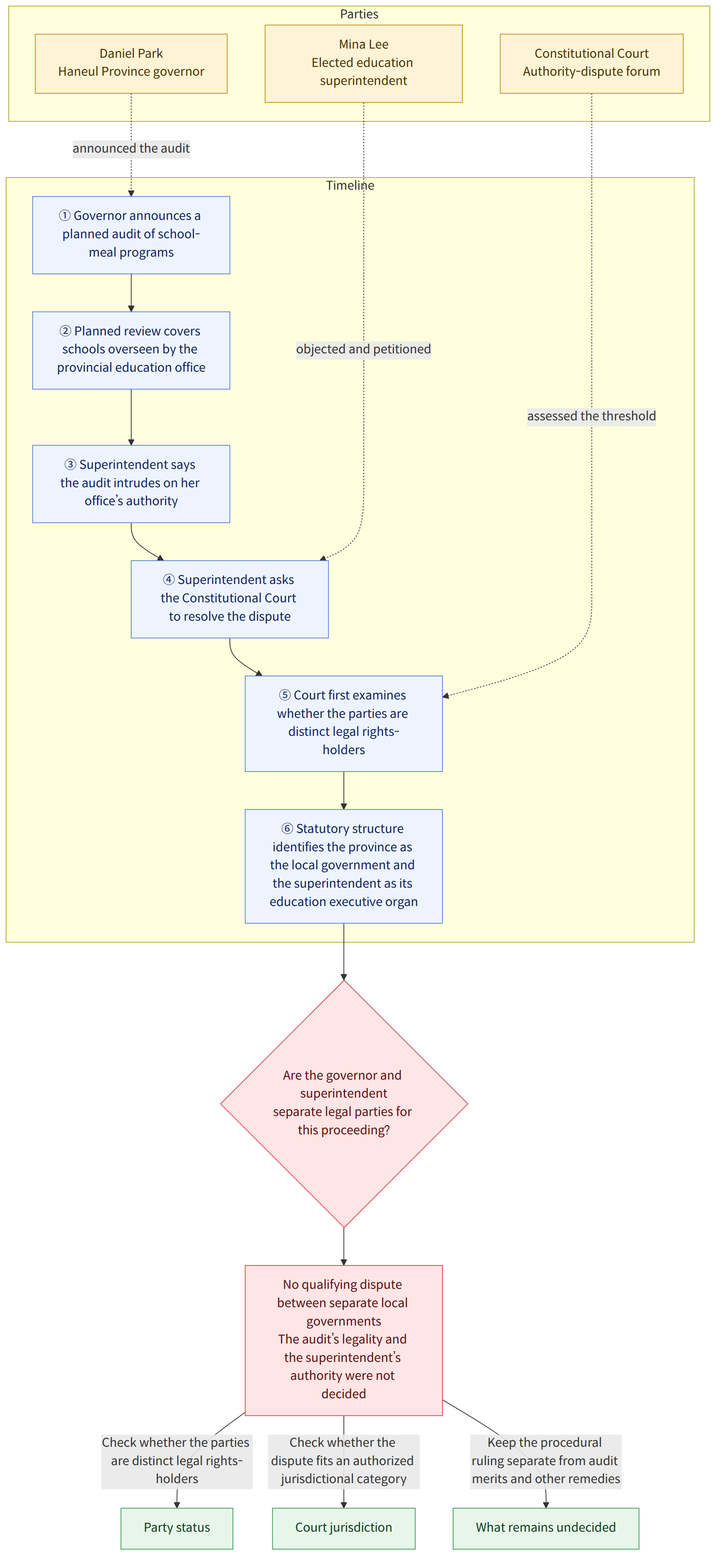
When Daniel Park, governor of Haneul Province, announced an audit of school-meal programs, his stated concerns sounded practical: Were public contracts awarded fairly? Had schools used approved ingredients? Were suppliers being favored? The review would cover schools overseen by the provincial education office.
Mina Lee, the province’s elected education superintendent, saw the announcement very differently. To her, the audit crossed into a field entrusted to her office. She believed the governor’s plan threatened the education authority’s own responsibility to supervise school operations, and she asked the Constitutional Court to resolve the dispute between them.
The immediate controversy was about school lunches. The first legal obstacle, however, was more basic: Could the governor and superintendent bring this kind of dispute to that court as opposing legal parties?
2. The Legal Question
Can a provincial education superintendent challenge the province’s governor in a constitutional authority-dispute proceeding, claiming that the governor’s proposed audit infringes the superintendent’s authority over school meals?
The answer turns not first on the scope of either official’s audit powers, but on whether the superintendent and the province count as separate rights-holders for this particular procedure.
3. What Korean Law Says
Korea’s Constitution assigns the Constitutional Court jurisdiction over certain disputes about the powers of state institutions and local governments. But that jurisdiction is not a general forum for every conflict between public officials.
The Constitution provides for the Constitutional Court to decide authority disputes between local governments. In this context, “between” means between distinct holders of legal rights and powers.
The key distinction is between a local government and an organ that exercises the local government’s functions. Under the Local Autonomy Act, local governments include provinces and other specified levels of local government. The Local Education Autonomy Act, in turn, describes the education superintendent as the executive organ responsible for educational and academic affairs in the relevant city or province.
That statutory role matters. An education superintendent may hold important responsibilities and exercise substantial authority. But the superintendent is not, for this type of constitutional proceeding, a separate local government merely because the office has a distinct educational mandate or is filled by election.
The main points are:
- A constitutional authority-dispute petition must fall within a category the Constitutional Court is authorized to hear.
- For a dispute between local governments, the parties must be legally distinct rights-holders.
- A superintendent is designated as the executive organ for a province’s educational affairs, rather than as a separate local government.
- The statutory list of local-government types is defined by law. The categories for constitutional authority disputes are not treated as an open-ended invitation to add internal disputes between a government and one of its organs.
The threshold question is who the parties are in law. If the dispute is internal to a single local government, it does not become a qualifying dispute between local governments simply because the officials involved have different duties or disagree sharply.
4. How Korean Courts Approach This
Korean courts, including the Constitutional Court, examine whether a case fits the precise jurisdictional category created by the Constitution and statute before reaching the underlying merits. A public official’s claim that another official has intruded on their authority does not, by itself, establish that the Constitutional Court can hear the case.
In disputes involving a governor and the same province’s education superintendent, the central question is whether they represent two separate legal entities. The statutory structure points the other way: the province is the local government, while the superintendent is the executive organ for its educational and academic functions. The court therefore treats the conflict as internal to the province for purposes of this particular authority-dispute procedure.
That conclusion is procedural, not a judgment that the governor necessarily had the right to conduct the audit. A court may dismiss a petition because it lacks jurisdiction over that kind of dispute without deciding whether the proposed audit was lawful, whether the superintendent’s authority was infringed, or what other remedies might be available.
5. Applying the Law to the Case
The reasoning in Mina’s case proceeds in several steps.
- Identify the parties. The proposed respondent is the governor acting for Haneul Province. The petitioner is the province’s education superintendent, whose statutory role is to execute the province’s educational and academic functions.
- Ask whether they are distinct local governments. They are not. Haneul Province is the local government; Mina’s office is an organ within the provincial structure for education-related affairs. The fact that the superintendent has a separate electoral mandate does not, by itself, make the office a different local government.
- Check the Constitutional Court’s authority. The local-government authority-dispute procedure is designed for disputes between legally distinct local governments, not internal disagreements between a local government and one of its executive organs. The court cannot expand that category merely because the conflict concerns important public responsibilities.
- Separate jurisdiction from the merits. Mina argues that the governor’s planned review intrudes on her audit authority. That may raise a serious question about the allocation of powers, but it does not cure the problem that the parties do not qualify as separate rights-holders in this proceeding.
The likely result is that the court dismisses Mina’s petition as inadmissible. It would not thereby endorse Daniel’s audit plan or decide that the governor had authority to inspect school-meal contracts. It would decide only that this constitutional procedure is not available for resolving this internal provincial dispute.
6. Conclusion: What Happened, and What Should You Do?
Mina’s petition would be expected to be dismissed before the court reached the dispute over school-meal oversight. Under the governing legal framework, she was the executive organ for the province’s educational affairs, not a separate local government bringing a case against another local government. The court’s procedural ruling would leave the legality and scope of the proposed audit unresolved.
For public officials and anyone advising a government body, three practical lessons follow:
- Check the parties before arguing the powers. Confirm that each side is a legally distinct rights-holder under the specific procedure being considered.
- Do not treat dismissal as a ruling on the underlying conduct. An inadmissible petition does not establish that the audit, decision, or policy was lawful.
- Assess alternative routes promptly. Review applicable statutes, administrative procedures, and other available legal remedies with counsel, paying close attention to deadlines and the exact authority being challenged.