
1. A Human Story
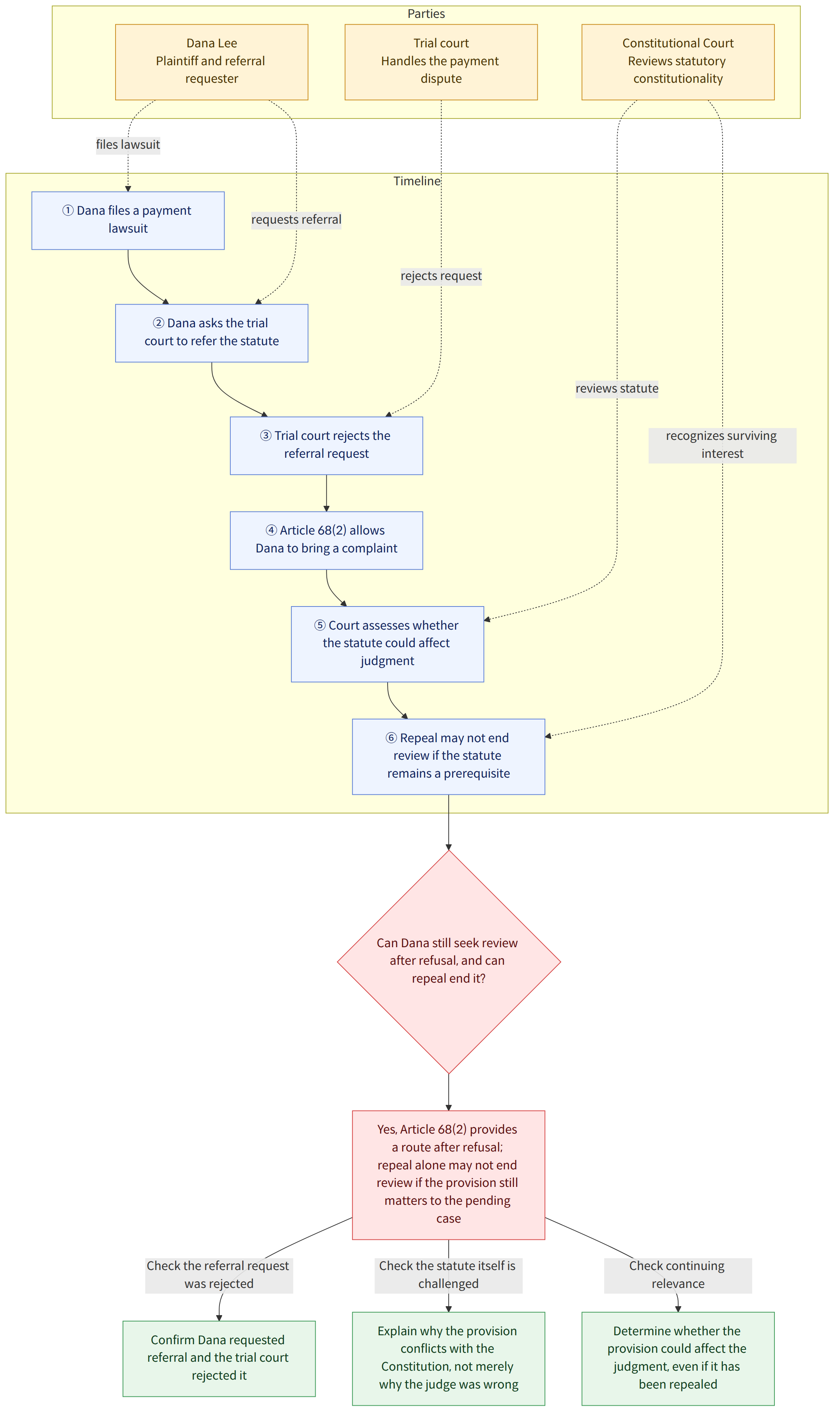
When Dana Lee filed a civil lawsuit over a payment dispute, the outcome seemed to turn on a single provision of a Korean statute. Dana believed that provision violated the Constitution and asked the trial court to refer the constitutional question to the Constitutional Court.
The judge refused. Dana’s lawsuit continued, but the legal question did not disappear. She wanted to challenge the statute directly, and then learned that the provision might be repealed before her case ended. Was the refusal the end of the road—and would repeal make any further challenge useless?
2. The Legal Question
When a Korean court rejects a party’s request to refer a statute for constitutional review, can the party still ask the Constitutional Court to examine the statute? And can that challenge continue to matter if the statute is later repealed?
3. What Korean Law Says
Korean law provides two related routes for examining whether a statute is constitutional. The first is a constitutional referral made by a court. The second is a constitutional complaint under Article 68(2) of the Constitutional Court Act, often described as a complaint-type review of a statute.
Under Article 68(2), a party whose request that the court refer a statute for constitutional review has been rejected may bring a constitutional complaint to the Constitutional Court.
The practical differences are these:
- Who sends the question to the Constitutional Court? In an ordinary referral, the court handling the lawsuit makes the referral. A party can ask the court to do so, but the court decides whether to grant that request.
- What happens if the court refuses? The party who requested the referral may use Article 68(2) to bring the constitutional question directly to the Constitutional Court.
- What is being examined? Although Article 68(2) proceedings are formally called a constitutional complaint, their substance is review of the challenged statute’s constitutionality. They are not simply an appeal asking the Constitutional Court to overturn the trial judge’s refusal.
- Why does the route exist? It gives a party a way to seek review of the statute even though the court’s refusal to refer the question is not itself subject to a separate constitutional complaint.
The challenged statute must still matter to the lawsuit. The key issue is whether the constitutionality of that provision is a precondition to deciding the case—in other words, whether the answer could affect the judgment.
The Constitutional Court has recognized that review may remain meaningful even after a statute is repealed, if the statute’s constitutionality is still a prerequisite to deciding the pending case.
4. How Korean Courts Approach This
Korean courts distinguish between reviewing a judge’s procedural decision and reviewing the constitutionality of a statute. An Article 68(2) complaint is not a way to relitigate the judge’s refusal as though it were an ordinary appeal. Its focus is the law that the party says is unconstitutional.
The Constitutional Court looks to the real connection between the challenged provision and the underlying lawsuit. If the court deciding that lawsuit must apply the provision, or its constitutionality could affect the judgment, constitutional review may have a practical purpose. If the provision has no bearing on the result, the basis for review may be absent.
The same practical approach explains why repeal is not always decisive. A repealed law may still govern the legal question in a case that remains pending. In that situation, the Court has said that the party’s interest in review can survive the repeal.
5. Applying the Law to the Case
Dana’s situation can be assessed in several steps.
- She asked for a referral in a pending lawsuit. Her request was directed to the court hearing her payment dispute, not originally to the Constitutional Court. The trial court had authority to decide whether to make the referral.
- The court rejected that request. That refusal does not, by itself, decide whether the statute is constitutional. Nor does it necessarily close off constitutional review. Because Dana was the party who requested the referral, Article 68(2) provides a separate route for her to ask the Constitutional Court to examine the statute.
- Her challenge must concern the statute, not merely the judge’s refusal. Dana would need to explain why the statutory provision itself conflicts with the Constitution. Article 68(2) is, in substance, a form of statutory constitutional review rather than a general appeal from the trial court’s decision.
- The provision must still be relevant to her case. If the payment dispute cannot be decided without applying the challenged provision—or if the provision’s validity could change the outcome—Dana has a stronger basis to show that constitutional review matters. If the lawsuit can be resolved without relying on it, the connection may be too remote.
- Repeal would not necessarily defeat her challenge. Suppose the legislature repeals the provision while Dana’s lawsuit is still pending. If the trial court must still decide the dispute under the former law, or the provision’s constitutionality otherwise remains a necessary question in that case, repeal alone would not make review pointless. But if the provision no longer affects the case or any relevant legal consequence, the reason for continuing the challenge may disappear.
6. Conclusion: What Happened, and What Should You Do?
Dana was not automatically shut out when the trial court refused her referral request. She could pursue an Article 68(2) constitutional complaint, provided she was the party who had made the referral request and the disputed statute remained relevant to the outcome of her lawsuit. Even if the statute were repealed, her challenge could still have a purpose if the pending case continued to depend on it.
For readers facing a similar situation:
- Keep the connection to your lawsuit clear. Identify exactly how the challenged provision affects the legal result in your pending case.
- Treat the two procedures as distinct. A referral request asks the trial court to send the issue to the Constitutional Court; an Article 68(2) complaint is the party’s route after that request is rejected.
- Get prompt procedural advice. These proceedings have specific requirements, and the status of the underlying lawsuit—including whether a repealed law still matters—can determine whether review remains available.