
1. A Human Story
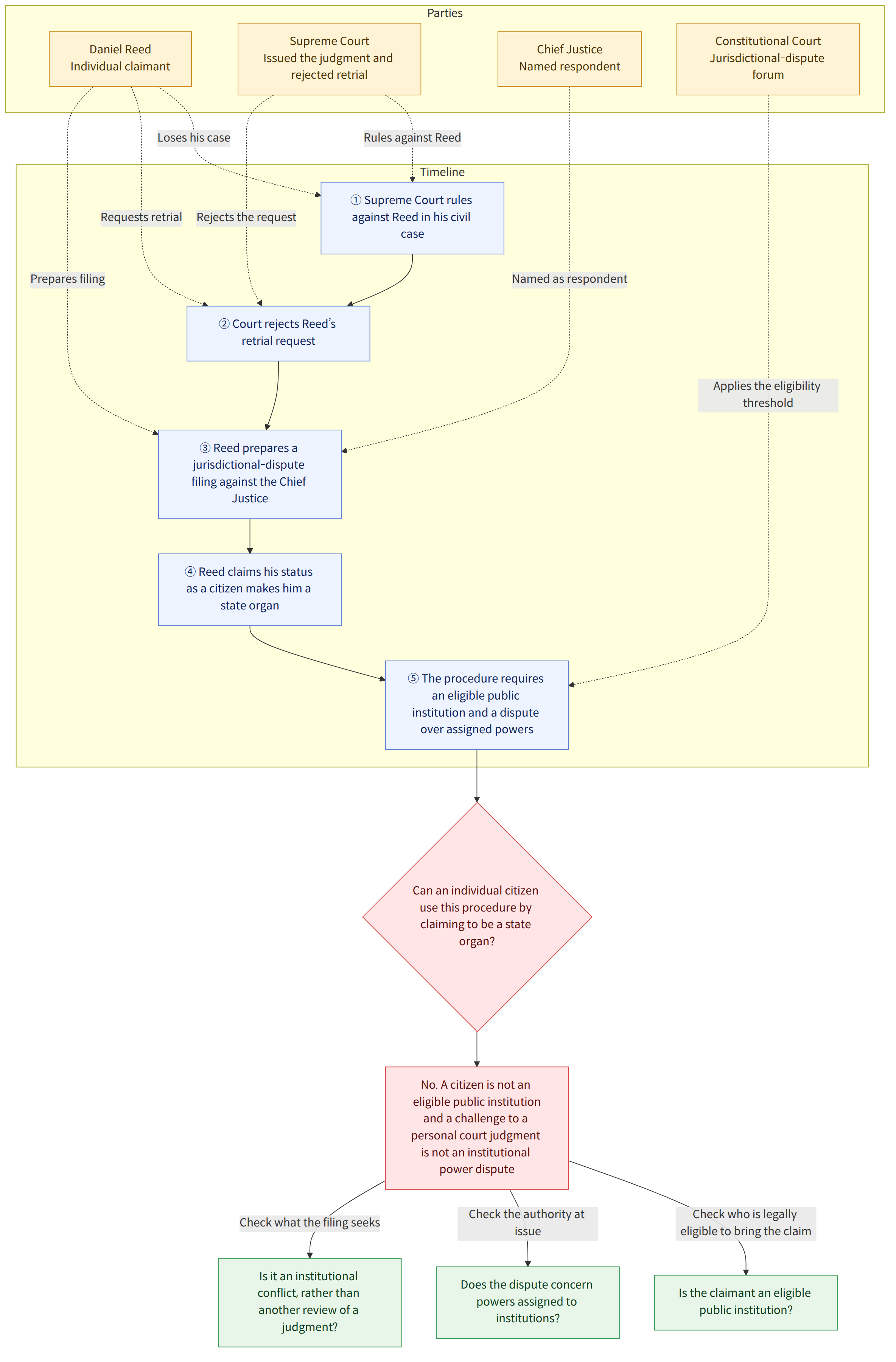
Daniel Reed had spent years fighting a civil case. When the Supreme Court ruled against him, he believed the judges had failed to apply the law properly. He asked for a retrial, hoping the court would reconsider the matter, but that request was rejected too.
The rejection left Daniel feeling that the courts had shut every door. He began preparing a new filing against the Chief Justice, arguing that the Supreme Court had denied him a lawful trial. His theory was unusual: as a citizen, he said, he should count as a “state organ” whose constitutional authority had been violated by the Court’s failure to decide according to law.
2. The Legal Question
Can an individual citizen bring a jurisdictional dispute before Korea’s Constitutional Court by claiming that a court’s judgment infringed the citizen’s authority as a “state organ”?
The answer is no. This procedure is designed for disputes between eligible public institutions over their respective powers, not for an individual seeking another review of a court’s decision.
3. What Korean Law Says
The Constitution gives the Constitutional Court authority to decide certain disputes over institutional powers. One category is jurisdictional disputes between state institutions.
The Constitution assigns the Constitutional Court jurisdiction over disputes concerning the authority of state institutions. It does not make every citizen a state institution entitled to bring such a dispute.
The Constitutional Court Act identifies public bodies that may take part in these proceedings, including the National Assembly, the government, the courts, and the National Election Commission. The central point is that the parties must be institutions with legally recognized public authority—not simply people who believe a public body has acted unlawfully.
For a jurisdictional dispute to be available, the claim must therefore concern a conflict over institutional powers. In practical terms:
- The claimant must be an eligible public institution.
- The dispute must concern that institution’s constitutionally or legally assigned authority.
- The procedure cannot be used simply to challenge an unfavorable judgment or obtain a further appeal.
Calling oneself a “state organ” does not satisfy these requirements. A citizen has constitutional rights, but that does not make the citizen an institution with independent state powers for purposes of this procedure.
4. How Korean Courts Approach This
Korean courts and the Constitutional Court look first at whether a case belongs in the procedure being used. In a jurisdictional dispute, that means examining the identity of the parties and the kind of authority allegedly at stake before considering the underlying grievance.
The Constitutional Court has made clear that an individual citizen, acting in a personal capacity, is not a state institution established by the Constitution and given independent powers under the Constitution or laws. A citizen therefore cannot become an eligible party merely by describing a right or interest as the authority of a state organ.
A jurisdictional dispute is about which public institution has authority—not whether a court reached the right result in an individual’s case.
That distinction matters. A person may genuinely believe a court misapplied the law, but that allegation does not itself create a dispute between state institutions. Nor does directing the filing against the Chief Justice transform a personal complaint into an institutional conflict.
5. Applying the Law to the Case
Daniel’s frustration is understandable, but his proposed route fails at the threshold.
- He is acting as an individual. Daniel is a citizen pursuing a personal legal claim. He is not bringing the case on behalf of a public institution with its own legally assigned powers.
- His allegation concerns the handling of his case. He says the Supreme Court did not decide according to law. That is a challenge to the treatment and outcome of his lawsuit, not a claim that one eligible state institution has taken authority constitutionally assigned to another.
- The “state organ” label does not change his status. A citizen does not become a state institution by asserting that his rights were infringed in the course of litigation. The legal test turns on the claimant’s actual institutional status and the nature of the authority in dispute.
- Naming the Chief Justice does not fix the problem. The defect is not simply the identity of the person named as the respondent. Daniel still lacks the status required to bring this kind of dispute, and his complaint remains a challenge to a judicial outcome in his own case.
As a result, the Constitutional Court would not use a jurisdictional-dispute proceeding to reconsider whether Daniel’s Supreme Court case was correctly decided. His filing would fail because he is not an eligible institutional party—not because the court has thereby ruled that every aspect of his original case was legally correct.
6. Conclusion: What Happened, and What Should You Do?
Daniel’s proposed jurisdictional dispute cannot proceed as a personal challenge to the Supreme Court’s judgment. He cannot obtain another review by claiming to act as a “state organ,” and filing against the Chief Justice does not alter that conclusion. The jurisdictional-dispute process is reserved for conflicts over authority between eligible public institutions.
For readers facing a similar situation:
- Identify the procedure before filing. A jurisdictional dispute is not an extra appeal from a judgment.
- Get prompt advice about any separate remedy. Ask a Korean lawyer whether a distinct procedure could apply to your circumstances and check its strict eligibility rules and deadlines.
- Keep the issues separate. A belief that a court made a legal error does not, by itself, establish that your personal rights qualify as institutional authority in a jurisdictional dispute.