1. A Human Story
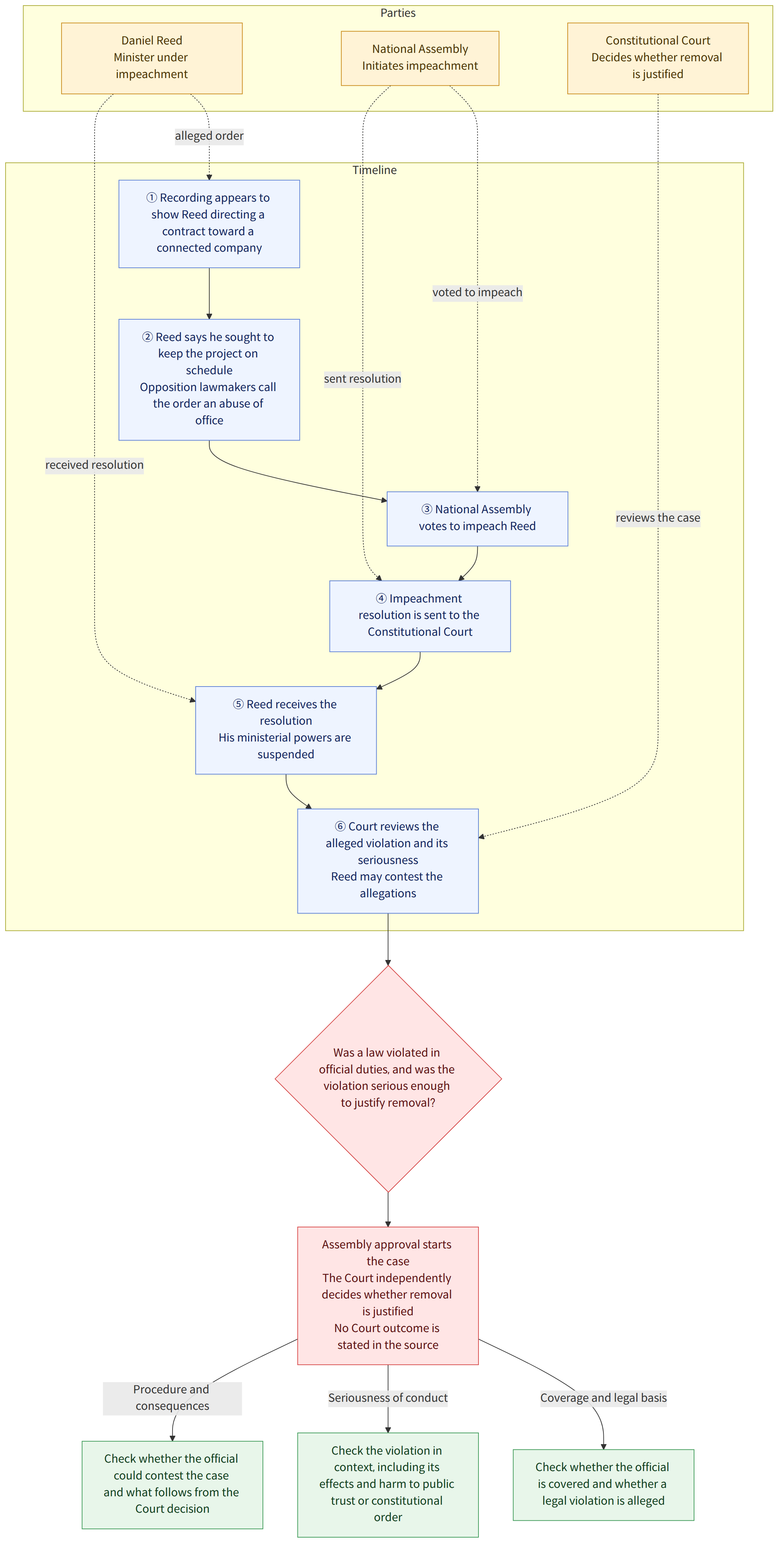
When Daniel Reed became South Korea’s Minister of Infrastructure, he promised to make public spending more transparent. Months later, however, a leaked recording appeared to show him instructing officials to steer a major contract toward a politically connected company, despite statutory procurement safeguards. Reed said he had been trying to keep a delayed project on schedule. Opposition lawmakers called the order an abuse of office.
The dispute quickly moved beyond press conferences and parliamentary questions. The National Assembly voted to impeach Reed and sent the resolution to the Constitutional Court. Once Reed received the document, he could no longer exercise his ministerial powers. His office remained in place, but its authority was temporarily out of reach. Now a court—not the Assembly alone—would decide whether he should lose the position permanently.
2. The Legal Question
Can the National Assembly remove a senior official simply because it has lost confidence in that person, or must it prove a legal violation? And what happens to the official while the Constitutional Court considers the case?
3. What Korean Law Says
Impeachment is a constitutional procedure for addressing misconduct by certain public officials whose positions make ordinary disciplinary measures inadequate or inappropriate. The officials covered include the President, Prime Minister, Cabinet members, heads of government ministries, Constitutional Court justices, judges, members of the National Election Commission, the chair of the Board of Audit and Inspection, and its commissioners.
The Constitution sets out the basic rule:
“When a public official designated by law has violated the Constitution or other laws in the performance of official duties, the National Assembly may pass a motion for impeachment.” — Constitution of the Republic of Korea, Article 65(1), in substance
The process has two distinct stages:
- The National Assembly initiates the case. For most covered officials, the motion must be approved by a majority of all Assembly members. A motion against the President requires a two-thirds vote of all members.
- The case goes to the Constitutional Court. After the Assembly passes the motion, the chair of its Legislation and Judiciary Committee submits the resolution to the Court.
- The official’s powers are suspended. Once the official receives the impeachment resolution, the official may not exercise the powers of the office until the Court issues its decision.
- The Court decides whether removal is justified. If the Court upholds the charge, the official is removed from office. At least six Constitutional Court justices must support an impeachment decision.
Impeachment does not, by itself, impose a criminal sentence. It determines whether the official may continue to hold public office.
Removal has a further consequence: a person removed through impeachment cannot become a public official again for five years from the date the decision is announced. Criminal prosecution or other legal proceedings may still be possible separately if the alleged conduct also amounts to a crime.
4. How Korean Courts Approach This
The Constitutional Court does not treat impeachment as a popularity contest or a simple vote of no confidence. The Assembly begins the process, but the Court must decide whether the official violated the Constitution or another law while performing official duties.
The Court also considers the seriousness of the violation. A technical breach or an isolated mistake will not necessarily justify the most consequential remedy—removal from office. The central question is whether the conduct is sufficiently serious, in context, to make it constitutionally appropriate for the official to lose the position. That assessment can involve the nature of the duty, the official’s responsibility, the effects of the conduct, and the damage it caused to public trust or constitutional order.
The Assembly’s decision starts the proceeding; it does not predetermine the outcome. The Constitutional Court must independently assess the alleged violation and whether it warrants removal.
The official must have an opportunity to contest the allegations in the Court proceeding. The Court may reject the case if the claim is not established or does not justify removal; if it upholds the impeachment, removal takes effect through its decision.
5. Applying the Law to the Case
Reed’s situation turns on more than the fact that lawmakers objected to his handling of a contract. The legal analysis would proceed in stages.
- Is Reed covered by the impeachment system? Yes. As a minister and head of a government ministry, he is among the officials who may be impeached under Article 65.
- Was the alleged conduct connected to his official duties? The reported instruction concerned a government contract and was allegedly given in his ministerial capacity. If proved, that would be conduct connected to his office, not merely private behavior.
- Did the instruction violate a law or the Constitution? The Court would examine the procurement rules and the evidence: what Reed actually ordered, what authority he had, whether officials were directed to bypass required safeguards, and whether the company received improper treatment. A political accusation alone would not establish a violation.
- Was the violation serious enough to require removal? If Reed knowingly used ministerial authority to evade legal safeguards and favor a connected company, the conduct could undermine lawful administration and public confidence. The Court would weigh those facts against his explanation, the harm caused, and the full circumstances.
- What happens during the case? The Assembly’s vote does not itself make Reed permanently lose his title. But after he receives the resolution, he cannot exercise ministerial powers while the Court considers the matter.
For this fictional case, assume the evidence confirms that Reed deliberately directed officials to bypass mandatory procurement rules for the benefit of the connected company. That finding would give the Court a concrete legal violation to assess, rather than a dispute based only on political disagreement.
6. Conclusion: What Happened, and What Should You Do?
The Constitutional Court upholds Reed’s impeachment. It finds that he used his official authority to override legally required safeguards and that the breach was serious enough to make continued service incompatible with the responsibilities of his office. Reed is removed on the date the decision is announced. Under the Constitutional Court Act, he cannot return to public office for five years. The decision does not automatically convict him of a crime; any criminal case would have to proceed separately.
For readers facing a similar situation, three practical points matter:
- Keep the process separate from the allegation. An impeachment vote suspends an official’s powers after receipt of the resolution, but removal follows only if the Constitutional Court upholds the case.
- Preserve evidence and identify the legal duty at issue. Orders, records, communications, and the specific rule allegedly breached may be central to showing what happened and whether it was serious.
- Do not assume impeachment replaces other proceedings. If the conduct may also be criminal or subject to ordinary discipline, seek advice on those separate procedures and deadlines.