1. A Human Story
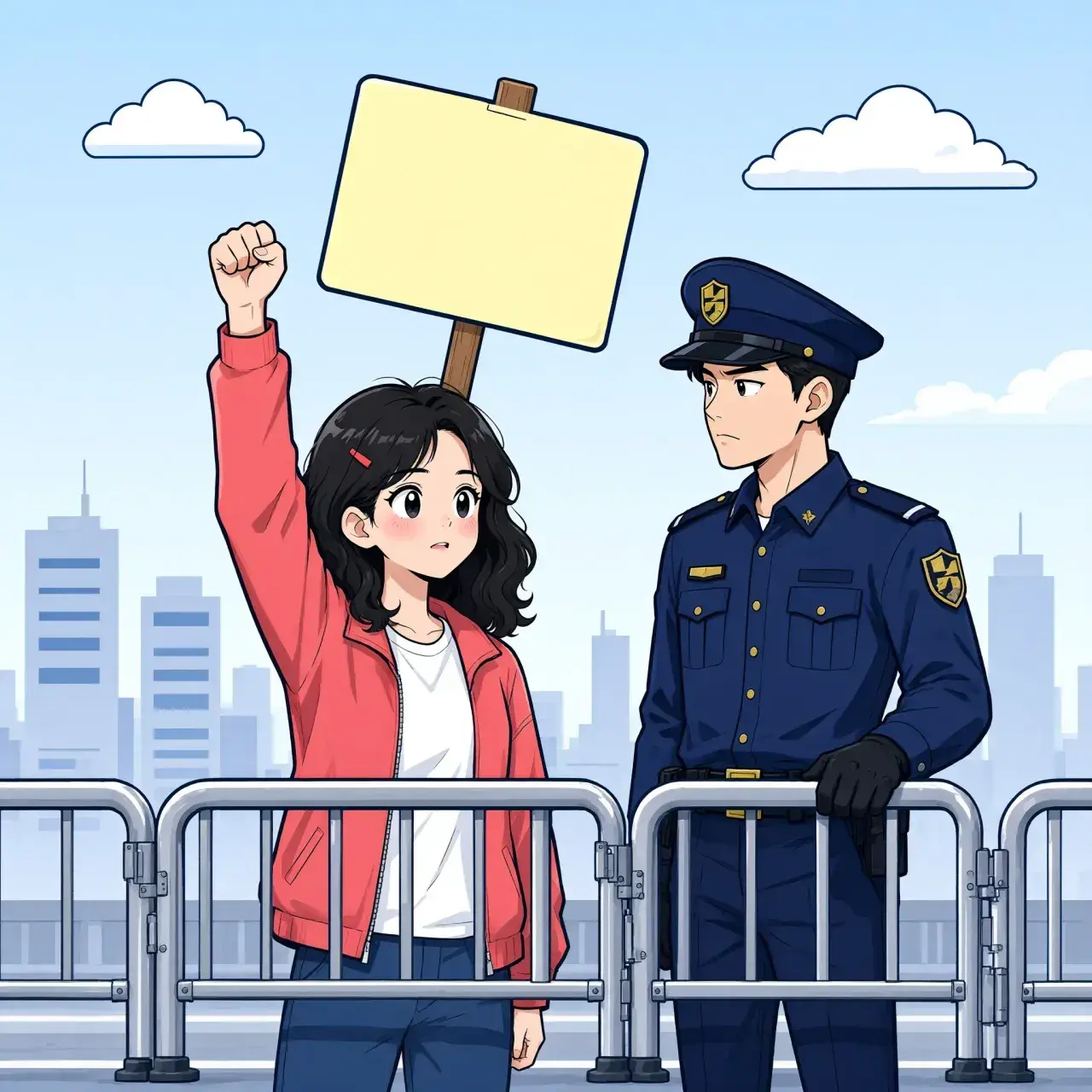
Daniel Cho had spent years volunteering for local campaigns, convinced that political change came through persuasion and the ballot box. That changed when he joined the fictional National Renewal Party, whose leaders began calling for an end to competitive elections and the replacement of South Korea’s multiparty system with permanent rule by a single political movement.
At first, Daniel thought the speeches were theatrical provocation. But the party’s platform and public activities increasingly treated political opposition as illegitimate and proposed dismantling institutions that allowed power to change hands. The government, after deliberating in the Cabinet, asked the Constitutional Court to decide whether the party should be dissolved. Daniel now faced an unsettling possibility: a party he had joined might legally cease to exist, not through an election defeat, but through a constitutional judgment.
2. The Legal Question
Can the South Korean government ask the Constitutional Court to dissolve a political party because its aims or activities conflict with the democratic basic order—and what must happen before such a drastic step can take effect?
3. What Korean Law Says
South Korea’s Constitution protects political parties and recognizes their important role in democratic life. But that protection has a limit: a party whose purpose or activities violate the country’s democratic basic order may be subject to a dissolution proceeding.
Constitution of the Republic of Korea, Article 8(4): If the purposes or activities of a political party are contrary to the democratic basic order, the government may request the Constitutional Court to dissolve it, and the party is dissolved in accordance with the Court’s decision.
The phrase democratic basic order refers to the foundations that make democratic government possible. These include respect for fundamental rights, separation of powers, representative institutions, a multiparty system, and elections. The constitutional order also protects important economic arrangements, including private property.
The process is tightly controlled:
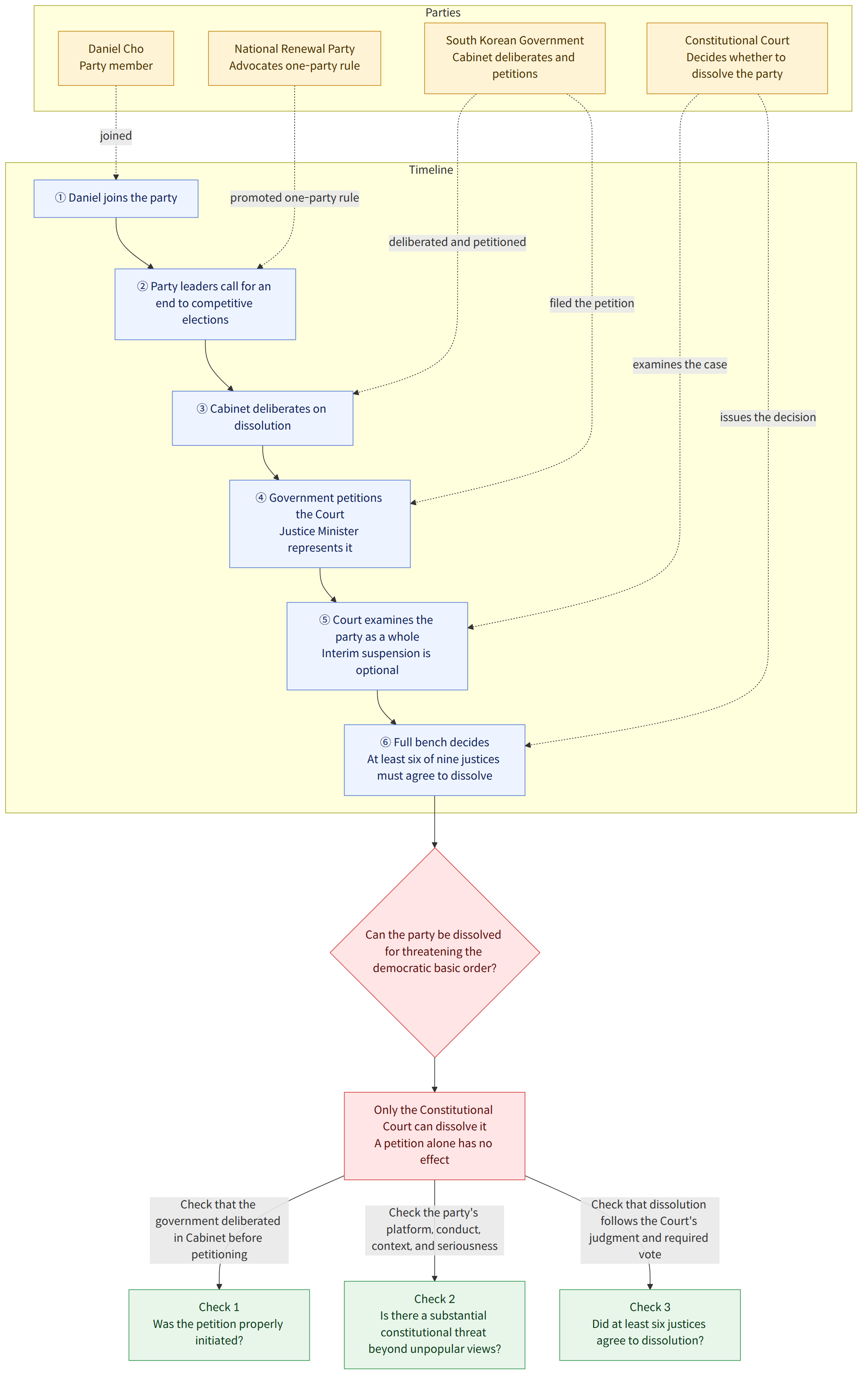
- The government initiates the case. A private citizen, rival party, or public official acting alone cannot file a party-dissolution petition. The government must first deliberate on the matter in the Cabinet.
- The Justice Minister represents the government before the Court. The petition is submitted to the Constitutional Court under the Constitution and the Constitutional Court Act.
- The Court may consider an interim suspension. If it considers continued activity during the proceedings inappropriate, it may suspend the party’s activities until its final decision. This can happen at the government’s request or on the Court’s own initiative; it is not automatic when a petition is filed.
- The full bench hears the case. Dissolution requires the agreement of at least six of the Court’s nine justices.
- A dissolution judgment has practical consequences. The National Election Commission removes the party’s registration and announces the result. The dissolved party’s assets become state property, and its leaders and officers may not create another party with the same or a similar platform.
The central safeguard: A government petition does not itself dissolve a party. Only the Constitutional Court can order dissolution after examining the case.
4. How Korean Courts Approach This
Dissolving a political party is an extraordinary interference with political association and competition. Korean courts therefore do not treat sharp criticism of the government, an unpopular ideology, or a party’s controversial proposals as sufficient by themselves. The question is whether the party’s aims or activities conflict with the democratic order protected by the Constitution.
The Court looks beyond a slogan or isolated remark. It assesses the party as a whole, including its platform, the conduct of its leaders and members, and the context and seriousness of the activities at issue. It also considers whether the alleged threat is substantial enough to justify dissolving the entire organization. In other words, the remedy must be connected to a genuine constitutional danger, not simply used to silence political disagreement.
A court’s task is not to decide which political opinions are popular. It is to determine whether the party’s purposes or activities cross the constitutional line into opposition to the democratic order itself.
Because dissolution ends the party’s legal existence and affects the rights of its members and supporters, the Court must reach its own judgment on the evidence. The government’s allegations alone cannot settle the matter.
5. Applying the Law to the Case
Daniel’s situation would turn on what the National Renewal Party actually sought and did—not merely on the government’s description of it.
- The government must use the proper procedure. If the Cabinet deliberates and the Justice Minister brings the petition on behalf of the government, the case can properly begin. Daniel, a rival party, or the Election Commission could not independently initiate this constitutional proceeding.
- The Court must examine the party’s aims and activities. The party’s calls to abolish competitive elections and the multiparty system would be central evidence because those institutions are among the foundations of democratic government. The Court would also consider whether those calls reflected the party’s genuine program and conduct, rather than isolated words or political exaggeration.
- The Court must decide whether dissolution is justified. Even strong evidence of anti-democratic rhetoric does not make dissolution automatic. The justices would assess the seriousness and context of the party’s activities and whether they amount to a threat to the democratic basic order sufficient to warrant this exceptional remedy.
- Interim suspension would require a separate judgment. If the Court concluded that allowing the party to continue operating while the case was pending was inappropriate, it could order a temporary suspension. Filing the petition alone would not stop Daniel’s party from functioning.
- A final order requires a supermajority. If at least six of the nine justices concluded that the party’s aims or activities violated the democratic basic order, the Court could order its dissolution. If that threshold were not met, the party would not be dissolved through this proceeding.
In Daniel’s fictional case, the evidence shows that the party’s proposals to eliminate meaningful elections and political competition were not passing remarks: they formed part of its platform and were reinforced by its activities. The Court finds that the party’s program attacks the democratic order itself, rather than merely advocating unpopular policies within it. With at least six justices agreeing, it orders dissolution.
6. Conclusion: What Happened, and What Should You Do?
The Constitutional Court’s judgment ends the National Renewal Party’s legal existence. The National Election Commission removes its registration and announces the result. The party’s assets become state property, and its leaders and officers cannot establish a new party with the same or a similar platform. Daniel’s membership does not, by itself, make him the party’s successor or decide whether he bears any separate legal responsibility; the dissolution judgment concerns the party, while individual conduct is a distinct question.
For readers facing a similar situation:
- Check who has started the proceeding and whether the required steps were followed. A government petition after Cabinet deliberation is the route; a political accusation alone is not a court order.
- Distinguish controversial speech from the legal test. The issue is whether the party’s aims or activities violate the democratic basic order, assessed in their full context.
- If you are a party officer or member, get advice before reorganizing. After dissolution, creating a party with the same or a similar platform is prohibited, and property and registration consequences can follow promptly.