1. A Human Story
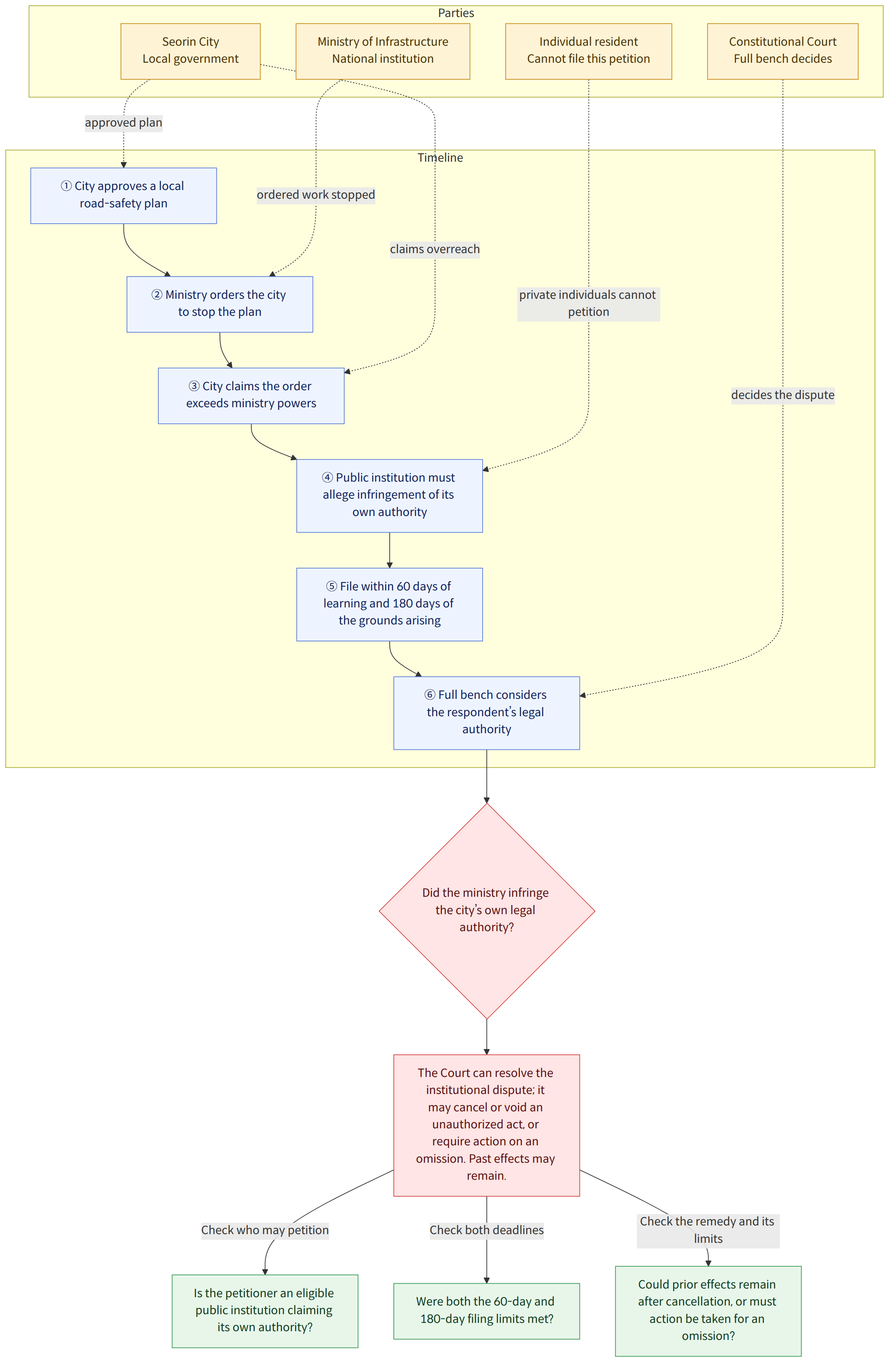
On a wet Monday morning, Mayor Daniel Lee stood in the council chamber of fictional Seorin City, watching a national ministry’s order appear on the screen. The Ministry of Infrastructure had directed the city to stop implementing a local road-safety plan. The plan had been approved by the city, and contractors were already preparing to begin work. The ministry said the project crossed into an area under national supervision. Seorin City believed the order reached beyond the ministry’s powers and into the city’s own lawful responsibilities.
The dispute quickly became more than a question of traffic cones and construction schedules. If the ministry could issue the order, the city had to comply. If it could not, the city’s authority to carry out its plan might have been unlawfully obstructed. The city’s legal team had to decide not only who was right, but also whether this was the kind of institutional conflict that Korea’s Constitutional Court could resolve—and how quickly the city had to act.
2. The Legal Question
Can a local government ask Korea’s Constitutional Court to decide whether a national institution has acted, or failed to act, beyond its legal powers and thereby infringed the local government’s own authority? And what remedies are available if the Court agrees?
3. What Korean Law Says
Korea’s competence dispute adjudication is a procedure for resolving conflicts over which public institution has a particular power, or how far that power extends. It applies to disputes between national institutions, between local governments, and between a national institution and a local government.
A public institution may petition the Constitutional Court when it claims that another institution’s act or omission has infringed—or poses a serious risk of infringing—its own authority under the Constitution or statute.
An omission means that an institution has failed to take an action it is legally required to take. The procedure is about institutional authority, rather than a general disagreement over whether a policy is wise or fair. Private individuals cannot bring this type of petition.
The main requirements and possible outcomes are:
- The petitioner must be an eligible public institution. A person, company, or other private party cannot file a competence-dispute petition in their own name.
- The dispute must concern the petitioner’s own powers. The petitioner must claim an infringement, or a serious risk of infringement, of authority granted by the Constitution or by law.
- Strict time limits apply. Under Article 63 of the Constitutional Court Act, the petition must be filed within 60 days of the date the petitioner learns of the grounds for the dispute and within 180 days of the date those grounds arose. Missing either deadline can result in dismissal.
- The Constitutional Court’s full bench decides the dispute. It considers whether the respondent institution had authority to take the challenged action or to remain inactive.
- The Court can provide institutional remedies. If it finds that the respondent acted without authority, exceeded its authority, or unlawfully failed to act, it may cancel the challenged disposition or declare it void. If it upholds a petition concerning an omission, the respondent must take action in line with the Court’s decision.
A ruling that cancels a disposition does not affect effects that the disposition has already produced for its recipient. The ruling resolves the institutional authority dispute; it does not automatically erase every consequence that has already arisen for the other party.
4. How Korean Courts Approach This
The Constitutional Court’s task is to identify the legal boundary between public institutions. It does not simply choose which side has the more persuasive political argument. The central questions are whether the petitioner has authority protected by the Constitution or statute, whether the challenged act or omission concerns that authority, and whether the respondent had legal power to act as it did—or was required to act but failed to do so.
That focus makes the petitioner’s case specific. It must point to its own institutional competence, identify the action or inaction at issue, and explain how that conduct has infringed its power or created a serious risk of doing so. A general objection to a policy, or a belief that another institution is behaving unfairly, is not enough by itself.
The Court also treats the filing periods as important limits, not informal targets. A public institution must track both when it learned of the dispute and when the relevant grounds first arose. And because the remedy concerns the relationship between institutions, a ruling against one institution does not necessarily reverse all effects already experienced by a recipient of the challenged act.
5. Applying the Law to the Case
Seorin City’s dispute fits the type of institutional conflict the procedure is designed to address—provided the city can establish the necessary legal basis.
- The city, rather than the mayor personally, would be the petitioner. The dispute concerns the city’s claimed public authority. Mayor Lee may lead the response, but the claim must be brought by the eligible institution asserting that authority.
- The city must identify its own source of power. It would need to point to the constitutional or statutory provisions that assign it responsibility for the relevant road-safety work. The ministry’s order alone does not prove that the city has exclusive authority; the Court would have to examine the legal division of responsibilities.
- The ministry’s order is the challenged act. Seorin City would argue that the order blocks the city from exercising a power entrusted to it and that the ministry lacked authority to issue that direction, or went beyond the limits of any authority it did possess. The ministry could respond that national law gives it supervisory or decision-making power in this area.
- The city must meet both deadlines. It must file within 60 days after learning of the grounds for its claim and, in any event, within 180 days after those grounds arose. Waiting for negotiations or for construction to be delayed further could put the petition outside the permitted period.
- The remedy would turn on the Court’s finding. If the Court concludes that the ministry lacked authority or exceeded its legal limits and thereby infringed the city’s competence, it may cancel the order or declare it void. If the dispute instead concerns a legal duty the ministry failed to perform, and the Court upholds a petition based on that omission, the ministry must act in accordance with the decision.
- The ruling would not necessarily unwind every consequence. If the order had already produced effects for its recipient, cancellation would not, by itself, erase those effects. The city’s institutional victory and the practical treatment of consequences already produced are related but distinct questions.
6. Conclusion: What Happened, and What Should You Do?
Seorin City filed its petition promptly, identifying the laws it believed gave it authority over the local plan and challenging the ministry’s order as an encroachment. The Constitutional Court examined the legal allocation of power—not which level of government had the better political slogan. If the Court found that the ministry had crossed the boundary set by law, it could cancel the order or declare it void. If it found that the ministry’s action fell within its lawful authority, the city would not obtain that remedy merely because it disagreed with the decision.
The crucial point for readers is that this procedure belongs to public institutions. A resident affected by a government decision cannot personally use a competence-dispute petition to resolve a clash between government bodies. The institution whose authority is at stake must bring the claim, and it must do so on time.
- Act quickly: Record both the date the institution learned of the dispute and the date the challenged act or omission arose; the 60-day and 180-day limits both matter.
- Build the case around legal authority: Identify the constitutional or statutory provisions that establish the petitioner’s own powers and explain precisely how the other institution’s conduct interferes with them.
- Separate institutional remedies from individual consequences: Even if an act is cancelled, ask separately what happens to effects already produced for its recipient and what further legal steps may be needed.